Best Software for Amazon Sellers in 2024
If you're an Amazon seller, you've probably heard of the big names in software, like Helium 10 or Jungle Scout. They’re popular for a reason—they bundle a ton of tools for product research, keyword tracking, and listing management. For anyone serious about growing their business, these kinds of platforms have become standard issue.
Why Top Sellers Rely on Specialized Software

Let's be honest: succeeding on Amazon today takes a lot more than just a good product and a gut feeling. The days of stumbling into a bestseller are pretty much over. What used to be a helpful advantage—specialized software—is now a core requirement for staying competitive, let alone profitable.
Think about the daily grind. You're up against thousands of other sellers, all fighting for the same eyeballs. You're trying to keep just the right amount of inventory on hand, knowing that stocking out or ordering too much can crush your margins. And then there's advertising—without solid data, Amazon PPC can feel like throwing money into a black hole.
The Core Pillars of Amazon Software
This is where the right tools come in. They give you the hard data you need to sidestep those challenges and make smart, profitable decisions. They handle the mind-numbing tasks, shine a light on market gaps you'd never find on your own, and give you a real-time pulse on the financial health of your business. The best software for Amazon sellers generally falls into a few key categories, each built to solve a specific problem.
Here’s a quick rundown of the essential tools that form the backbone of a serious seller's operation:
- Product Research: These are your crystal balls for finding high-demand, low-competition niches. They help you vet ideas with real sales data, so you aren't just guessing what to sell next.
- Keyword & SEO Optimization: This is all about getting found. These tools uncover the exact search terms customers are using, helping you climb the organic search rankings and get more eyes on your listings.
- PPC & Ad Management: Running ads on Amazon without a dedicated tool is tough. This software helps automate your bids, track what's working, and make sure your ad spend is actually making you money.
- Inventory & Repricing: Winning the Buy Box and avoiding stockouts is a constant battle. This software can automatically adjust your prices to stay competitive and forecast your inventory needs to prevent costly mistakes.
Ultimately, Amazon seller software isn't just another expense—it's a strategic investment in efficiency and growth. It gives you the intelligence to operate like a major brand, even if you're just a one-person shop.
Comparing Key Software Categories
Each of these software types has a distinct job, and knowing what they do helps you build a tech stack that actually works for you. Your choice depends entirely on what you're trying to achieve, whether it's launching your first product or squeezing more profit out of your current bestsellers.
| Category | Primary Function | Why It's Essential |
|---|---|---|
| Product Research | Identifies profitable product opportunities and analyzes market demand. | Reduces the risk of launching a product that won't sell. |
| Keyword/SEO | Boosts organic visibility by optimizing listings with relevant search terms. | Drives free, high-intent traffic to your product pages. |
| PPC Management | Automates and optimizes Amazon advertising campaigns for better ROI. | Prevents wasted ad spend and increases sales velocity. |
| Inventory/Repricing | Manages stock levels and automates price changes to win the Buy Box. | Maximizes sales opportunities while preventing stockouts. |
The real magic happens when you see these tools as interconnected parts of a bigger machine. Great keyword research doesn't just help your organic rank; it fuels your PPC campaigns. And those successful ad campaigns create demand that your inventory management system needs to be ready for. This holistic approach is what separates the sellers who thrive from those who just tread water.
How to Choose the Right Amazon Seller Tools
Before you get lost in a sea of software subscriptions, it's smart to ground your search in a solid strategy. Picking the best software for Amazon sellers isn't about chasing a single "perfect" platform. It’s about building a toolkit that fits your business model, your current size, and where you're headed. A hasty choice often means you’re either paying for features you don't touch or missing out on ones you desperately need.
Start with an honest look at your business. Are you a private label brand owner, building something unique from the ground up? A wholesale reseller juggling multiple distributor relationships? Or an arbitrage seller who thrives on spotting retail price gaps? Each of these paths has its own unique hurdles and demands a different set of tools to clear them.
Define Your Seller Profile
A startup launching its very first product has completely different needs than a seven-figure brand. That new seller is laser-focused on product research and validation tools to avoid a bad initial investment. Their biggest worry is finding a profitable niche without getting crushed by the competition.
On the other hand, an established brand is probably more concerned with advanced analytics, sophisticated PPC automation for a hefty ad budget, and sharp inventory forecasting to prevent stockouts across dozens of ASINs. Their game has shifted from discovery to pure optimization and scale.
Key Insight: Don't just pick the most popular software. Choose a tool that solves the exact problems you have right now. A powerhouse platform built for a high-volume wholesaler is likely total overkill for a brand-new private label seller.
Specialized Stack vs. All-in-One Platform
Another big decision is whether you want to build a specialized 'software stack' or go with an all-in-one platform. A specialized stack means you’re picking the best-of-the-best for each job—one tool for keyword research, another for repricing, a third for analytics. This approach gives you incredible depth and power in every category.
The downside? It gets expensive and can be a headache to manage all those different logins, subscriptions, and data streams. An all-in-one platform simplifies things with a single dashboard, one monthly bill, and a connected workflow. While some individual features might not be as robust as a standalone tool, the convenience and cost savings are a huge plus, especially for smaller teams. And no matter what you choose, prioritize platforms that help with staying compliant with Amazon's changing policies, as that's non-negotiable for long-term survival.
The competition on Amazon is no joke, which makes these tool choices more critical than ever. In 2024, about 2,000 new sellers are jumping on the platform every single day. They're all fighting for a piece of a market where US sellers averaged $290,000 in annual sales.
With only about 20% of the 9.7 million global sellers actively selling, the right software gives you the edge needed to join the 10,000+ independent merchants who blew past $1 million in annual sales. You can dig deeper into these Amazon seller statistics and their impact. The numbers make it clear: tools for inventory management, pricing, and competitor analysis are what separate the winners from the rest.
Comparing The Top Amazon Software Platforms
Trying to find the right software for your Amazon business can feel like you're lost in a jungle of options. With dozens of platforms all screaming they’re the best, it’s easy to get paralyzed by choice. The trick is to stop looking for a single "best" tool and start looking for the right tool for a specific job. The best software stack is rarely a one-size-fits-all solution; it's a handpicked arsenal built for your specific needs.
This breakdown cuts through the noise and compares the heavy hitters across the four most critical software categories. We’ll go beyond the marketing hype to show you where each platform actually shines in the real world.
Product and Niche Research Tools
Finding a winning product is the bedrock of any Amazon business. These tools are all about replacing gut feelings with hard data, helping you size up market demand, scope out the competition, and forecast profitability before you spend a dime on inventory.
Jungle Scout: As one of the original players, Jungle Scout's strength has always been in spotting opportunities. Its Opportunity Finder tool is fantastic for digging up high-demand, low-competition niches from millions of data points. A huge plus is the built-in Supplier Database, which lets you find and vet potential factories without ever leaving the platform. This makes it a go-to for new private label sellers who need a clear path from research to sourcing. Digging into how tools connect with Amazon, like with Jungle Scout and its use of Amazon MWS keys, helps you understand the technical side of things.
Helium 10: While also a product research powerhouse, Helium 10 is all about surgical precision. Its Black Box tool comes packed with an insane number of filters, letting you get incredibly granular with your search. You can filter by exact monthly revenue, price point, review count, and even the number of images on a listing. This level of detail is perfect for seasoned sellers who already have a clear idea of what they're looking for and just need the data to prove it.
Situational Recommendation:
- For New Private Label Sellers: Start with Jungle Scout. Its workflow is intuitive, guiding you from a product idea straight through to finding a supplier. It just makes sense.
- For Data-Driven Veterans: Go with Helium 10. If you love crunching numbers and testing specific product hypotheses, its deep well of filters will give you a serious edge.
This simple framework shows why you need to think about your strategy before you ever start a free trial.
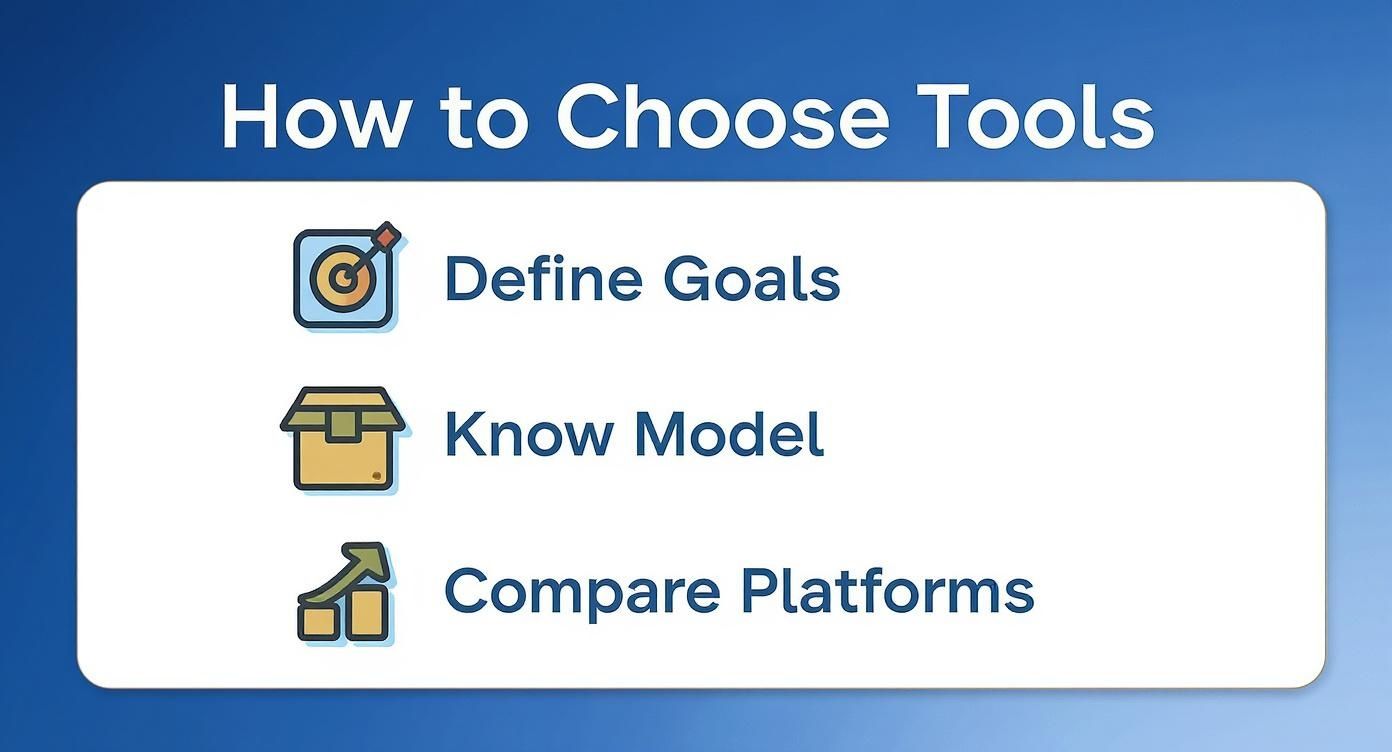
As the visual shows, your business goals and seller model should drive your decision-making process from the very beginning.
Listing and Keyword Optimization
Once you've got a product, you need to get it in front of customers. This is where Amazon SEO comes in. These tools help you unearth the exact search terms shoppers are using and build listings that don’t just attract clicks, but actually convert them into sales. Strong organic ranking is your ticket to lower ad spend and higher profits.
When you're picking tools, it really boils down to your primary focus. Helium 10's keyword tools are unmatched for deep-diving on competitors, but Jungle Scout's integrated supplier database is a massive shortcut for private label sourcing.
Helium 10: This is where Helium 10 truly flexes its muscles. Tools like Magnet (for keyword discovery) and Cerebro (for reverse ASIN lookups) are the gold standard for a reason. Cerebro is a game-changer. You can pop in a competitor’s ASIN and see a full list of the keywords they rank for, giving you a ready-made roadmap to steal their traffic.
SellerApp: A strong contender, SellerApp brings a data-science and automation angle to the table. Its Listing Quality score gives you an instant, data-backed report card on your product page with clear, actionable steps for improvement. Their AI-powered tools can even help write listing copy, which is a lifesaver for sellers trying to optimize a large catalog without spending weeks on it.
Situational Recommendation:
- For Aggressive SEO & Competitor Spying: It has to be Helium 10. Its reverse-ASIN tools are simply the best for taking apart what your competitors are doing right.
- For Optimizing at Scale: Give SellerApp a look. If you have a big catalog, its AI features and automated audits will save you a ton of time.
PPC and Advertising Management
Amazon Advertising is a beast. Tame it, and it will drive incredible sales. But if you let it run wild, it will burn through your cash faster than you can say "ACOS." PPC software is designed to bring order to the chaos by automating bids, finding profitable keywords, and showing you exactly what your return on ad spend (ROAS) is.
Teikametrics: Built from the ground up for AI-driven optimization, Teikametrics is a serious platform for serious advertisers. Its flagship feature, Flywheel 2.0, uses machine learning to automatically adjust bids and target keywords to maximize your profit. This is the kind of tool you graduate to when you have a significant ad budget and complex campaigns that are too much to manage manually.
Perpetua: Perpetua comes at advertising from a different angle. Instead of fiddling with individual keyword bids, you tell the software your high-level goal—like launching a new product, dominating a category, or maximizing profit—and its AI builds the campaign strategy to get you there. It’s a great fit for brand managers who want to focus on the big picture and let the technology handle the day-to-day tactics.
Situational Recommendation:
- For Large, Data-Heavy Campaigns: Teikametrics is the choice. Its algorithmic bidding can handle complexity that would overwhelm a human.
- For Strategy-Focused Brands: Perpetua is perfect. You set the destination, and its AI figures out the best way to drive there.
Inventory and Repricing Management
Running out of stock is a cardinal sin on Amazon—you lose sales and your ranking plummets. But having too much inventory is just as bad, as it ties up your capital. This category of tools helps you walk that fine line, while repricers keep your prices competitive around the clock to win the Buy Box.
InventoryLab: This tool is beloved by arbitrage and wholesale sellers, and for good reason. It makes listing a breeze and, most importantly, gives you crystal-clear, real-time profitability tracking down to the individual unit. You can instantly see your exact net profit after all of Amazon’s fees, shipping costs, and your cost of goods are subtracted. It’s an accounting must-have.
Seller Snap: If you're selling in a cutthroat category, a "dumb" repricer that just undercuts the lowest price is a recipe for disaster. Seller Snap uses a game-theory-based AI that thinks like a chess player. It analyzes what your competitors are doing and aims to win the Buy Box at the highest possible price, protecting your margins. It understands that being the cheapest isn't always the smartest move.
Situational Recommendation:
- For Resellers Focused on Profit Tracking: InventoryLab is essential. It gives you an honest, real-time look at your finances.
- For Competitive Private Label or Wholesale Sellers: Seller Snap is the intelligent choice for repricing. It's about winning the Buy Box profitably.
Amazon Seller Software Category Comparison
To give you a bird's-eye view, here's how some of the top tools stack up based on their core strengths. This isn't about which is "best," but which is best for a particular job.
| Category | Leading Tool | Primary Strength | Ideal For Seller Type | Pricing Model |
|---|---|---|---|---|
| Product Research | Jungle Scout | Opportunity finding & supplier database | New private label sellers | Subscription (SaaS) |
| Keyword/SEO | Helium 10 | Competitor analysis (Reverse-ASIN) | Data-driven, experienced sellers | Subscription (SaaS) |
| PPC/Advertising | Teikametrics | AI-powered bid automation at scale | Brands with large ad budgets | % of Ad Spend / SaaS |
| Inventory | InventoryLab | Per-unit profit tracking & accounting | Arbitrage & wholesale resellers | Subscription (SaaS) |
| Repricing | Seller Snap | AI-driven, margin-focused repricing | Highly competitive sellers (PL/WS) | Subscription (SaaS) |
As the table shows, the "best" choice is completely dependent on your business model and what specific problem you're trying to solve right now. The key is to match the tool's core strength to your biggest challenge.
Building Your Perfect Amazon Software Stack
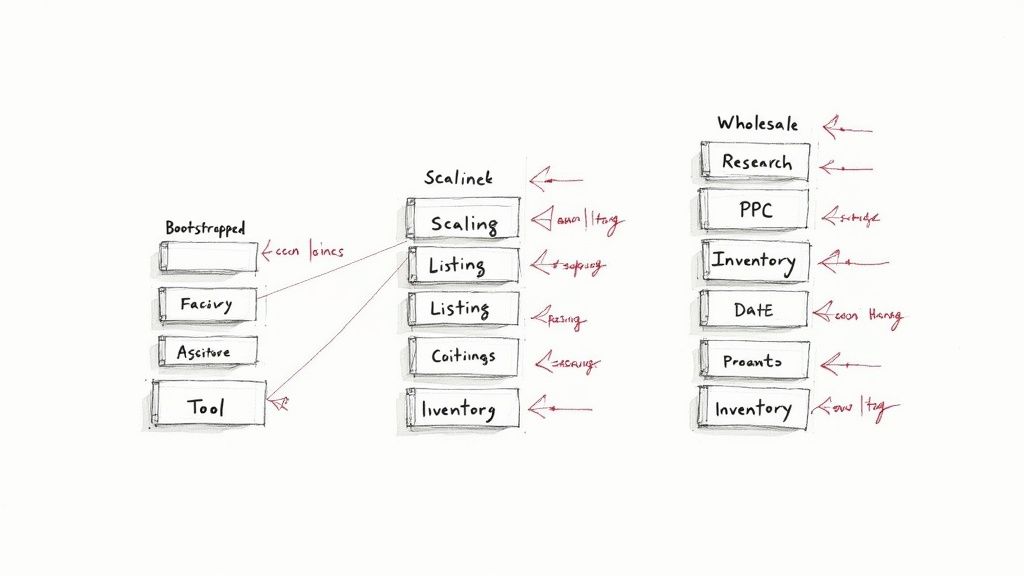
The real magic isn't in finding one perfect tool; it's in building a smart, cohesive system where all your tools work together. Finding the best software for Amazon sellers means creating a "stack" that fits your business model like a glove. Get it wrong, and you're just bleeding cash and wrestling with disconnected data. Get it right, and you've built a smooth, growth-powering engine.
We've laid out three practical blueprints below, each tailored to a different seller journey. Think of these as curated toolkits designed to tackle the real-world challenges you'll face at each stage, making sure every dollar you spend on software is an investment that pays off.
The Bootstrapped New Seller Stack
When you're just starting out, every single penny is precious. The name of the game is validating a product idea with the absolute minimum financial exposure. This stack is all about leveraging powerful free plans and essential, low-cost tools to find that first winner and get it launched without an ounce of wasted spend.
Your focus should be squarely on the front end of the business: finding a product and getting it live.
- Product Research: Grab a basic plan for a tool like Jungle Scout or Helium 10. The browser extension is your new best friend—use it to analyze sales data right on Amazon's search pages and validate demand before you ever think about placing a big inventory order.
- Keyword Research: You can stick with the free or entry-level tiers of these same platforms. The goal here isn't to master the entire keyword universe, but to find a core group of 5-10 "striking distance" keywords that you have a realistic shot at ranking for to get that initial trickle of traffic.
- Supplier Outreach: Use the free supplier databases built into your research tool or head over to a platform like Alibaba. Right now, it's all about communication and ordering samples, not locking in a massive production run.
This minimalist stack is laser-focused on one thing: getting you to your first sale as cheaply and quickly as possible. It deliberately sidesteps the cost and complexity of advanced analytics or PPC automation—you simply don't need them until you have a proven product with sales to analyze.
The Scaling Private Label Brand Stack
Once you've proven a product has legs, the strategy shifts. You're no longer just trying to survive; you're trying to dominate. A scaling private label brand has to defend its turf, master advertising, and manage inventory like a pro. This is where you bring in more sophisticated tools for automation and deeper insights.
At this stage, you start layering in tools to protect your hard-won margins and amplify your marketing efforts.
- Advanced Keyword & SEO: It's time to upgrade to a full Helium 10 suite. Use its Cerebro tool to perform deep reverse-ASIN lookups on your top competitors. You'll uncover the exact keywords driving their sales, giving you a treasure map for optimizing your own listing and PPC campaigns.
- PPC Automation: Manually managing ads is no longer sustainable. Bring in a dedicated advertising tool like SellerApp or Perpetua. These platforms use AI to automate your bidding, which is a lifesaver for keeping your ad spend profitable as your campaigns inevitably get more complex.
- Inventory & Profit Analytics: This is non-negotiable. A tool like InventoryLab gives you crystal-clear, per-ASIN profitability. It shows you exactly what you're making after Amazon fees, storage costs, and ad spend are all factored in. Without this data, you're just guessing when it's time to reorder.
The Multi-Channel Wholesale Operator Stack
For wholesalers and arbitrage sellers, the business is a high-stakes race defined by speed, volume, and winning the Buy Box. This stack is engineered for pure operational efficiency, intelligent repricing, and managing a massive, fast-moving catalog—often across more than just Amazon.
The entire strategy here revolves around operational velocity and protecting slim margins at scale.
- Intelligent Repricing: A simple race-to-the-bottom repricer won't cut it. You need a game-theory-based tool like Seller Snap. It doesn't just undercut; it analyzes competitor behavior to win the Buy Box at the highest possible price, actively protecting your profit in brutally competitive listings.
- Inventory & Accounting Sync: Software like A2X or a robust integration with QuickBooks becomes the central nervous system of your operation. It automatically reconciles sales data from Amazon with your books, giving you an accurate, real-time picture of your financial health across hundreds or even thousands of SKUs.
- Multi-Channel Management: If you're selling beyond Amazon, you need a platform that syncs inventory levels across every channel (like Shopify or eBay). This is mission-critical for preventing overselling and keeping your order fulfillment process from turning into chaos.
The All-in-One vs. Specialized Tool Debate
Sooner or later, every growing Amazon seller hits a crossroads. Do you stick with the collection of specialized tools you've pieced together, or do you move everything under one roof with an all-in-one platform? This isn't just about personal preference—it's a core strategic decision that dictates your budget, your daily workflow, and even how you compete.
An all-in-one system, like our EcomEfficiency platform, is built on the promise of simplicity and synergy. The biggest win is having a single, connected workflow. Insights from your product research can immediately guide your keyword strategy, which in turn powers your PPC campaigns. It all happens inside one dashboard.
This also gives you a single source of truth for all your business data. No more endless exporting and importing of CSV files between tools that don't talk to each other. Plus, managing one subscription instead of five or ten just makes life easier and your monthly expenses far more predictable.
The Case for All-in-One Platforms
When you think about operational efficiency, the value of a unified suite really clicks. Your team only has to master one system, not half a dozen. That cuts down on training and frees everyone up to focus on making smart decisions instead of fighting with software.
For most sellers, this is the most logical way to scale. You get a comprehensive toolkit that handles 80% of what you need without the staggering cost and headache of managing a dozen different accounts. It’s often the clear answer for businesses searching for the best software for Amazon sellers without a massive budget.
A consolidated platform like EcomEfficiency isn't just about saving money on subscriptions; it's about reclaiming your time. By bundling dozens of premium tools, it eliminates the administrative burden of managing multiple accounts, letting you focus on growth activities.
When Specialized Tools Still Reign Supreme
But let's be honest, there's still a powerful case for sticking with a specialized software stack. All-in-one solutions offer breadth, but specialized tools deliver depth. They are designed to be the absolute best at doing one thing, and they often provide a level of power and nuance that a generalist platform just can't match.
Think about a few situations where a dedicated tool has a clear edge:
- Advanced PPC Bidding: An AI-powered advertising tool might have more sophisticated bidding algorithms built for managing massive, complex campaigns with thousands of keywords.
- International Repricing: A brand selling in multiple global marketplaces could need a specialized repricer with advanced logic for currency conversions and region-specific pricing strategies.
- Complex Logistics: A high-volume seller juggling different fulfillment methods often requires a dedicated inventory system with powerful forecasting and multi-warehouse support.
This is especially true for sellers who live and breathe by Fulfillment by Amazon (FBA). The right logistics software is crucial for growth, considering FBA sellers can generate 6.3 times more sales in their first year. With FBA shipping being up to 70% cheaper, a specialized tool can help you squeeze every drop of value out of those advantages. You can dig into more of these powerful Amazon seller statistics to see just how vital logistics has become.
Ultimately, the right choice comes down to your business's complexity and your priorities. If your entire competitive edge is built on mastering one specific area, a best-in-class specialized tool might be essential. But for the vast majority of sellers who value efficiency, cost savings, and a powerful, interconnected workflow, an all-in-one solution is the smarter way to scale.
Frequently Asked Questions
Jumping into the world of Amazon seller software can feel a bit overwhelming. Let's cut through the noise and answer some of the most common questions sellers have when they're trying to pick the right tools for the job.
What Is the Most Important Software for a New FBA Seller?
Without a doubt, a solid product research tool is the single most important piece of software for a new FBA seller. Before you spend your hard-earned cash on hundreds or thousands of units, you absolutely need data to tell you if it's a smart move.
Tools like Jungle Scout or Helium 10 help you see if people are actually searching for a product, what your competition looks like, and what you can realistically expect to make. This helps you dodge the classic rookie mistake: picking a product based on a gut feeling instead of actual numbers. Think of it as your insurance policy against a warehouse full of duds.
Key Takeaway: For new sellers, product research software isn't just a nice-to-have; it's a critical risk management tool. It answers the one question that matters most—"Will this thing actually sell?"—before you commit serious capital.
Can I Succeed on Amazon Without Using Paid Software?
Technically, yes, you could start an Amazon business with just manual research and Amazon's free reports. But being honest? It would be incredibly difficult to build a competitive and scalable business that way. In today's market, you'd be putting yourself at a huge disadvantage.
Your competitors are using sophisticated tools to find hidden keywords, automate their ad campaigns, and reprice their products in real-time to win the Buy Box. Trying to do all that by hand is like bringing a calculator to a supercomputer fight. You’ll be slower, less informed, and almost certainly less profitable.
How Much Should I Budget for Software?
For a brand-new seller, a realistic starting budget is somewhere between $50 and $150 per month. This range usually covers the must-haves for product and keyword research, which are the two pillars you need to get a strong launch off the ground.
As your store grows, a good rule of thumb is to set aside about 1-3% of your monthly revenue for your software stack. It’s crucial to see this as an investment in your operations, not just another bill. The right tools should pay for themselves by making you more efficient, boosting sales, and protecting your profit margins.
What Are the Risks of an All in One Solution?
The main risk with an all-in-one platform is that it can sometimes be a "jack of all trades, master of none." The convenience of having everything on one dashboard for one subscription fee is fantastic, but some of the individual tools might not be as powerful as a dedicated, best-in-class alternative.
For instance, the PPC tool inside a big suite might be fine for most sellers, but it probably won't have the advanced, algorithm-driven bidding features you'd get from a specialized advertising platform. When you go for an all-in-one, you're making a trade-off: you're choosing integrated convenience and cost savings over the deep, specialized functionality of a standalone tool.
Ready to consolidate your tools and cut your software bill by up to 99%? With EcomEfficiency, you get access to 50+ premium tools like Helium10, Semrush, and Midjourney for one low monthly price. Stop overpaying and start scaling smarter today.