Ecommerce Marketing Automation Software: Drive Growth in Your Store
At its heart, ecommerce marketing automation software is a system designed to handle marketing tasks and customer conversations automatically across channels like email, SMS, and even social media.
Think of it as your most dedicated employee—one who works 24/7 to create amazing customer experiences without ever needing a break. This is the technology that sends a welcome email the second a customer signs up, nudges them about products left in their cart, and even sends a special discount on their birthday. The best part? It does all of this without you having to lift a finger.
What Is Ecommerce Marketing Automation
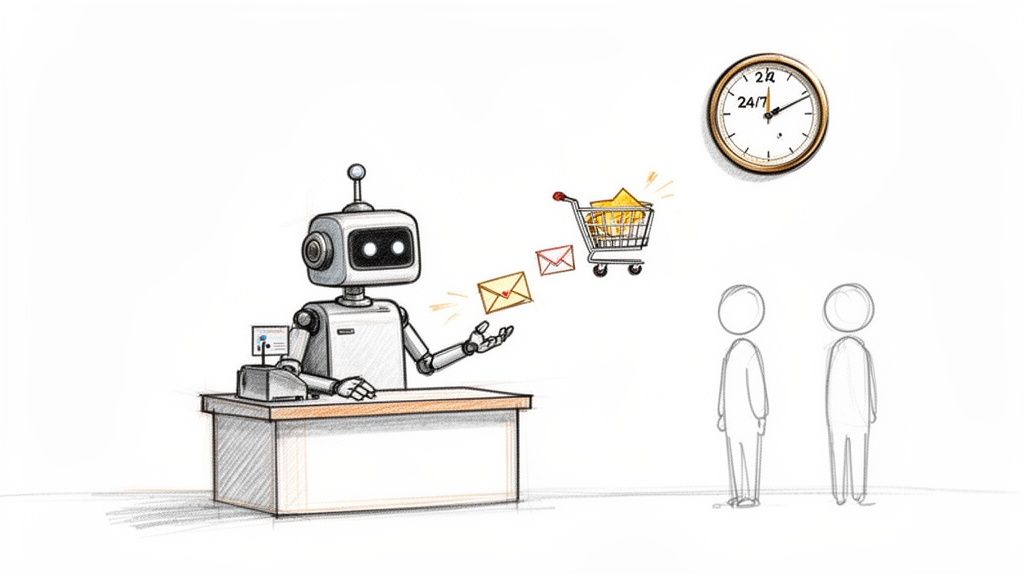
Fundamentally, ecommerce marketing automation is about using smart software to run repetitive marketing tasks. You aren't just scheduling messages; you're building intelligent sequences, or workflows, that operate on their own based on customer actions. This setup allows you to deliver personal, timely, and relevant messages to every single customer—at a scale that would be impossible for any human team to handle.
Picture this: a new visitor subscribes to your newsletter. That single action can kick off an entire "welcome series" workflow. The software instantly sends a 'thank you' email, follows up a day later showcasing your bestsellers, and then a few days after that, offers a special discount to encourage their first purchase. Each step is perfectly timed to guide that new subscriber toward becoming a loyal customer.
Moving Beyond Manual Marketing Efforts
Without automation, marketing can feel like you're always one step behind. You might be sending a weekly newsletter to your entire list, but that one-size-fits-all approach misses the mark. A customer who just bought something gets the same message as someone who hasn't visited your site in six months. The result is generic communication that gets tuned out.
Ecommerce marketing automation completely changes the game by letting you respond to customer behavior in real-time. It plugs directly into your store’s data—like purchase history, browsing activity, and abandoned carts—to build incredibly specific customer segments.
The real power of marketing automation lies in its ability to create one-to-one conversations at a one-to-many scale. It transforms marketing from a series of disconnected blasts into a continuous, personalized dialogue that nurtures customer relationships and drives revenue.
The True Purpose of Automation
Sure, saving time is a huge perk, but it's not the main goal. The real purpose is to grow revenue by making the customer experience genuinely better. When you send the right message at the right moment, you can dramatically improve your most important metrics. For a deeper dive, this comprehensive guide to ecommerce marketing automation breaks down the benefits and how to get started.
Here are the core problems that ecommerce marketing automation software is built to solve:
- Abandoned Carts: It automatically follows up with shoppers who leave items behind, recovering what would have been lost sales.
- Customer Onboarding: It welcomes new subscribers and first-time buyers, making them feel valued and increasing the chances they'll shop with you again.
- Customer Churn: It identifies customers who are slipping away and re-engages them with targeted "win-back" campaigns.
- Personalization at Scale: It uses customer data to recommend products they'll actually love and tailor offers, making every shopper feel seen.
In today's crowded market, automation isn't just a nice-to-have. It’s a fundamental tool for turning one-time buyers into lifelong fans and getting the absolute most value out of the traffic you already have.
The Core Features That Drive Growth
To really get what ecommerce marketing automation can do, you need to look under the hood. These platforms aren't just glorified email blasters; they're sophisticated engines built to engage customers and drive sales on autopilot. Each feature works together to turn generic marketing broadcasts into personal, timely conversations that actually convert.
Think of these tools as the instruments in an orchestra. One violin is nice, but when the whole string section, brass, and percussion play together, you create something powerful. Let’s break down the core components that make these systems tick.
Automated Email and SMS Workflows
This is the absolute heart of any solid automation platform. Workflows—sometimes called sequences or journeys—are a pre-built series of messages that fire off based on what a customer does (or doesn't do). They’re your digital sales team, working 24/7.
The most famous and profitable example is the abandoned cart workflow. A shopper adds items to their cart but gets distracted and leaves. Instead of that sale just vanishing, the system automatically sends a timed sequence of email and SMS reminders, gently nudging them back to finish the purchase. It sounds simple, but this one workflow can single-handedly recover a huge chunk of otherwise lost revenue.
Other essential workflows you'll want to set up include:
- Welcome Series: This is your first impression. It engages new subscribers right away, introduces your brand story, and guides them toward that all-important first purchase.
- Post-Purchase Follow-up: A simple "thank you" goes a long way. These sequences confirm orders, provide shipping updates, and ask for a review, building trust that turns one-time buyers into loyal fans.
- Win-Back Campaigns: This automatically targets customers who have gone quiet. A well-timed special offer can be all it takes to bring them back into the fold.
Advanced Customer Segmentation
Segmentation is just a fancy word for grouping your audience based on shared traits. This is how you stop shouting at everyone with the same message and start having relevant conversations. An ecommerce marketing automation software makes this process dynamic and almost effortless.
Instead of spending hours manually pulling static lists, the software can build these customer groups in real-time using a ton of different data points.
By grouping customers based on their behaviors and preferences, you can deliver messages that feel less like marketing and more like a personal recommendation from a trusted friend. This relevance is what drives higher open rates, click-through rates, and ultimately, more sales.
For example, you can instantly create segments for:
- High-Value Customers: Your VIPs. Target them with exclusive offers, early access to new products, and special treatment.
- First-Time Buyers: Nurture this group with content designed to build a habit and encourage that second purchase.
- Category Shoppers: Group people who only bought, say, "women's running shoes" and cross-sell them running apparel or accessories.
- Inactive Subscribers: Isolate users who haven't opened an email in 90 days so you can try a targeted re-engagement campaign without hurting your main list's deliverability.
Dynamic Personalization and Analytics
Personalization takes segmentation one step further. It uses individual customer data to make each message feel one-of-a-one. It can be as simple as using a customer’s first name in the subject line or as advanced as showing them dynamically populated product recommendations based on their unique browsing history.
Finally, robust analytics tie everything together. These platforms give you detailed dashboards that show you what’s working and what’s not. You can see exactly how much revenue your abandoned cart sequence generated, which welcome email converted best, and how your customer lifetime value is trending. This data is pure gold for understanding your ROI and making smarter decisions.
The demand for these tools is exploding. The global marketing automation software market was valued at around USD 6.65 billion in 2024 and is on track to blow past USD 13 billion by 2030. Ecommerce businesses are at the forefront of this trend, with their adoption expected to grow at an impressive 17.7% CAGR. You can read more about the rapid expansion of the marketing automation market to see just how critical these tools have become.
Choosing the Right Automation Software for Your Store
Picking the right ecommerce marketing automation software can feel a bit like navigating a maze. There are so many features, pricing models, and flashy promises that they all start to blur together. But this isn't just about buying another app; it’s about choosing a partner that will become the command center for all your customer communication.
Get it wrong, and you're looking at a wasted budget and a painful migration down the road. But get it right? You’ll have one of the most powerful growth engines in your entire tech stack. To make a smart choice, you need a solid game plan that goes beyond just looking at the price. The best platform for a new Shopify store is worlds away from what a high-volume DTC brand needs, so let's break down how to find the perfect fit for you.
Start by Defining Your Needs and Budget
Before you even start looking at demos, take a step back and look inward. Where are the biggest leaks in your marketing bucket right now? Are you losing sales to abandoned carts every single day? Is your welcome series failing to turn new subscribers into first-time buyers? Are you struggling to bring back old customers? Your most pressing problems should be your top priorities.
Jot down a simple list of "must-haves" versus "nice-to-haves." For instance, a rock-solid email and SMS abandoned cart flow is probably a must-have. On the other hand, super-advanced social media ad automation might be a nice-to-have you can grow into later.
Next, you have to talk money. Set a realistic budget. Most of these platforms price their plans based on how many contacts you have or how many messages you send. Be real with yourself about your current list size and where you expect to be in 12 months. This keeps you from getting locked into a plan that’s either too small or gets way too expensive, fast.
Dig Into the Technical Details
With your needs and budget mapped out, you can start putting potential platforms to the test. These are the make-or-break technical details that determine if a tool will actually work for your store or just cause headaches.
Plays Well With Others (Integrations): Does the software have a deep, one-click integration with your ecommerce platform, like Shopify, WooCommerce, or BigCommerce? A native integration is non-negotiable—it ensures critical data like purchase history, browsing activity, and customer info syncs up perfectly in real time.
Easy Enough for a Human to Use: Your marketing team shouldn't need a computer science degree to build a simple workflow. Look for an intuitive, drag-and-drop builder. A clean, straightforward interface means your team can be fast and creative without waiting on a developer.
Room to Grow (Scalability): Think about the future. Can this platform handle your list growing from 5,000 to 50,000 contacts without slowing down or breaking the bank? Check out their higher-tier plans to make sure the features and pricing will still make sense as you scale up.
Choosing the right software is all about finding that sweet spot between power and usability. The platform with the most features on earth is useless if your team finds it too confusing for their daily tasks. Always lean toward a tool that makes it easy to get things done.
Look Beyond the Software
Finally, remember you're not just buying software; you're partnering with the company behind it. A great tool with terrible support is a recipe for frustration.
Customer Support: What kind of help do they offer? Is it just email tickets, or can you get a real person on live chat or the phone when things go wrong? Scour review sites to see what actual customers are saying about how fast and helpful their support team is.
Learning and Strategy Resources: Does the company actually help you win? Look for a solid knowledge base, video tutorials, and strategy guides. A vendor that's truly invested in your success will teach you how to use their tool effectively, not just sell you a login.
By working through these steps—from understanding your own needs to checking the tech and vetting the vendor—you can cut through all the marketing hype. This process helps you find an ecommerce marketing automation platform that will feel less like a tool and more like a true partner in your brand's growth.
All-in-One Suites vs. Specialized Point Solutions
Another big decision is whether to go with an all-in-one platform that does a little bit of everything or piece together a "best-of-breed" stack of specialized tools. Each approach has its pros and cons, and the right choice depends on your team's size, technical skills, and specific needs.
An all-in-one suite simplifies your life by putting email, SMS, pop-ups, and more under one roof. This often means a single bill, unified data, and a consistent user experience. On the flip side, specialized point solutions are the masters of their domain—think of a tool that does only SMS marketing but does it better than anyone else. This gives you best-in-class functionality for each channel, but it can lead to more complexity in managing multiple vendors and syncing data.
Here’s a quick comparison to help you weigh the options:
| Attribute | All-in-One Platforms | Specialized (Point) Solutions |
|---|---|---|
| Functionality | Broad range of features (email, SMS, pop-ups, etc.) | Deep, best-in-class features for a single channel |
| Data & Analytics | Centralized customer data and unified reporting | Data is siloed; requires integrations for a full view |
| Ease of Use | Generally easier to learn with a single interface | Requires learning and managing multiple different tools |
| Cost | Often more cost-effective with bundled pricing | Can become expensive when paying for multiple subscriptions |
| Flexibility | Less flexible; you're locked into their ecosystem | Highly flexible; you can swap out tools as needed |
| Best For | SMBs, teams wanting simplicity and a single source of truth | Larger teams with specific needs and technical resources |
Ultimately, there's no single "best" answer. If you're a lean team that values simplicity and unified data, an all-in-one platform like Klaviyo or Omnisend is probably your best bet. If you have the resources and a deep need for the absolute best performance in every channel, building a custom stack with tools like Attentive for SMS and Justuno for pop-ups might be the way to go.
High-Impact Automation Workflows You Can Build Today
Enough with the theory—let's talk about making money. It's time to go from understanding what ecommerce marketing automation software can do to actually building the workflows that drive revenue. These automated sequences are the unsung heroes of your marketing strategy, acting like a 24/7 sales team that never sleeps.
We're going to walk through the blueprints for three of the most profitable automations you can set up right now. Think of these as proven recipes for turning window shoppers into first-time buyers and one-time customers into lifelong fans.
The whole process boils down to a few key stages: assessing your needs, integrating the right tool, and then scaling up what works.
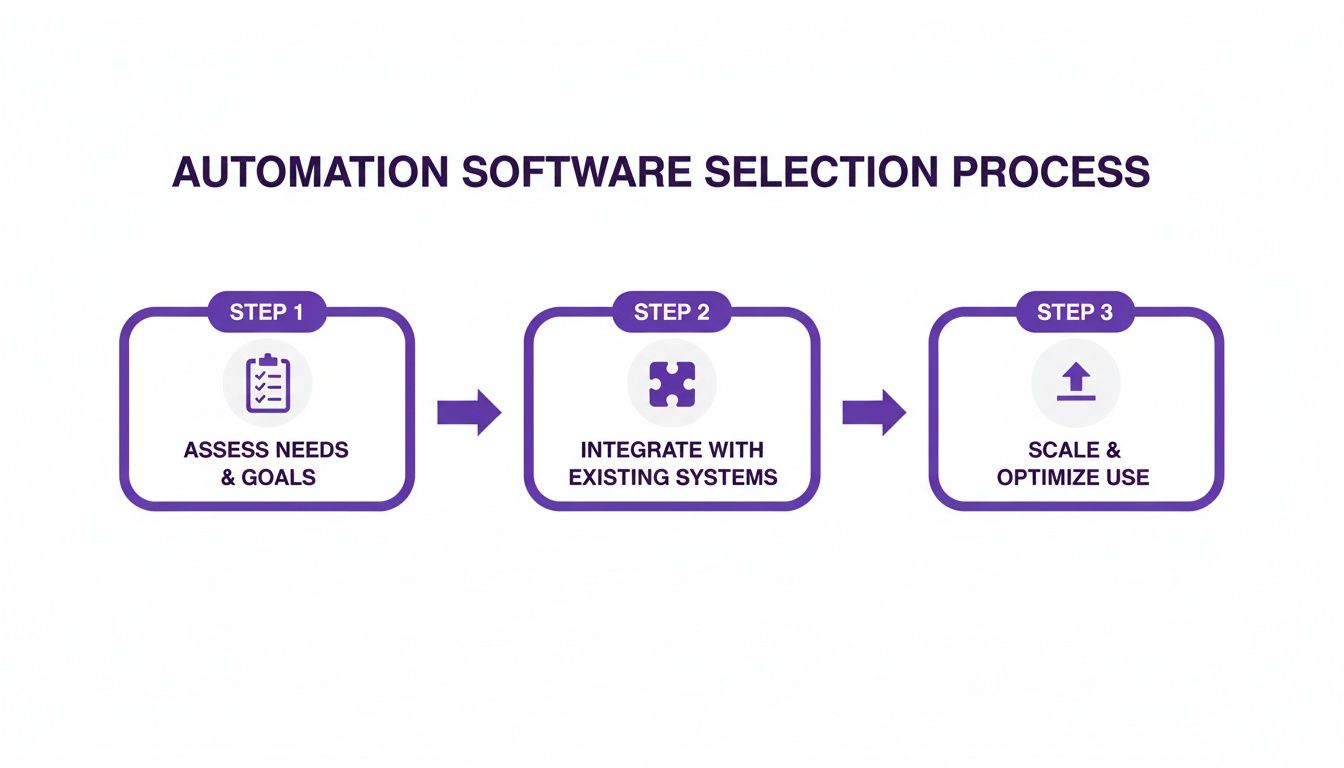
Choosing the right platform is just the first step. The real magic happens when you integrate it seamlessly into your store and start scaling these automated flows.
The Ultimate Abandoned Cart Recovery Sequence
Abandoned carts are a fact of life for every online store. It's just part of the game. But a huge slice of that seemingly lost revenue is completely recoverable with a smart, multi-channel follow-up sequence. This is almost always the first workflow stores build for one simple reason: it delivers an immediate and measurable ROI.
The secret to a great abandoned cart sequence is to be persistent without being pushy. By mixing email and SMS, you meet customers where they are and gently nudge them about the awesome stuff they left behind.
Here’s a proven blueprint for a high-converting sequence:
- The Trigger: A customer adds products to their cart but doesn't finish checking out within a specific timeframe, like 30 minutes.
- Message 1 (Email - 1 Hour Later): Send a friendly reminder. The vibe should be helpful, not pushy. Think a subject line like, "Did you forget something?" and make sure to include images of the exact items they left in their cart.
- Message 2 (SMS - 4 Hours Later): If they still haven't bought, a quick text can work wonders. "Hey [FirstName], your items at [Your Store Name] are waiting! We saved your cart for you: [Link]." SMS open rates are through the roof, often grabbing attention when an email gets lost in a crowded inbox.
- Message 3 (Email - 24 Hours Later): Now's the time to introduce a little incentive. A subject line like "Complete your order and get 10% off" is hard to ignore. Use this email to also tackle common roadblocks, like mentioning your easy return policy or shipping details.
- The Exit: The second a customer makes a purchase, they're automatically pulled out of this workflow. No more reminders.
The Engaging Welcome Series
When someone new subscribes to your list, they are at their peak level of engagement. They’ve literally just raised their hand to say, "I'm interested!" This is your golden opportunity to start a relationship and guide them toward that crucial first purchase. A welcome series is more than a simple "hello"—it's a strategic onboarding process.
This one workflow accomplishes three huge goals:
- It sets expectations: You're letting them know what kind of cool stuff you'll be sending and how often they can expect to hear from you.
- It builds trust: This is your chance to share your brand's story, show off some glowing customer reviews, and highlight what makes you unique.
- It drives the first sale: You can showcase your best-selling products and sweeten the deal with a special one-time offer to turn that subscriber into a customer.
Here’s how you can structure it:
- The Trigger: A visitor signs up for your newsletter through a form or pop-up on your site.
- Email 1 (Immediately): Deliver the goods. If you promised a discount, give it to them right away. A subject like "Welcome! Here’s your 15% off code" is perfect. Keep it simple and make that code impossible to miss.
- Email 2 (1 Day Later): Tell your story. Who are the people behind the brand? What’s your mission? This is how you build an emotional connection that goes way beyond price tags.
- Email 3 (3 Days Later): Show them the good stuff. Introduce your bestsellers. You can even get fancy and segment this based on what page they were on when they signed up, showing them top products from that specific category.
- Email 4 (5 Days Later): Introduce a little urgency. A friendly heads-up that their welcome discount is about to expire can be incredibly effective. "Last chance to use your welcome discount" often does the trick.
The Strategic Win-Back Campaign
It's an old marketing saying because it's true: keeping a customer is way cheaper than finding a new one. A win-back campaign automatically spots customers who've gone quiet and triggers a targeted sequence designed to re-engage them and bring them back into the fold.
The mission here is to remind them why they loved shopping with you in the first place and give them an irresistible reason to come back.
- The Trigger: A customer hasn't purchased from you in a set amount of time, say, 90 days. This window can change depending on your products and typical buying cycles.
- Email 1 (90 Days Post-Purchase): Start with a gentle nudge. A simple "We miss you!" message featuring some new arrivals or products related to what they've bought before can be enough to spark their interest again.
- Email 2 (120 Days Post-Purchase): Time to bring out a bigger incentive. This should be a compelling offer, like 20% off or free shipping with no minimum spend. You want to make it a no-brainer for them to click "shop now."
- Email 3 (150 Days Post-Purchase): This is your final shot. You can ask for feedback on why they've been away or give them one last call to use their special offer before it's gone for good.
By putting these three foundational workflows in place, your ecommerce marketing automation software stops being just another subscription and becomes a predictable, revenue-generating machine that works for your business around the clock.
Measuring Success and Proving Your Automation ROI
So, you've got your new automation software up and running. That's a great first step, but the real work starts now. Just letting your workflows run in the background isn't enough. You have to prove that this investment is actually making you money, turning it from a line item on your expense sheet into a genuine profit center for your store.
The big question you need to answer is simple: is this thing working? And I don't mean looking at vanity metrics like email open rates. I'm talking about connecting your automated campaigns directly to cold, hard cash and proving that your business is growing because of them.
Defining Your Key Performance Indicators
Before you can track success, you need to decide what success actually looks like for your brand. Your platform’s analytics dashboard is a treasure trove of data, but it’s easy to get lost in the noise. The key is to zero in on the Key Performance Indicators (KPIs) that truly matter.
Here are the essential KPIs you should be laser-focused on to prove your automation ROI:
- Automation-Attributed Revenue: This is your North Star. It's the exact dollar amount that came directly from customers who bought something after receiving an automated message. No guesswork here.
- Workflow Conversion Rate: Of all the people who enter your abandoned cart flow, what percentage actually complete a purchase? This metric tells you how effective each specific automation really is.
- Average Order Value (AOV): Are your automated upsell and cross-sell emails actually working? If customers are spending more per order after getting these messages, you have your answer.
When you track these numbers, you can go to your team and say, "Our abandoned cart workflow recovered $10,000 in lost revenue last month." That’s a whole lot more powerful than, "Our emails had a 25% open rate."
Looking Beyond Immediate Sales
While attributing revenue is critical, the true power of great marketing automation plays out over the long term. This is where Customer Lifetime Value (CLV) comes into play. A well-crafted welcome series doesn't just get you one sale; it builds a relationship that can lead to dozens of repeat purchases over the years.
To really get a handle on this, it's worth learning how to calculate customer lifetime value using different models. By comparing the CLV of customers who've been through your automations against those who haven't, you start to see the real, long-term financial impact of your work.
The goal isn't just to make a sale today. It's to use automation to build relationships that increase how much each customer is worth to your brand over their entire lifetime. Good automation builds loyalty, and loyalty shows up as a higher CLV.
The Role of Modern Platforms in Measurement
This kind of precise measurement is a huge reason why modern marketing tools have exploded in popularity. Cloud-based automation platforms are booming, with over 70% of users choosing them for their powerful data features and ease of use. For small and medium-sized stores, these tools make it possible to run sophisticated marketing campaigns and track performance without needing a massive IT budget.
At the end of the day, proving your ROI is pretty straightforward. You calculate the total revenue your automations brought in, then subtract the cost of the software and any time you spent on it. When that number is positive and growing, you have concrete proof that your ecommerce marketing automation software isn't an expense—it's one of the best investments you can make in your business.
Frequently Asked Questions
Jumping into the world of ecommerce marketing automation can feel like learning a new language. You've got questions about cost, what these tools really do, and how long it'll take before you see a payoff. It’s smart to want clear answers before you commit.
Let’s tackle some of the most common questions head-on and clear up the confusion around choosing and using an automation platform for your store.
How Much Should I Expect to Pay for This Software?
There’s no single price tag here—it really depends on the scale of your business. The cost is almost always tied to two things: the number of contacts you have and how many messages (emails and texts) you send each month.
For Starters: If you're just getting off the ground, you can find basic plans for as little as $20 to $50 a month. These are perfect for setting up the essentials, like a welcome series or a simple abandoned cart workflow.
For Growing Stores: Once you start scaling, you'll likely land in the $150 to $500 per month range. This tier typically unlocks more powerful tools for segmentation, A/B testing, and handling a larger list of subscribers.
For the Big Players: High-volume brands often invest thousands per month. That price gets you premium features, dedicated support, and the horsepower to manage massive customer databases.
The trick is to find a plan that fits where you are now but has room for you to grow over the next year. This way, you're not paying for features you don't need, but you also won't have to go through a painful platform migration in six months.
Is This Just Another Tool for Email?
Not at all. While email is a huge part of the equation, modern ecommerce marketing automation software is built for a world that exists beyond the inbox. The real goal is to create one seamless conversation with your customers, reaching them wherever they are most active.
Think of it this way: a good automation strategy doesn't just shout messages from one place. It creates a personalized conversation that follows the customer, whispering the right thing at the right time, on the right channel.
Besides email, you can automate touchpoints like:
- SMS/MMS Messages: For urgent stuff like flash sale announcements or cart reminders, nothing beats SMS. The open rates are nearly 100%.
- Website Pop-ups: You can trigger targeted pop-ups to collect emails, offer a discount, or catch a visitor just before they leave your site—all based on their specific behavior.
- Social Media Ad Audiences: Automatically sync your customer segments (like VIPs or one-time buyers) with platforms like Facebook and Instagram to run incredibly targeted ad campaigns.
- Push Notifications: If you have a mobile app, you can send timely alerts for new products or special offers right to your users' home screens.
How Long Until I Actually See Results?
This is a mix of instant wins and long-term gains. You definitely won’t be waiting a year to see if your investment is paying off.
For instance, a solid abandoned cart workflow can start recovering lost sales within 24 hours of you flipping the switch. It's one of the fastest ways to see a direct return. But the real magic of automation builds over time. Things like customer nurture sequences and loyalty programs are designed to boost customer lifetime value, and that's a metric that grows over months, not days.
As a general rule, you should expect to see a real, measurable lift in key metrics like revenue per recipient and overall conversion rates within the first 3 to 6 months of getting everything set up and running strategically.
Is Marketing Automation a Pain to Set Up?
It really depends on the platform you choose and how ambitious your goals are. The good news? Most modern tools have worked hard to make setup as painless as possible.
Many of the top platforms now offer intuitive, drag-and-drop editors for building workflows and simple, one-click integrations with giants like Shopify. You can often get foundational automations—like your welcome series or abandoned cart flow—up and running in a single afternoon.
Of course, if you're planning on more complex strategies involving custom data or API integrations, you might need a bit more technical know-how. But the best providers know this and offer fantastic customer support, step-by-step guides, and video tutorials to walk you through it.
Ready to slash your software costs and unlock powerful tools for your store? EcomEfficiency gives you consolidated access to over 50+ premium AI, SEO, and ad-spy tools for one low monthly price. Stop paying thousands and start growing faster.