Facebook Ad Spy Tools Your Competitors Use
Think of Facebook ad spy tools as your personal window into your competitors' entire advertising playbook. These platforms gather up everything your rivals are doing on Facebook, showing you their hottest ad creative, the exact copy they're running, and even who they're targeting. This isn't about cheating; it's about making smarter decisions with real data.
Why Ad Spy Tools Are a Marketer's Secret Weapon
Launching a new Facebook ad campaign can feel like throwing money into a black hole. You spend days, maybe weeks, perfecting an ad you believe is a sure winner, only for it to completely tank. Engagement is low, and your return on ad spend (ROAS) is even lower. That’s when you realize that competitive intelligence isn't just a nice-to-have—it’s a must-have.
Using Facebook ad spy tools gives you a fighting chance, especially if you're a smaller brand going up against giants. It lets you learn from the big-budget wins and painful losses of massive campaigns without risking a single dollar of your own money on guesswork.
Deconstruct Winning Formulas
Spying on competitor ads isn’t about just ripping off their work. It's about breaking down what makes their campaigns tick. You start to see patterns in their approach.
- Messaging: What customer problems are they focusing on? Are they using humor, fear, or excitement in their copy?
- Creatives: Do raw, user-generated videos get more traction than slick, professional ones? What colors and visual styles seem to stop the scroll?
- Offers: Is their go-to offer a straight discount, a free trial, or maybe a "buy one, get one" deal?
Once you spot these trends, you can weave those successful elements into your own brand's voice and promotions. This shortcut helps you leapfrog the expensive A/B testing phase and start with tactics already proven to connect with your audience.
The real power of an ad spy tool isn't just seeing what your competitors are doing right now; it's understanding the why behind their successful campaigns. It turns reactive marketing into a proactive, strategic advantage.
Validate Ideas and Mitigate Risk
Got a new product idea? Before you sink cash into inventory and a huge launch, you can use an ad spy tool to check the pulse of the market. If you see major competitors already throwing serious ad spend behind a similar product, that's a pretty strong green light indicating real customer demand.
This data-first approach takes a lot of the "I hope this works" out of your business strategy. It’s a low-risk way to confirm your hunches and sidestep expensive blunders by learning from what others have already figured out. The market's rapid growth proves just how critical this is. The global ad intelligence software market exploded to $3.13 billion in 2024 and is on track to hit $10.5 billion by 2035. This growth is fueled by brands scrambling for an edge on platforms like Facebook, which is projected to pull in a staggering $156.8 billion in ad revenue in 2025. You can discover more insights about the ad intelligence market.
Before we dive into the "how-to," let's look at the key players in the ad spy tool space. Choosing the right one depends entirely on your budget and what you need to accomplish.
Top Facebook Ad Spy Tools at a Glance
This table gives you a quick rundown of the leading tools, highlighting what they're best for, a standout feature, and what you can expect to pay to get started.
| Tool Name | Best For | Unique Feature | Starting Price |
|---|---|---|---|
| AdSpy | E-commerce & Dropshipping | Massive, searchable ad database with advanced filtering. | $149/month |
| Minea | Product Research | All-in-one tool combining ad spy with product discovery. | €49/month |
| PiPiADS | TikTok & E-commerce | Unrivaled focus on TikTok ads, great for trendspotting. | $77/month |
| BigSpy | Multi-Platform Analysis | Covers 9+ social platforms beyond just Facebook. | $9/month |
| PowerAdSpy | Lead Gen & Agencies | Deep filtering for funnels and call-to-action types. | $49/month |
Each of these tools offers a slightly different flavor of competitive intelligence. For our guide, we'll be focusing on a general process that applies to most of them, but it’s worth checking out their free trials to see which interface and feature set feels right for you.
Uncovering High-Performing Ads Like a Pro
Alright, you've got your ad spy tool fired up. Now the real fun begins—playing detective. Just punching in a few keywords is like casting a net in the ocean; you'll get something, but probably not the treasure you're looking for. The key is to cut through all that noise and find the ads that are actually making an impact.
This is where you need to think beyond the obvious. Instead of just searching for "running shoes," start filtering by what really matters: engagement. I'm not talking about vanity likes, either. Look for ads with a ton of shares and comments. A share is a personal endorsement; it means someone found the ad so compelling they put their own reputation on the line to show it to their friends. That's gold.
Refining Your Search for Actionable Insights
Once you've zeroed in on high-engagement ads, start dissecting the "how." Are the top players in your space crushing it with quick, snappy video ads on Reels? Or are they winning with detailed carousel ads that tell a story in the main feed? Most decent ad spy tools will let you filter by format and placement, so use it.
Pay close attention to the small stuff, like the call-to-action (CTA) buttons. If you spot that your three biggest competitors are all consistently using "Shop Now" on their video ads, that's not a coincidence. It’s a signal that they've likely tested the heck out of it and found a winner. It’s these little breadcrumbs that lead to a powerful, optimized strategy.
This whole process—analyzing what's working, spotting gaps, and then validating your own ideas—is the core of smart competitive intelligence.
This workflow isn't just about snooping; it's about turning a sea of data into a clear, strategic roadmap for your own campaigns.
Tracking Campaigns Over Time
Here’s a pro-tip I swear by: don’t just look at what’s new. Find the old stuff. Filter your search to show only ads that have been running for 30, 60, or even 90+ days. Why? Because nobody keeps pouring money into an ad for three months unless it's printing cash. An ad with that kind of lifespan is a proven winner. It tells you the offer, the creative, and the targeting are all in perfect harmony.
Tracking long-running ads is the closest you'll ever get to peeking at a competitor's P&L sheet. If an ad is still live after 90 days, you can bet your bottom dollar it's profitable.
This long-term view also gives you incredible insight into creative fatigue. By seeing when a competitor finally pulls the plug on a long-running campaign, you get a feel for how long a winning ad can last in your market before it starts to burn out.
The best part is that today’s Facebook ad spy tools make this kind of in-depth analysis totally achievable for anyone. What used to be an exclusive strategy for big-budget agencies is now fair game. A tool like AdSpy is a powerhouse for e-commerce brands, known for its incredible filtering options at $149 per month. But there are also fantastic budget-friendly options like BigSpy, which starts at just $9 per month, putting these insights within reach for virtually any business. You can explore more about the best ad spy tools to find the right fit for your budget and goals.
Taking Apart Your Competitor's Strategy
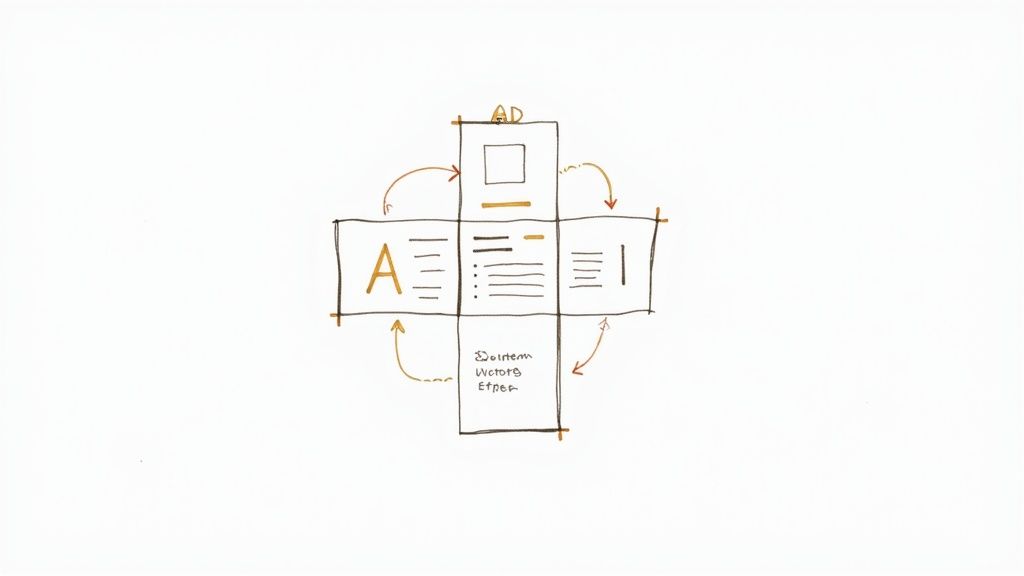
Finding a competitor's winning ad is just the start. The real insight—the kind that actually moves the needle—comes from taking that ad apart piece by piece to figure out why it’s resonating with people. Just glancing at the creative is a classic rookie mistake. You have to look at the entire machine, from the first impression right through to the final conversion.
This process isn't about blatant copying. It’s about reverse-engineering the strategic DNA of a successful campaign. A great ad is so much more than a cool video; it’s a finely-tuned system of hooks, persuasive copy, and a slick sales funnel all working together.
Analyzing the Ad Creative
The creative is your first, and often only, chance to stop the scroll. You’ve got maybe three seconds. When you're looking at a competitor's ad, don't just watch it—dissect it.
- The Hook: What’s happening in the first 1-3 seconds? Is it a jarring visual? A direct question? A shot that immediately highlights a common problem? A great example I saw was for a blender brand; instead of a boring smoothie shot, they dropped a phone into the blender. That gets your attention.
- Visual Pacing: Pay attention to the editing. Are the cuts fast and frantic, designed for a younger audience on Reels? Or is it slower, more cinematic, and aimed at an older demographic in the main feed? The pace sets the mood.
- Color Psychology: What are the dominant colors? Are they using calming blues to build trust for a new skincare line, or are they blasting you with vibrant oranges to create urgency for a flash sale? These choices are almost never an accident.
Every one of these elements is a deliberate decision made to trigger a specific emotion and guide the user's eye exactly where they want it to go.
Dissecting the Ad Copy
Next up, the words. The copy is what transforms that initial flicker of interest into a real desire to click. You need to look beyond the basic product description and uncover the formula they’re using.
A huge mistake I see people make is focusing all their attention on the main body text. In reality, the headline is often 80% of the ad's power. If your headline falls flat, nobody is even going to read the rest of your copy.
Look closely at the pain points they're hitting. Are they talking about the frustration of constantly sharpening kitchen knives or the daily annoyance of tangled headphones? The more specific they are about the problem, the more powerful their solution feels. Also, check out the call-to-action (CTA). Beyond the button, what kind of action-oriented language are they using in the text itself to push you toward that click?
This kind of deep research has been completely changed by modern Facebook ad spy tools. Tools like Minea, for example, don't just show you Facebook ads. They pull in data from TikTok and Pinterest too, capturing millions of ads and updating daily so you can see the exact creative and copy that's driving current trends.
Examining the Full Sales Funnel
This is easily the most critical—and most frequently skipped—step. An ad is just the front door. To really understand the strategy, you have to walk through the entire house.
So, click the ad. Go to the landing page. Does it feel like a natural continuation of the ad's promise? Look for consistency in the message, the branding, and the visuals.
Then, analyze the offer. What are they actually pushing? Is it a straight percentage discount, a BOGO deal, or the classic free shipping offer? Finally, look at the page layout itself. Is it clean and minimalist, focused on a single product? Or is it a busier page loaded with upsells and cross-sells? Every element gives you a clue about their conversion strategy. By mapping out this entire journey, you can see exactly how they turn a casual scroller into a paying customer.
Bringing It All Back Home: Applying What You've Learned
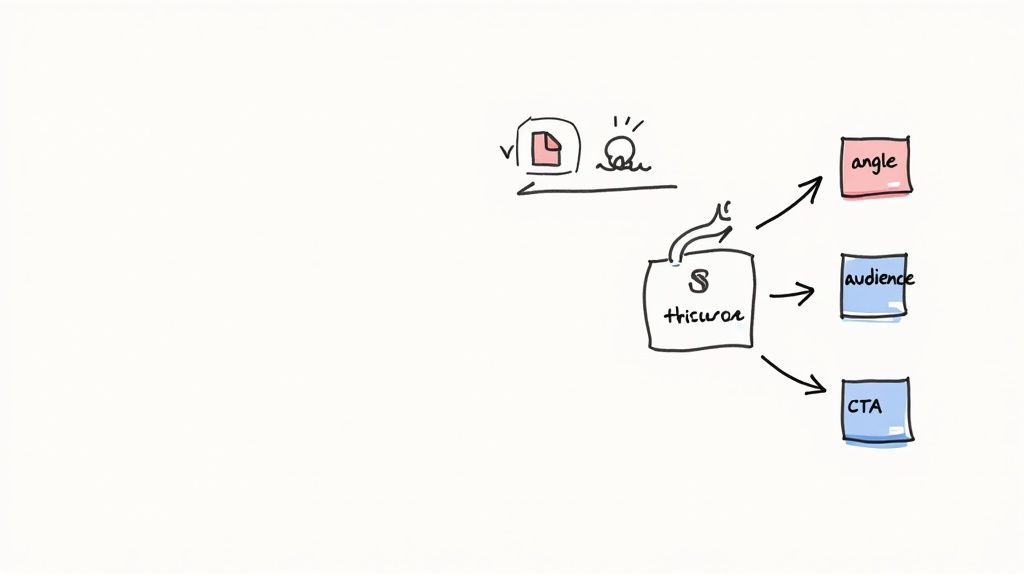
This is where the rubber meets the road. All that digging and analyzing is great, but the real value comes from turning those insights into fresh, high-performing ads for your own brand.
Let's be crystal clear: the goal is innovation, not imitation. Ripping off a competitor’s ad is a terrible idea. It’s lazy, unethical, and honestly, it just doesn't work. You don't have their brand recognition or the specific sales funnel they've built on the back end.
Instead, you should treat their winning ads as a creative starting point.
The best way I've found to do this is by creating a "swipe file." This isn't just a folder of random screenshots. It's a curated library of standout components. I grab screenshots of killer headlines, video hooks that stop me in my tracks, unique ways of presenting a value prop, and calls-to-action that feel genuinely persuasive. This becomes an invaluable resource for breaking through creative blocks later on.
Finding Your Own Unique Angle
With your swipe file ready, you can start brainstorming. Imagine you sell high-performance blenders, and you discover your biggest rival’s top-performing ad hammers home the pain point of "lumpy protein shakes." That’s a goldmine of an insight—it tells you exactly what frustrates your shared audience.
Now, instead of making your own ad about lumpy shakes, you use that core customer frustration to explore different, related problems your product solves.
- The "Quiet Morning" Angle: What about the sheer noise of most blenders? You could create an ad showing someone making a pre-dawn smoothie without waking up the entire house. A huge win for early risers.
- The "Five-Second Cleanup" Angle: Everyone hates cleaning blenders. Your creative could focus on how ridiculously easy your model is to clean—a quick rinse, and you're done. Contrast that with the nightmare of disassembling other models.
See the difference? You’re using their validated customer pain point as a clue to find a unique, authentic story that only your brand can tell.
De-Risking Your Ad Spend with Smarter Testing
The data you pull from Facebook ad spy tools is basically a cheat sheet for your next tests. If you notice your top three competitors are all having success targeting audiences interested in a specific fitness influencer or a niche hobby like trail running, that’s not a coincidence. It's a signal.
This is your cue to build an ad set targeting a similar, adjacent audience. Maybe you test interests related to a different (but similar) fitness personality or a complementary hobby like bouldering. This is infinitely smarter than just guessing at random interests and burning through your budget.
The big takeaway here is to let your competitors' ad spend de-risk your own. They've already spent the money to validate an audience type or a messaging style. You get to take that insight and run a much more calculated, informed test.
This is the strategic mindset that separates the pros from the beginners. By adapting what works, you dramatically shorten your learning curve and stop wasting money. It's how smart brands, especially those using tools like the EcomEfficiency suite, build a real, sustainable edge in a crowded market.
Common Mistakes to Avoid When Spying on Ads
Spying on competitor ads feels like having a secret playbook, but it's easy to get lost in the noise if you're not careful. I've seen countless brands fall into the same traps, so let's walk through how to avoid them.
The biggest mistake? 'Shiny object syndrome.' You're scrolling through a Facebook ad spy tool and see a competitor's ad just exploding with likes and comments. The immediate temptation is to drop everything and try to replicate that magic.
But chasing trends without a second thought is a surefire way to burn your budget. It yanks you off your own game plan and onto theirs. Before you even think about mimicking a viral ad, take a step back and ask: does this angle, this tone, this offer actually make sense for my brand and my customers?
Another classic blunder is trying to copy-paste a competitor's entire campaign. It almost never works. What you see in an ad spy tool is just the creative—the tip of the iceberg. You have no idea what their backend funnel, email marketing, or retargeting strategy looks like. That ad might be killing it because it's only shown to a warm audience that's been nurtured for years, something you can't replicate overnight.
Focusing on the Wrong Competitors
It's natural to want to peek at what the industry giants are doing. Everyone wants to know the secrets of the Nikes and Gymsharks of their niche. The problem is, their strategies are often completely irrelevant to a smaller, growing business.
Those behemoths are playing a different game. They have massive budgets to pour into broad brand awareness campaigns that might not even be profitable on the front end. They're aiming for total market domination, not necessarily a direct ROAS on every ad.
A much smarter move is to find competitors who are just a year or two ahead of you. These are the brands that were in your shoes not too long ago and have figured out how to scale. Their tactics will be infinitely more practical and applicable to your own campaigns.
A crucial lesson I've learned is that high engagement does not equal high sales. An ad with thousands of likes might be a dud when it comes to conversions, while a "boring" ad could be quietly printing money.
Misinterpreting the Data You Collect
Not all data points are created equal, and it's easy to get fooled by vanity metrics. An ad can go viral for being funny or controversial, attracting tons of attention from people who will never, ever buy from you. That's not a win; it's a distraction.
To find the real gold, you need to develop a filter for what actually matters. Look for signals of longevity and profitability.
Here’s what I always look for:
- Long-Running Ads: The first thing I do is filter for ads that have been active for at least 30 days. No one keeps an unprofitable ad running for that long. It's a dead giveaway that something is working.
- Consistent Messaging: Do you see a competitor using the same theme or angle across multiple creatives? That’s not a fluke. It’s a sign they've tested it and found a winning formula.
- Direct Call-to-Action: I pay way more attention to ads with a clear, sales-oriented CTA like "Shop Now" or "Get 50% Off." Vague calls-to-action like "Learn More" can be used for anything, but a direct sales pitch tells you they're going for the conversion.
Learning to think this way is what separates the pros from the amateurs. It turns a Facebook ad spy tool from a simple library of ads into a source of genuine strategic insight, helping you adapt proven concepts instead of just chasing flashy tactics.
Your Questions About Ad Spy Tools Answered
Exploring competitor ads can feel overwhelming. You want clear answers before diving in—and that’s exactly what we’ll cover here.
Are Facebook Ad Spy Tools Legal To Use
You’re in the clear. Publicly available ads are exactly that—public. Meta even maintains its own Facebook Ad Library, and spy tools simply collect and sort this data for you.
They add advanced filters, historical archives, and reporting features, but never cross into private sectors. Think of them like a magnifying glass for market research—similar to SEO tools tracking site rankings rather than peeking behind locked doors.
How Do I Choose The Right Ad Spy Tool
It boils down to your goals and budget. Here’s how to narrow it down:
- E-commerce Focus: Minea, AdSpy—ideal for digging into product variations and angles.
- Tight Budget: BigSpy shines across multiple platforms without high fees.
- Agency Scale: Tools that span Facebook, TikTok, and Google give you a true 360° view.
Try before you commit. Block off a day, run a few searches, and see if the filters and dashboard fit your workflow.
The best way to judge a tool is hands-on experience—no demo video replaces real use.
Can I Find My Competitors Exact Targeting
You won’t see every interest, lookalike percentage, or custom audience list inside their Ads Manager. Meta keeps those details private.
However, top-tier spy platforms reveal valuable clues:
- Regions where ads run
- Demographic splits (age, gender)
- Preferred placements (Feed, Stories, Reels)
Use these insights as your roadmap. They’ll guide your own audience tests and campaign setup.
How Often Should I Check Competitor Ads
That depends on how fast your market moves. For high-velocity niches—think dropshipping or trend-driven fashion—peek once or twice a week. If you’re in steadier sectors like B2B services, every two weeks or once a month usually suffices.
The real win comes from consistency. Schedule a recurring slot in your calendar and treat competitor reviews like any other meeting.
Regular check-ins turn reactive tweaks into proactive strategies.
Ready to go beyond guesswork? The EcomEfficiency suite rolls 50+ premium ad spy, SEO, and AI tools into one subscription—cutting your software costs by up to 99%. Unlock your competitive edge with EcomEfficiency today.