The Real Deal on Group Buy Websites for E-Commerce Tools
It's an offer that's hard to ignore: premium, expensive e-commerce tools for a tiny fraction of their retail price—sometimes as low as 99% off. For any entrepreneur trying to keep costs down, this looks like the ultimate hack. But is it a brilliant cost-saving move or a disaster waiting to happen for your business?
Let's dig into what's really going on behind that tempting price tag.
What Are Group Buy Websites Really Selling?
Think of it like this: someone buys a single, all-access Costco membership. Then, they stand outside and "rent" their card to hundreds of other people for a few bucks each. Everyone gets a shot at the deals inside without shelling out for a full membership. It sounds like a clever workaround, right?
But we all know that's not how it works. This is a clear violation of Costco's rules, and it creates a messy, unreliable situation for everyone involved. That one membership card is constantly at risk of being shut down, leaving everyone who paid for access out in the cold.
This is the exact same playbook group buy websites run. They buy one premium subscription to a powerful tool—say, an expensive SEO platform or a sophisticated product research suite—and then sell shared access to a huge group of users. You're not actually buying the software; you're just renting a tiny piece of someone else's account.
The Illusion of Ownership
When you purchase software the right way, directly from the company that made it, you get a whole package: your own unique license, a secure login, access to customer support, and the peace of mind that the tool will be there when you need it.
Group buy services offer none of that. Instead, you're handed one of these less-than-ideal workarounds:
- Shared Credentials: You get a single username and password that's also being used by dozens, if not hundreds, of other people.
- Browser Extensions: You're often required to install a custom plugin that logs you into the shared account, which can be a massive security risk.
- Remote Desktops (RDP): Sometimes, you'll have to log into a virtual computer where the tool is already running—a slow, clunky, and frustrating experience.
This is the core difference between a real purchase and a gray-market gamble. You're not a recognized customer of the software company. You're an anonymous stranger piggybacking on an account that's actively breaking the rules and could be terminated at any second.
The entire business model of a group buy website is built on violating the terms of service of the very software they're selling. Because of this, instability isn't just a risk—it's a guarantee.
That rock-bottom price is a distraction. It's meant to make you overlook what you're actually getting: temporary, high-risk, and completely unsupported access to a tool. It's a shortcut that almost always leads to a dead end, leaving you scrambling when a critical tool vanishes right when you need it most. Before we go any further, it's crucial to grasp that the initial "savings" come with a hefty price in security, reliability, and your own peace of mind.
How These Tool Sharing Services Actually Work
To really grasp the risks, you need to pull back the curtain and see how these group buy websites are put together. The entire model is built on a simple, yet shady, foundation: the provider buys one legitimate, high-level subscription to a popular tool like Ahrefs or SEMrush. Then, they use a few technical tricks to chop up that single access point and sell it to dozens, sometimes hundreds, of different people.
Think of it like a landlord buying a single master key to a luxury apartment building. Instead of giving tenants their own unique keys, he just makes a bunch of illegal copies of the master key and sells them on the cheap. Sure, you can get in the front door, but you have no privacy, no security from the other keyholders, and the real building owner could change the locks at any second, leaving you out in the cold.
That's exactly what’s happening here. These services aren't official partners or resellers; they’re just peddling unauthorized access to a single, overloaded account.
This little map shows the difference between the safe, official route and the shaky path of a group buy.
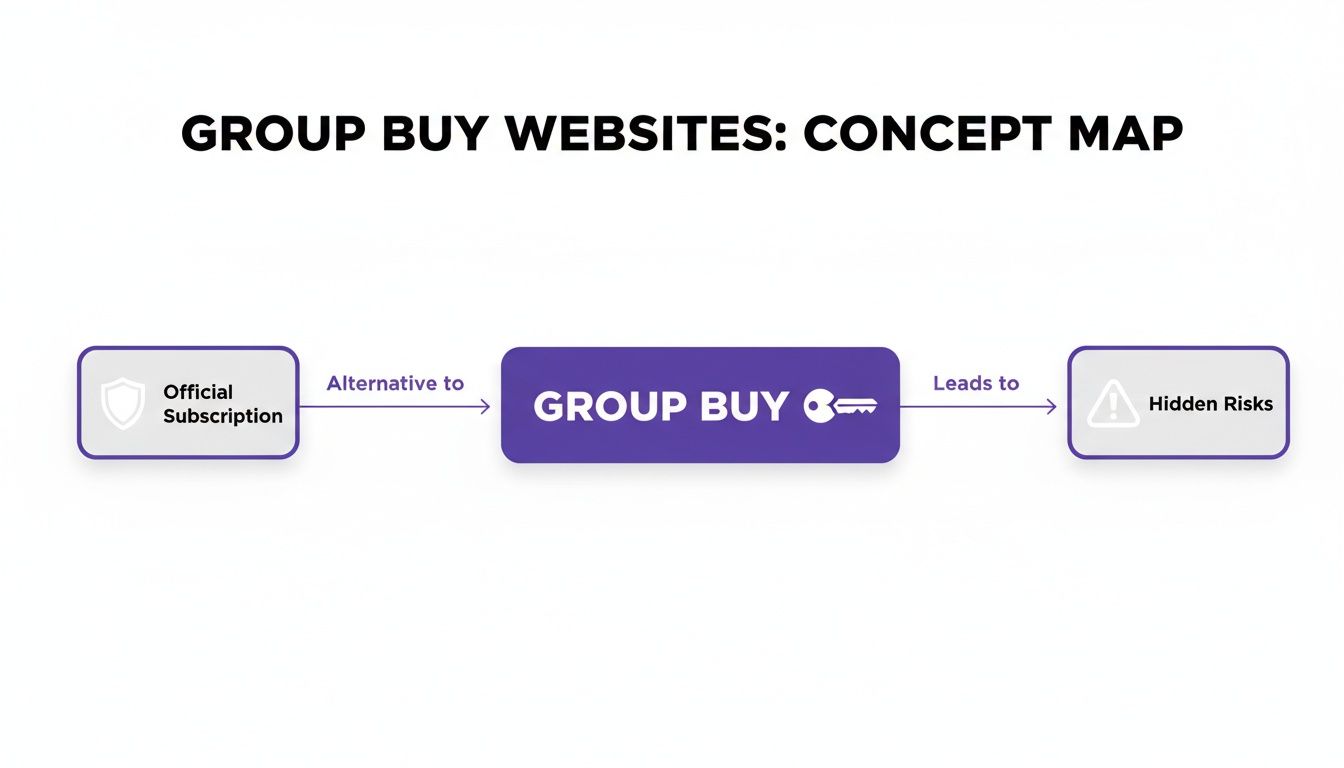
As you can see, the group buy model creates a broken bridge between you and the tools you need to run your business, and that bridge is loaded with hidden dangers.
Common Methods for Sharing Access
These providers typically use one of three methods to give you access, and honestly, they all come with their own set of headaches. Knowing what to look for helps you understand why these services are so flaky and insecure.
Shared Login Credentials
This is the most straightforward and common approach. You're simply given a username and password that everyone else in the "group" also uses. You log in like normal, but you're stepping into a crowded room where none of your work is private.Custom Browser Extensions
A lot of these services will ask you to install their own browser extension. This little piece of software handles the login for you behind the scenes. It might seem convenient, but you're installing unvetted code directly onto your computer, opening up a huge security hole for all your business data.Remote Desktop Protocol (RDP)
Some of the slightly more "sophisticated" providers give you access to a remote computer that has the tool already installed. You log into this virtual machine to do your work. This is almost always a clunky, slow experience that makes it a pain to save files or connect the tool with your other work.
Key Takeaway: No matter how they deliver access, the fundamental problem is the same. You are an unauthorized user on a single account, and that account is breaking the software's Terms of Service. This is the root cause of the constant instability and why your access can vanish overnight without any warning.
Each of these workarounds is a fragile attempt to bypass the software's intended design—one license for one person or team. While they might be clever, they're built on a house of cards that could collapse at any moment. This is what directly leads to the security, legal, and operational risks that can do real damage to your e-commerce business.
The Evolution of Collective Buying
The idea of pooling resources to get a better deal is as old as commerce itself. Think about your local food co-op or even just a group of friends pitching in on a bulk order—it’s a simple, powerful concept. This model of collective buying has always been about strength in numbers. The more people who join in, the more leverage they have to negotiate discounts that businesses are happy to provide.
This timeless idea got a digital makeover in the late 2000s with the meteoric rise of companies like Groupon. They didn’t invent the concept, but they launched it into the internet age. By acting as the middleman, they connected huge online audiences with local businesses hungry for new customers. It was a classic win-win: businesses saw a rush of foot traffic, and customers got amazing deals on everything from dinner out to weekend getaways.
Crucially, this entire model was legitimate. Merchants were active, willing partners. They set the terms, agreed to the discount, and prepared for the influx of new customers. The whole process was transparent and consensual, creating real value for everyone involved.
The Rise of Digital Group Deals
The growth was explosive. Collective buying re-emerged as a major e-commerce trend, and by the early 2010s, it was big enough to shake up the market. Groupon, which started in late 2008, had already amassed 33 million subscribers across 48 countries just a few years later. Their daily deals, often slashing prices by 20%–70%, were driving millions in revenue for local businesses. The model fed on itself—more buyers attracted better deals, which attracted more buyers—all amplified by smartphones that made finding and sharing deals a breeze. You can dig deeper into the online group buying market on Verified Market Reports.
The defining feature of legitimate group buying is consent. Every discount and every purchase happens with the full knowledge and permission of the business offering the product or service. This is what builds a healthy, sustainable system based on trust.
But as the market evolved, the shiny "group savings" concept got co-opted. The positive, familiar idea of "group buying" was about to be twisted into something else entirely.
How the Model Was Hijacked
The group buy websites you see today for SEO tools and software are a completely different beast. They've essentially stolen the friendly "group buy" name but abandoned the principles of partnership and consent that made the original model work. Instead of working with software companies, they operate in the shadows, actively breaking the rules.
Let’s be perfectly clear about the difference:
- Legitimate Group Buying (The Groupon Way): A large group of people gets a discount directly from a business that has agreed to the deal. Every single person gets their own legitimate product or service.
- Unauthorized Software Sharing (Today’s "Group Buy" Sites): A single organizer buys one premium account and then illegally shares access with a large group of paying users. Nobody gets their own account; they all share a single, compromised one.
This is the whole ballgame. One is a marketing partnership; the other is a direct violation of a company's terms of service. One builds relationships between businesses and their customers, while the other completely cuts out the creators of the tools you rely on. This hijacking preys on our natural desire for a good deal, but what it delivers is unstable, insecure, and unethical. Understanding this bait-and-switch is the first step to realizing the serious risks these sites pose to your business.
2. The Hidden Costs: Unpacking the Real Risks of Group Buy Websites
That rock-bottom price on a group buy site feels like a clever hack, but it’s a classic case of "too good to be true." The real price isn't paid in dollars—it's paid in the massive security, legal, and operational risks you’re taking on. These aren't just hypothetical problems; they're genuine threats that can do lasting damage to your e-commerce business.
The moment you hand over your payment information and install their software, you're walking into a minefield. The entire group buy business model is built on breaking the rules, and that shaky foundation creates three major categories of risk for you. Let's dig into exactly what you're gambling with.

Severe Security Risks
When a service tells you to install a custom browser extension or use shared login details, you're essentially handing a stranger the keys to your digital kingdom. The security fallout can be enormous, and most people don't see it coming until it's far too late.
Embedded Malware and Spyware: Many of these services require you to install their own browser extension. These aren't vetted by official app stores and can easily be loaded with malicious code designed to scrape your data—we're talking other business logins, customer information, and even financial details.
Stolen Credentials: You’re given a shared username and password, which means you have zero control over who else is using it. An unscrupulous user—or the provider themselves—could use those credentials to try and access your other accounts, especially if you reuse passwords (a common but dangerous mistake).
No Data Privacy: Any keyword research you do, products you analyze, or strategies you map out are completely exposed. Other people on the shared account, not to mention the provider, can see everything. For an e-commerce owner, that could mean a competitor snatching your next winning product right from under you.
Picture this: You spend weeks using a group-buy SEO tool to uncover a fantastic, low-competition niche. But because your activity isn't private, another user on that same shared account sees your research. They beat you to market, and by the time you're ready to launch, the niche is already saturated. All that hard work is gone in an instant.
Legal and Compliance Risks
While you probably won’t end up in jail, using these services puts your business in a very dicey legal spot. You are knowingly participating in an activity that breaks a contract, and the consequences can be swift and severe.
The main issue here is the violation of the software’s Terms of Service (ToS). Every legitimate software company has a ToS agreement that explicitly forbids sharing, reselling, or distributing account access. When you use a group buy service, you are an active party in breaking that legally binding agreement.
Software companies are not oblivious to this. They actively monitor for suspicious activity, like simultaneous logins from multiple IP addresses across the globe. When they spot it, they don’t just send a warning—they terminate the account. For you, this means instant loss of access without a refund and with no one to appeal to. For any business thinking about these services, having a strong third-party risk management framework is crucial for protection.
Functional and Business Risks
Beyond the security and legal minefields, the day-to-day experience of using group buy websites is often one of pure frustration. The tools are unreliable, and these functional headaches can halt your workflow and hurt your business momentum.
Here’s what you can realistically expect:
Unreliable Access: The tools are down. A lot. Logins suddenly stop working, accounts get suspended, and you can lose access for hours or even days—usually right when you need it most, like during a product launch or ad campaign analysis.
Missing or Broken Features: You’re using a shared, often restricted, account. This means key features might be disabled or just won't work properly. You could find you can’t save projects, export critical data, or use the very advanced functions you signed up for.
Zero Customer Support: When the tool breaks, you're on your own. You can't contact the real software company for help because you aren't their customer. And the group buy provider? Their support is typically slow, unhelpful, or completely nonexistent.
Damage to Your Reputation: Relying on tools that are constantly failing makes your business look unprofessional. If you miss a client deadline or can't pull campaign data because your access is down, it erodes trust with partners and customers.
The following table breaks down just how different the experience is between a group buy service and an official subscription.
Risk Comparison: Group Buy Websites vs. Official Subscriptions
| Feature | Group Buy Website | Official Subscription |
|---|---|---|
| Security | High risk of malware, spyware, and data theft. Shared logins are insecure. | Secure, private account. Data is protected by the company's security protocols. |
| Data Privacy | None. All activity is potentially visible to others on the shared account. | Fully private. Your research, data, and strategies belong only to you. |
| Legal Standing | Direct violation of the software's Terms of Service. Risk of account termination. | Fully compliant with all legal terms. You are the legitimate license holder. |
| Account Access | Unreliable and frequently suspended or terminated without notice or refund. | Stable and guaranteed access for the duration of your subscription period. |
| Functionality | Features are often limited, broken, or disabled. | Full access to all features included in your subscription plan. |
| Customer Support | Nonexistent or unresponsive. You cannot contact the official software provider. | Direct access to official customer support for troubleshooting and assistance. |
| Reputation | Puts your business's professionalism and reliability at risk. | Upholds a professional image by using legitimate, reliable business tools. |
Ultimately, the cheap entry price is just an illusion. The true cost is paid in wasted time, glaring security holes, and the constant stress of trying to build a business on a foundation you know could collapse at any moment.
Why Safe Alternatives Are a Better Investment
The temptation to pay just a few bucks for a tool that normally costs hundreds is hard to ignore. I get it. But that initial "savings" is almost always an illusion. Once you start adding up the very real costs of using group buy websites—wasted time, potential security nightmares, and sudden business interruptions—that so-called bargain vanishes pretty quickly.
Ditching these risky shortcuts isn't just about dodging a bullet; it's a strategic move to build your business on solid ground. The real value of an official software subscription isn't just the tool itself. It's the whole ecosystem of stability and support that comes wrapped around it.
The True Value of an Official Subscription
When you pay for a legitimate license, you're buying so much more than just access. You're buying operational consistency and peace of mind, two of the most valuable assets any growing business can have.
Here’s what that investment really gets you:
- Guaranteed Uptime: Your tool just works, period. You won't get locked out right in the middle of a huge product launch or a critical marketing campaign.
- Access to the Latest Features: Software companies are constantly tweaking and improving their products. With an official license, you get every update, bug fix, and new feature the second it drops.
- Dedicated Customer Support: Run into an issue? You have a direct line to a team of experts who can actually solve your problem, often in minutes. That can be the difference between a tiny speed bump and a complete operational meltdown.
- Ironclad Data Security: Your keyword research, your marketing strategies, your customer data—it's all protected. You don't have to lie awake at night wondering if competitors or some unknown third party is snooping on your most sensitive information.
Think of it this way: choosing a tool isn't just a line item on a budget; it's a strategic decision. A reliable, official tool generates value that blows its monthly cost out of the water by boosting efficiency, uncovering insights, and securing your entire operation.
ROI-Driven Tool Acquisition
Instead of just comparing the price tag of a group buy service to an official license, you need to reframe the decision around its return on investment (ROI). Ask yourself this: "How much value will this tool actually generate for my business if it works reliably and securely every single time I need it?"
A premium SEO tool that helps you snag the top spot for a high-converting keyword could bring in thousands in new revenue each month. An ad-spy tool that uncovers a winning campaign could deliver a massive return on your ad spend. These game-changing results are only possible with a tool you can truly depend on. The small monthly fee for an official license becomes practically insignificant when measured against that kind of upside.
Rather than taking a gamble on the shaky offerings of group buy sites, it's a far better investment to explore a list of reliable inventory management tools for small businesses that come with legitimate support and security. This same logic applies to every tool category out there, from keyword research to product analytics.
Shifting from Cost to Investment
Opting for safe, legitimate alternatives is a fundamental shift in mindset. It’s about moving from a short-term, cost-cutting mentality to a long-term, value-building strategy. Your business's tech stack is the engine that drives its growth. Using unreliable parts from group buy websites is like trying to build a race car with parts you found in a junkyard—it’s guaranteed to break down the second you hit the accelerator.
By investing in official tools, you’re really investing in stability, security, and your own team's efficiency. You’re building your business on a rock-solid foundation, which gives you the confidence to focus on what actually matters: winning new customers, creating amazing products, and scaling your brand. The few dollars you might "save" with a group buy will never be worth the long-term cost of instability.
How to Access Premium Tools on a Budget
When you're running a lean e-commerce business, hearing "just buy the official version" can feel a little out of touch, especially when every dollar counts. The good news? You don't have to turn to shady group buy websites to get the software you need to grow. There's a much smarter, safer way to build your toolkit by using the legitimate, budget-friendly options that software companies already provide.
This isn't about finding sketchy workarounds; it's about being resourceful. By focusing on real value and what you truly need right now, you can build an impressive tech stack without breaking the bank. It's an ethical approach that protects your business and gives you the power to compete.

Master Freemium Plans and Free Trials
Before you spend a single penny, your first move should always be to explore the official free offerings. Almost every major software tool has a free trial or a freemium plan, and for good reason—they want you to experience the tool’s value firsthand.
Free Trials: These are your best friend, but you have to use them strategically. Don’t just sign up and let the clock run out. Dedicate some real time to test the software on an actual project. A 14-day trial is plenty of time to figure out if its features will genuinely move the needle for your business.
Freemium Plans: Many platforms offer a "free forever" tier. While these plans are usually stripped down, they're often perfect for handling basic tasks and getting comfortable with the software. You might be surprised to find that a free version is all you need at your current stage.
Hunt for Official Discounts and Programs
Software companies want you as a customer, and many have programs specifically designed to bring small or new businesses into the fold. You just need to know where to look. These aren't back-alley deals; they're official discounts that get you the full, secure version of the software for a much lower cost.
A lot of SaaS companies have great discounts that they don't plaster all over their main pricing page. A quick Google search for things like "[Software Name] startup program" or "non-profit discount" can lead to some serious savings.
Keep an eye out for these common deals:
- Startup Programs: Many tech companies offer special pricing for new businesses that meet certain criteria, often giving you a massive discount for your first year.
- Annual Billing: If you can swing it, paying for a year upfront instead of month-to-month can easily save you 15-25%. It's one of the easiest discounts to get.
- Educational or Non-Profit Discounts: If your business has an educational or non-profit angle, you could be eligible for premium tools at a fraction of the standard price.
Prioritize Based on Immediate ROI
At the end of the day, the most effective budget strategy is simply being ruthless with your priorities. Don't fall into the trap of wanting cheap access to a dozen tools from a group buy site. Instead, focus your limited funds on the one or two tools that will give you the biggest and fastest return on investment (ROI).
Ask yourself a simple question: which tool will directly help me find more winning products, boost my conversion rate, or cut my ad spend right now? Put your money there. Buy the official version of that one high-impact tool. The revenue it helps you generate can then pay for the next tool on your wish list. This step-by-step approach builds a powerful, legitimate tech stack without putting your entire business on the line.
Your Top Questions About Group Buy Tools Answered
Diving into the world of group buy websites can feel a bit murky, especially when you see those incredibly low prices. Let's clear the air and tackle the most common questions e-commerce owners have about these services.
Are Group Buy Websites Actually Illegal?
This is the big one. While they might not be breaking criminal laws in the traditional sense, they exist in a legal gray area and are almost always in direct violation of the software's legally binding Terms of Service.
Think of it like this: when you sign up for a tool, you agree to a contract. Sharing your login through a group buy is a clear breach of that contract. This gives the software company every right to shut down the account instantly, often taking all your data with it. Forget about getting a refund.
Can Software Companies Really Detect Group Buy Users?
Absolutely, and they're getting smarter about it all the time. Software providers have sophisticated systems in place to spot the tell-tale signs of a shared account.
- Jumping IP Addresses: A single account logging in from New York, London, and Sydney within the same hour? That’s a massive red flag.
- Impossible Usage Patterns: If an account is running complex reports and creative tasks 24/7 without a break, it doesn't look like a human user. It looks like a shared account.
Once an account gets flagged, the ban hammer usually comes down fast and without any warning.
Aren't Some Group Buy Services Safer Than Others?
It's a nice thought, but it's a myth. The core problem isn't the seller's reputation; it's the shared access model itself. The risk is baked into the service.
No matter what a seller promises, they can't magically protect you from the inherent dangers. You're still exposed to malware piggybacking on shared browser extensions, your private data is visible to strangers, and the account could vanish at any moment.
What Are the Best Affordable Alternatives?
Instead of taking a gamble on risky shortcuts, you can build a powerful, legitimate toolkit on a budget. The smart move is to focus on sustainable strategies. Start with official free plans and trials to see what a tool can really do for you. Prioritize your spending on one or two high-impact subscriptions that you own directly.
Even better, look for platforms that bundle multiple tools together legally. This gives you access to a wide range of functions for a single, predictable price, without any of the risks.
Ready to access 50+ premium e-commerce tools the right way? EcomEfficiency brings together everything you need—from top-tier SEO and ad-spy tools to AI content creators—for one simple monthly price. Start saving today at EcomEfficiency.