How to Create Buyer Personas: A Practical Guide for Better Marketing
At its core, a buyer persona is a semi-fictional character you build based on real research into your audience’s demographics, behaviors, and motivations. It's the process of turning abstract data into a relatable human profile, which is absolutely critical for personalizing your marketing and—more importantly—stopping the bleed on ad spend that just isn't converting.
The goal is to scale without dubious shortcuts and without hurting your credibility.
Moving Beyond Generic E-Commerce Marketing

In e-commerce, the old "spray and pray" method is a surefire way to burn through your budget. You know the drill: blast the same generic message to the widest possible audience and hope something sticks. You might see some clicks, sure, but conversions will almost always disappoint because the message isn’t truly connecting with anyone.
This is exactly where understanding buyer personas becomes a game-changer for any brand serious about growth.
Think about it. You wouldn't pitch a seasoned dropshipper running multiple stores the same way you'd talk to a TikTok creator who's just starting to monetize their audience. Their worlds are completely different. The veteran is looking for efficiency and scale, while the newcomer needs something that's affordable and easy to jump into.
Why Surface-Level Data Is Not Enough
So many brands get stuck on basic demographics—age, gender, location. And while that's a decent starting point, it barely scratches the surface. Knowing your customer is 25-34 and lives in a major city doesn't tell you the one thing you actually need to know: why they buy.
A buyer persona is a research-backed profile that represents a key segment of your audience. Think of it as a detailed character sketch of your ideal customer, complete with the behaviors, motivations, goals, and pain points that actually drive their buying decisions.
Real connection happens when you dig into their psychographics. You need to understand their goals, what keeps them up at night, and what truly motivates them. It’s the difference between seeing a "dropshipper" and seeing 'Sara the Savvy Dropshipper,' who is constantly overwhelmed by juggling expensive subscriptions for tools like Semrush and Pipiads. You now know she spends her evenings hunting for a cost-effective alternative to boost her razor-thin profit margins.
Now that's someone you can talk to.
The Foundational Role of Personas
Creating buyer personas isn’t just a fluffy marketing exercise; it’s a foundational strategy that touches almost every part of your e-commerce business. Once you have a crystal-clear picture of who you're talking to, every decision becomes sharper and more precise.
Here’s where you’ll see an immediate impact:
- Targeted Ad Copy: You can finally write ads that speak directly to a persona’s specific problems. For Sara, an ad screaming about an all-in-one tool bundle for a single low price will crush a generic ad about "powerful marketing tools."
- Informed Product Development: Insights from your personas will guide your next move. If you discover a huge segment of "Saras" in your audience, building a bundled subscription like EcomEfficiency becomes an obvious win.
- Content That Converts: Start creating blog posts, videos, and social content that actually answers your persona's most urgent questions. This is how you stop being just another store and start becoming a trusted resource.
Ultimately, buyer personas are the antidote to generic, forgettable marketing. They force you to shift from broadcasting a message to having a real conversation, transforming faceless data points into actual people. That shift is what separates the brands that fizzle out from the ones that scale.
Finding the Data That Actually Matters
Great buyer personas aren't built on guesswork; they’re built on real data. And the good news is, you're probably already sitting on a goldmine of it. The trick is knowing where to look and, more importantly, how to weave together different threads of data to tell a complete story about your customers.
This isn’t about becoming a data scientist overnight. It’s about being a good detective. By blending the quantitative data (the "what") from your analytics with the qualitative data (the "why") from actual human conversations, you can build personas that feel real because they are.
Start with the Data You Already Own
Before you even think about sending out a survey, your first stop should be inside your own house. Your existing platforms are constantly gathering intel on how people find you, what they do on your site, and what finally convinces them to click "buy."
Google Analytics: Go beyond the basic Demographics and Interests reports. Those are a good start, but the real magic is in the Behavior Flow report. This shows you the actual paths people take through your site. Are they all dropping off on one specific product page? Do they keep returning to your "About Us" page before finally making a purchase? These are clues about their motivations and hesitations.
Your E-commerce Platform & CRM: Your Shopify dashboard or CRM is packed with hard numbers. Look for patterns in your purchase data. Who are your highest-value customers? Dig into metrics like Average Order Value (AOV) and Lifetime Value (LTV) to spot the customers you want more of. These are the people you want to clone.
Social Media Insights: Don’t just look at follower counts. The analytics dashboards on platforms like TikTok, Instagram, and Facebook tell you what your audience truly cares about. You might find that a simple, unpolished video showing your product solving a real problem gets 10x the engagement of a slick, professional ad. That’s a massive insight: your audience values utility over flash.
Creating accurate personas isn't just an academic exercise—it's a direct lever for your bottom line. When you truly get who you're talking to, you can dial in your messaging with a precision that drives real results.
This is especially true for email marketing. Did you know that brands using buyer personas can boost their email open rates by two to five times? It’s because the content hits home. A DTC brand could send one persona tips on using product research tools like Helium10, while another gets updates on creative AI tools like Midjourney. That level of relevance is what gets you the click. You can dig into more of the research on buyer persona statistics to see the full impact.
Digging for the "Why" with Qualitative Insights
Numbers tell you what happened, but conversations tell you why. To get to the core of your customers' goals, frustrations, and desires, you have to talk to them. This doesn’t need a massive budget—a handful of targeted conversations can be incredibly revealing.
Your mission here is to understand their world, not just their opinion of your product. Ask about their day. What other tools do they use? What was the biggest headache in their life that led them to look for a solution like yours in the first place?
Here’s where to find those golden nuggets:
- Customer Interviews: Just reach out. Talk to a mix of your best, most loyal customers and even a few who recently left. A quick 15-minute chat can uncover pain points and use cases you never even imagined.
- Surveys: Keep them short and sweet. Use simple tools like Google Forms or SurveyMonkey. Instead of a generic question like "Do you like our product?" ask something specific: "What was the one problem you were hoping to solve when you bought this?"
- Your Sales and Support Teams: These folks are on the front lines every single day. They are a treasure trove of direct customer feedback, hearing every objection, question, and piece of praise. A quick weekly chat with them can give you a powerful summary of what customers are really thinking.
Essential Data Sources for E-Commerce Personas
To build a well-rounded persona, you need a mix of data types. This table is a quick-reference guide to make sure you're pulling both the hard numbers and the human stories.
| Data Source | Type of Insight | Key Metric to Track |
|---|---|---|
| Google Analytics | Quantitative | User demographics, behavior flow, top landing pages |
| CRM/Shopify | Quantitative | Purchase history, Average Order Value (AOV), LTV |
| Social Media Insights | Quantitative | Follower demographics, post engagement rates |
| Customer Surveys | Qualitative | Goals, challenges, motivations, direct quotes |
| Customer Interviews | Qualitative | "Day in the life," pain points, emotional triggers |
| Support Tickets | Qualitative | Common questions, product frustrations, feature requests |
By pulling from all these sources, you move beyond a flat, one-dimensional customer profile. You start to see the person behind the clicks—their frustrations, their goals, and the exact words they use to describe their problems. This is the rich foundation that separates a useless persona from one that can genuinely guide your strategy and grow your brand.
Bringing Your First Buyer Persona to Life
You've done the heavy lifting—you’ve dug through the analytics, CRM data, and social media insights. But right now, you’re probably staring at a pile of disconnected facts, figures, and quotes. The real magic happens now, when you synthesize all that research into a living, breathing profile your team can actually get behind.
This is the step where abstract data becomes a humanized tool. We’re moving beyond spreadsheets and transforming numbers into a narrative. By giving your ideal customer a name, a face, and a story, you create an anchor for every marketing decision your team makes.
From Data Points to a Cohesive Story
The first move is to just start looking for patterns. As you sift through your survey responses, interview notes, and analytics reports, common themes will begin to pop up. You might notice that a big chunk of your high-LTV customers mention "saving time" as their main goal, or that a lot of new users found you through a specific TikTok influencer.
These recurring threads are the building blocks of your persona. Your job is to group these related data points into logical categories that will eventually form your persona profile. Don't just list facts; start connecting them. For instance, if you see high engagement on Instagram and your customer interviews reveal a frustration with complex software, you can infer that this segment values visual, easy-to-digest solutions.
This is all about sourcing data from different streams—quantitative analytics, CRM behavior, and qualitative social insights—to build a complete picture.
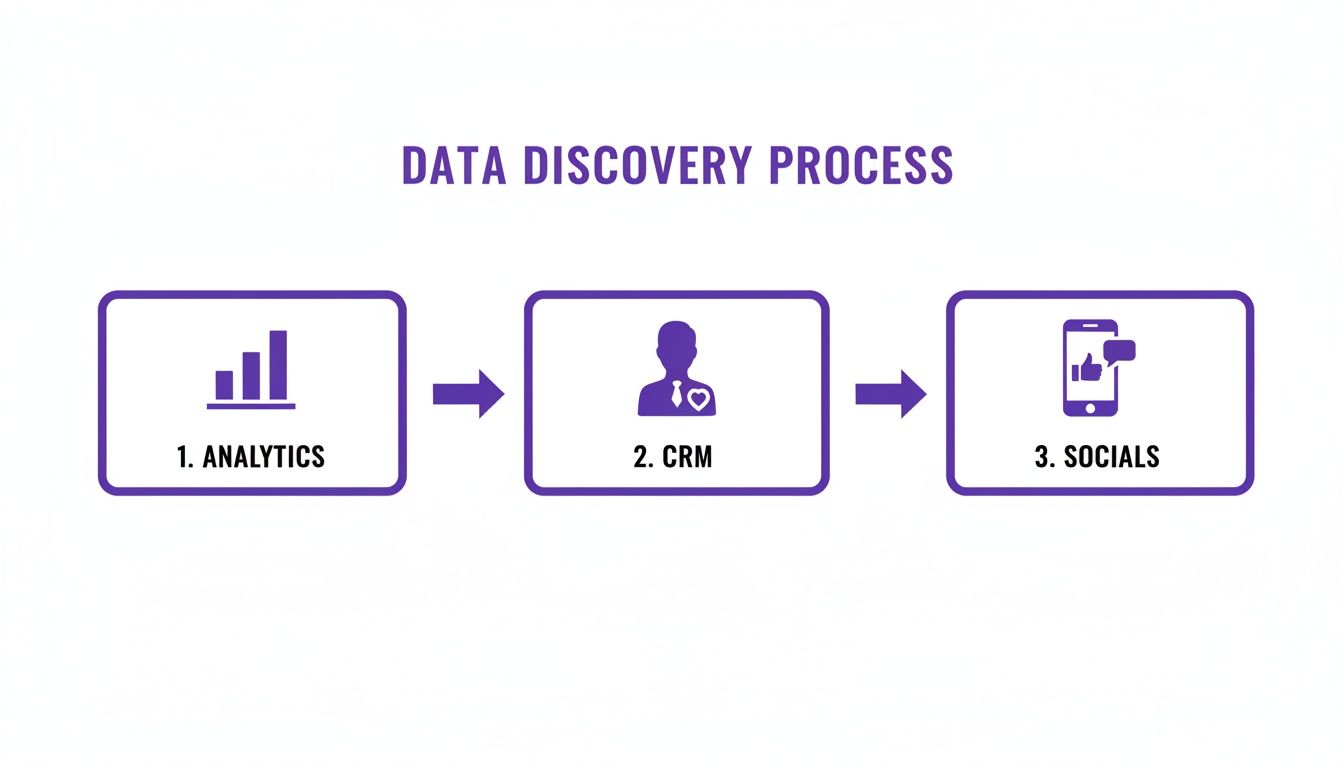
A well-rounded persona pulls from all these places, making sure it reflects both what people do and why they do it.
Building Your Persona Template
Now, let's give this data a home. While every business is different, a solid persona template usually has a few key components. The goal is to create a one-page document that's easy to scan and immediately useful for your marketing, sales, and product teams.
Think of it as a character sheet for your ideal customer. Here’s a breakdown of what to include:
- Name and Photo: Give your persona a memorable, alliterative name like 'Sara the Savvy Dropshipper' or 'Content Creator Chris.' Find a stock photo that represents their demographic. This simple step makes the persona feel like a real person, not just an abstract concept.
- Demographics: This is the foundational stuff. Include their age, job title, income level, location, and education. For a brand like EcomEfficiency, you'd also want to note their business size or monthly revenue.
- A Day in Their Life Narrative: This is where you really bring them to life. Write a short, first-person story describing their typical workday. What’s the first thing they do? What tools are open on their desktop? What are their daily frustrations? This narrative builds empathy and makes the persona stick in your team's memory.
Pro Tip: Weave direct quotes from your customer interviews into the narrative. Including real words that customers used—like "I'm just tired of juggling ten different expensive subscriptions"—makes the persona far more authentic and powerful.
Defining Goals and Uncovering Pain Points
With the basic profile down, it's time to get into the psychographics—the "why" behind their behavior. Honestly, this is the most important part of the process, as it directly informs your messaging and product positioning.
Focus on these two critical areas:
- Primary and Secondary Goals: What is this person ultimately trying to achieve in their business or life? For 'Sara the Savvy Dropshipper,' a primary goal might be "achieve a 30% profit margin on my products." A secondary goal could be "free up five hours a week by automating repetitive tasks."
- Challenges and Pain Points: What's standing in their way? This is where your product comes in. Sara’s challenges might include "sky-high software costs eating into profits" or "wasting time logging into multiple platforms to find winning products."
These goals and challenges should map directly to the solutions you offer. For EcomEfficiency, Sara's pain point about expensive subscriptions is a perfect setup to introduce the value of an all-in-one tool bundle.
Finally, you’ll want to round out the profile with a few more details to make it truly actionable.
- Where They Hang Out: Which social media platforms do they use professionally? Think TikTok for ad inspiration or Twitter for industry news.
- What Influences Them: Do they trust industry blogs, YouTube creators, or peer recommendations in private communities?
- Your Solution: End with a concise "elevator pitch" that frames your product as the perfect solution to their specific challenges.
By following this structure, you transform a scattered collection of research into a focused, actionable tool. This finished persona becomes the north star for your entire team, ensuring that from ad copy to feature development, everyone is building for—and speaking to—the same customer.
Putting Your Personas to Work in Your Funnel
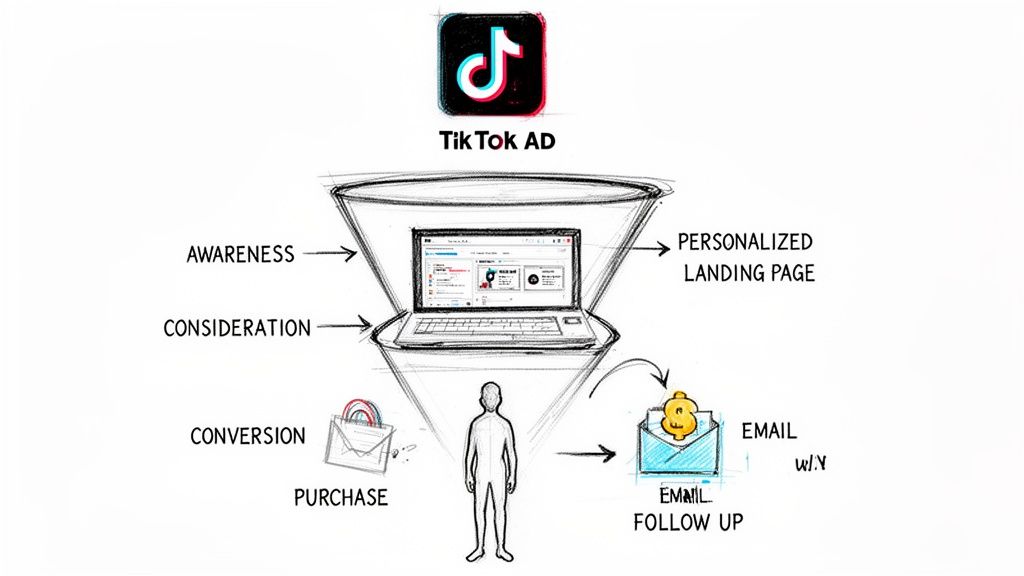
So you’ve put in the work and created a handful of detailed buyer personas. Great. But that's only half the job. A persona profile is useless if it just sits in a shared folder, collecting digital dust. The real magic happens when you start applying those insights to every single touchpoint in your marketing funnel.
This is where all that research pays off—literally. When your personas guide your strategy, you stop shouting into the void with generic messaging. Instead, you start having sharp, personalized conversations that actually resonate with specific people and get them to act.
Crafting High-Converting Ad Copy
Let’s start at the very top of the funnel: your ads. This is your first shot at grabbing someone's attention, and your persona is the cheat code to making that impression count. You no longer have to guess what might work; you can write copy that speaks directly to what keeps them up at night.
Picture your target, 'Sara the Savvy Dropshipper.' You know her biggest headache is the $3,900+ per month she’s burning on different software subscriptions.
A generic ad might say something bland like: "Powerful E-commerce Tools for Your Business."
But a persona-driven ad hits different: "Stop Juggling Subscriptions. Get 50+ Tools like Semrush & Midjourney for $19.99."
See the difference? That second version calls out her specific pain point (cost and complexity) and immediately offers a clear, compelling solution. It’s not just an ad; it’s an answer to a problem she’s actively trying to solve. This direct approach is killer on platforms like TikTok and Instagram, where authenticity cuts right through the noise.
Tailoring Landing Page Experiences
Once someone clicks your ad, the personalization can't just end there. Your landing page needs to continue the conversation you started, doubling down on the value proposition that caught their eye in the first place. A one-size-fits-all landing page is a massive, and all-too-common, missed opportunity.
For a persona like 'Content Creator Chris,' who’s always on a deadline to produce high-quality creatives, the landing page should instantly showcase tools like Midjourney, Canva, and Capcut. The headline could be, "Create Stunning Ad Creatives in Minutes, Not Hours."
But for 'Sara the Savvy Dropshipper,' that same page needs to pivot. Her focus is on the bottom line, so you’d want to emphasize product research and competitor analysis tools like Helium10, Pipiads, and ShopHunter. A headline like "Find Your Next Winning Product and Outsmart Competitors" would scream value and efficiency to her.
This kind of targeted approach makes visitors feel like you get them. The content immediately confirms they’re in the right place, which is huge for reducing bounce rates and pushing them toward signing up.
Driving Engagement with Segmented Email Marketing
Email is where personas truly shine. It's your chance to nurture leads with highly relevant content instead of just blasting everyone with the same generic newsletter. By segmenting your email list based on your personas, you can deliver real value that keeps your brand top of mind.
Here’s a quick look at how this works in practice:
- Custom Welcome Series: Ditch the single welcome sequence. Create a unique one for each persona. 'Sara' could get a series focused on finding winning products, while 'Chris' gets a drip campaign with tips for creating viral TikTok videos using your tools.
- Relevant Content: Tailor your newsletters. Send 'Sara' a case study on how another dropshipper doubled their profit margins. For 'Chris,' send a tutorial on using AI to generate ad scripts.
- Targeted Promotions: When you add a new tool, you don't have to announce it to everyone. If you integrate a powerful SEO tool, send a dedicated email to your performance marketer persona. They're the ones who will see the most value in it.
This isn't just theory. The data backs it up. 93% of companies that blow past their lead and revenue goals segment their database by buyer personas. It’s not just a trend; it's a proven strategy that can lead to 73% higher conversion rates.
Enhancing Customer Support and Satisfaction
Your personas aren't just for the marketing team. Your customer support crew can use them to deliver a more empathetic and effective experience. When a support agent understands a customer's background and likely goals, they can provide much better, more contextual solutions.
For example, if a ticket comes in from someone who fits 'Sara's' profile, the support agent knows she’s probably focused on profitability and efficiency. They can frame their response around saving her time and money, not just solving a technical glitch.
By integrating your personas into your support workflows, you can proactively improve customer satisfaction by speaking their language and anticipating their needs. This is how you build real, long-term loyalty.
Ultimately, putting your personas to work is about creating a seamless, personalized experience across the entire customer journey. From the first ad they see to the support they get months later, every interaction should reinforce that you understand their world and have the perfect solution for their challenges. That's how you turn casual browsers into your biggest fans.
How to Keep Your Buyer Personas Relevant
Getting your first set of buyer personas built is a huge win, but let's be clear: it’s the starting line, not the finish. Your market is always in motion. Customer habits change, new trends pop up, and what was a dead-on persona six months ago could be way off base today.
The sharpest e-commerce brands I know treat their personas like living, breathing documents—not dusty artifacts saved in a forgotten Google Drive folder. They need regular check-ups to stay effective and actually guide your strategy. This habit of constant refinement is what really separates the good marketing teams from the great ones.
The Create, Apply, Measure, Refine Loop
To stop your personas from going stale, you need a system. I'm a big fan of a simple feedback loop that turns customer understanding into a sustainable process, making sure your marketing is always tuned into what’s happening right now.
The model is incredibly straightforward but powerful:
- Create: You start here, building your initial personas from all that great research we talked about.
- Apply: Now, put them to work. This is where you use them to shape ad copy, design landing pages, and segment your email flows.
- Measure: Watch what happens. Track the results. Do the segments you targeted behave the way you predicted?
- Refine: Finally, take what you've learned from the performance data and fresh customer feedback to sharpen your personas.
Following this cycle keeps you honest. It forces you to constantly check your assumptions against real-world results and moves you away from a "set it and forget it" mentality. In e-commerce, continuous improvement is the only way to stay ahead.
Practical Steps for Validation and Refinement
So, what does measuring and refining actually look like day-to-day? It boils down to a few key activities that should become a regular part of how you operate.
A/B testing your messaging is a great place to start. Pit a generic ad against one written specifically for a persona—let's call her 'Sara the Savvy Dropshipper.' If the persona-driven ad crushes the generic one in click-throughs and conversions, that's a powerful signal your insights are on the money.
Next, get comfortable in your analytics. If you built a persona who's supposed to be all about saving money, their on-site behavior should back that up. Are they jumping straight to the "sort by price" filter? Do they gravitate toward your product bundles? If their actions don't line up with their supposed motivations, it’s a sign you need to dig deeper.
Key Takeaway: Your personas are only as valuable as their accuracy. If your 'budget-conscious' persona is consistently buying your most expensive premium add-ons, your initial assumptions might be flawed, signaling a need for an update.
And finally, never stop talking to your customers. I recommend setting up quick, informal interviews every quarter with a handful of new and repeat buyers. Ask them about new challenges they're facing or what new tools they’re using. To make sure your personas stay sharp and your marketing hits the mark, it’s also crucial to track customer satisfaction metrics. These ongoing chats provide the fresh qualitative insights you need to keep your profiles relevant and genuinely human.
Clearing Up Common Questions About E-Commerce Personas
Even with the best game plan, building buyer personas can feel a bit fuzzy around the edges. It's totally normal to have questions. Let's walk through some of the most common ones I hear from e-commerce operators so you can move forward with confidence.
How Many Buyer Personas Do I Actually Need?
It's tempting to want a persona for every single type of customer, but that's a classic rookie mistake. You'll just end up spreading yourself too thin.
For most e-commerce brands, the magic number is somewhere between three and five core personas. This gives you enough detail to create meaningful segments without overwhelming your marketing team. Go past five, and your focus gets diluted. Stick with less than three, and you risk being too generic.
The key is to start with your most important customer groups. Imagine you're selling high-end camera equipment. You might build personas for:
- The professional wedding photographer who needs gear that's an absolute workhorse.
- The up-and-coming travel vlogger who cares most about portability and versatility.
- The weekend hobbyist who obsesses over review blogs and is always hunting for a good deal.
See? Each one is distinct, with different needs and buying triggers. That's the goal.
What’s the Real Difference Between a Buyer Persona and a Target Audience?
This one trips people up all the time, but the distinction is critical. A target audience is the wide-angle shot—it's broad and defined by demographics. Think: "Women, aged 25-40, who live in cities and care about sustainable fashion."
A buyer persona is the close-up. It's a fleshed-out character from within that audience. You give them a name, a backstory, and, most importantly, you figure out what makes them tick.
Target Audience: The "who" (e.g., DTC brand owners).
Buyer Persona: The "why" (e.g., 'Alex, the 32-year-old founder who's burned out on expensive software and needs a better way to scale ad creative').
A target audience gives you a direction. A persona gives you a real person to talk to, which is how you build empathy and write copy that truly connects.
How Often Should I Update My Personas?
Your personas shouldn't be carved in stone. Think of them more like living, breathing documents that evolve right along with your customers and the market itself.
A solid practice is to schedule a formal review and refresh every 6 to 12 months.
But don't just wait for the calendar. A major event is the perfect trigger for a persona check-in. Did you launch a new product line that's attracting a totally different crowd? Did a new sales channel like TikTok Shop suddenly take off? Those are signs that your customer landscape is changing, and your personas need to reflect that new reality.
Keep feeding them new insights from your analytics, customer service chats, and sales team. A persona is only as good as the data behind it, so keep it fresh.
Ready to stop guessing and start building data-driven personas that actually drive sales? EcomEfficiency gives you access to over 50+ premium tools like Semrush, Helium10, and Midjourney in one simple subscription. Get all the data you need to truly understand your audience and hit your goals, all while cutting your software costs by 99%. Join over 1,000 members scaling their brands today.