How to Find Suppliers for Dropshipping A Founder's Playbook
So, you're ready to find a dropshipping supplier. You could just jump on marketplaces like AliExpress or Alibaba, or maybe sift through directories like Collective and Syncee. Another route is to go straight to a manufacturer and ask for their list of wholesale partners.
But hold on. Before you type a single search query, you need a plan. The real secret is creating a blueprint of your ideal partner first. This is all about focusing on the things that actually matter: reliability, product quality, and solid communication.
Building Your Supplier Sourcing Foundation
Let's be honest, finding the right partner isn't about luck—it's about preparation. Diving in without a clear set of criteria is a surefire way to end up with an unreliable supplier who tanks your brand reputation with shoddy products, painfully slow shipping, and ghost-like customer service.
Think of this first phase as drawing up the blueprint for your perfect supplier. You’re not just looking for someone who has the products you want to sell. You’re defining the operational backbone that will either set you up for success or cause endless headaches down the road.
Define Your Ideal Supplier Profile
First things first, build a checklist of your non-negotiables. This list will be your filter, helping you instantly weed out partners who aren't a good fit.
- Product Quality Standards: Are you positioning your brand as premium, where craftsmanship is everything? Or are you a budget-friendly option competing on price? The quality has to match the brand promise.
- Shipping and Fulfillment Expectations: Where do your customers live? If you're selling to a U.S. audience, a supplier with warehouses in North America is a massive advantage over one shipping everything from Asia. Decide on your maximum acceptable delivery time.
- Communication Style: How quickly do you need answers? A 12-hour time difference is totally manageable with a responsive partner, but it's a complete nightmare if they take days to get back to you.
- Technology Integration: Can they sync inventory in real-time? Is order processing automated? Manually entering orders is a recipe for disaster and overselling as your business grows.
Your supplier is the most important partnership in your dropshipping business. They're your inventory manager, your fulfillment center, and a direct reflection of your brand. Choose them with the same care you’d use to choose a co-founder.
The global dropshipping market is exploding, projected to blow past $1.2 trillion by 2030. That growth means you have more supplier options than ever, but it also means the competition is fierce. A detailed supplier profile helps you slice through the noise and find partners who can actually help you scale. You can dig into the numbers in the global dropshipping market outlook on grandviewresearch.com.
The Main Types of Suppliers to Consider
With your criteria in hand, you’ll start noticing a few different types of suppliers out there. Each one comes with its own quirks, benefits, and drawbacks, and the right choice really depends on your business model.
This is where a simple, three-step framework comes in handy for building a solid supplier foundation.
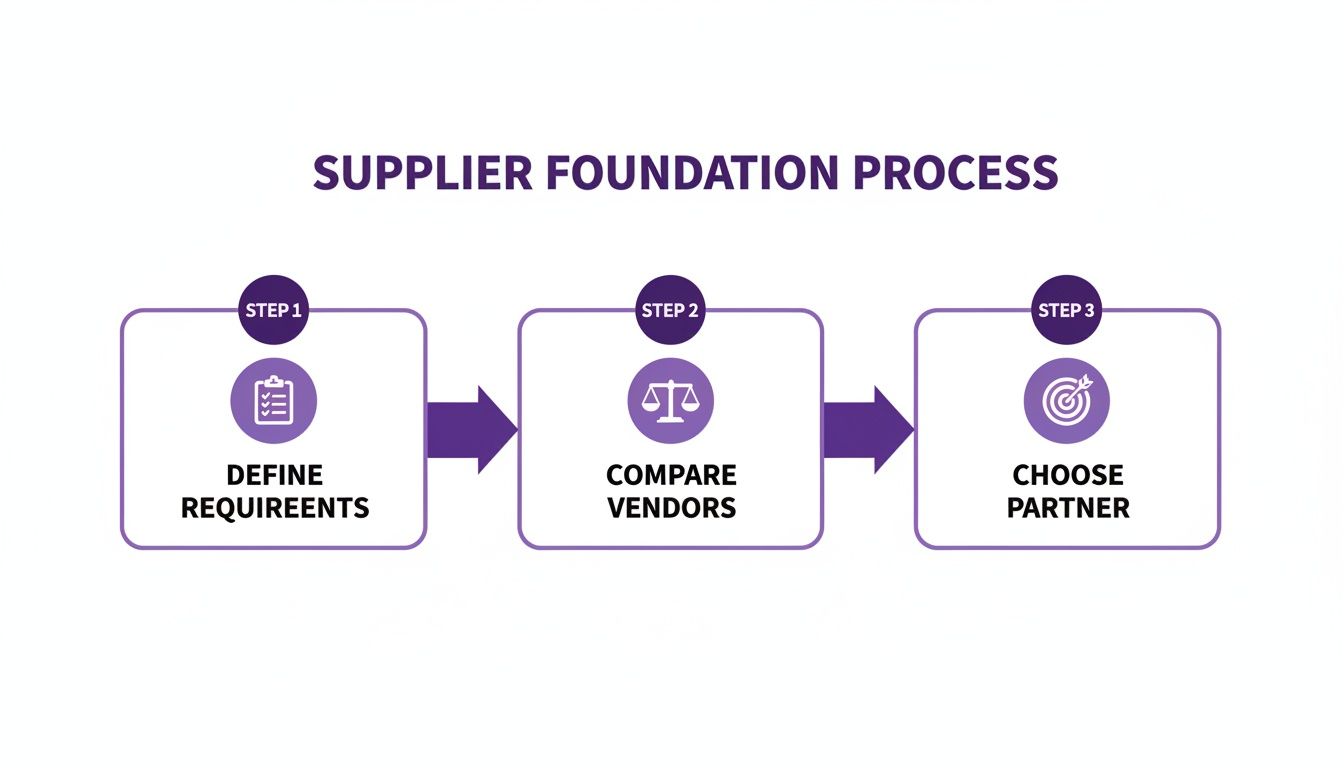
This workflow keeps you focused: start by defining exactly what you need, systematically compare your options, and only then commit to a partner.
To help you figure out which direction to go, here’s a quick comparison of the main supplier models you'll encounter.
Comparing Dropshipping Supplier Types
| Supplier Type | Best For | Pros | Cons |
|---|---|---|---|
| B2B Marketplaces | Newcomers and businesses testing a wide variety of products. | Massive product selection, no minimum order quantity (MOQ), easy to get started. | Quality can be inconsistent, long shipping times from overseas, intense competition. |
| Wholesalers | Businesses with proven product-market fit looking to scale. | Better pricing, faster shipping from domestic warehouses, more reliable inventory. | Often require a business license, may have MOQs, smaller product selection than marketplaces. |
| Manufacturers | Established brands wanting to create unique products or secure the best margins. | Lowest cost-per-unit, potential for custom branding and white-labeling. | High MOQs, longer lead times, requires more capital upfront. |
| Dropshipping Agents | Sellers who need a "boots on the ground" partner for sourcing, quality control, and faster fulfillment. | Quality checks, consolidated shipping, can negotiate with multiple factories. | Adds another layer of cost, requires finding a trustworthy agent. |
Ultimately, there's no single "best" type of supplier—it all comes down to your business goals, your budget, and how much control you want over your supply chain.
Where to Actually Discover Your Next Supplier
Alright, you know what you're looking for in a supplier. Now, where do you actually find them? A quick Google search for "dropshipping supplier" will send you down a rabbit hole of sketchy directories and outdated lists. Real partners aren't found that way.
To find the good ones, you have to dig deeper, using a mix of platforms, clever search tactics, and even a bit of digital spy work. The goal isn't just to find a supplier; it's to build a solid list of potential partners to vet and compare.
Master the Supplier Directories and Marketplaces
Supplier directories are the obvious first stop, and for good reason—they’re basically giant online malls for e-commerce products. Everyone knows the big players like AliExpress, DSers, and CJDropshipping, which are fantastic for connecting with thousands of overseas manufacturers.
But don't just stop there. Niche-specific or regional directories are often where you'll strike gold.
- For U.S. and Canadian Suppliers: Check out apps like DropCommerce and Syncee. They specialize in North American suppliers, which means you get much faster shipping times and often higher-quality products.
- For Fashion and Apparel: Trendsi is a powerhouse for clothing, and they have U.S. warehouses to get orders to your customers quickly.
- For Lifetime Access: A service like Worldwide Brands is a one-time investment, but it gives you access to a massive, heavily vetted directory of certified wholesalers. It's a game-changer for serious, long-term sourcing.
While we're talking dropshipping, the core principles of finding and vetting suppliers are pretty universal. These same strategies are just as effective if you're looking for the best suppliers for Amazon FBA.
Go Beyond Directories with Advanced Search Tactics
Here's a secret: the best suppliers rarely have the best websites. They're busy being great manufacturers and wholesalers, not SEO experts. Their online presence can be minimal, so you have to think like a purchasing manager to find them.
This is where advanced Google searches come in. Instead of just typing "[product] dropshipper," get more specific with industry terms.
Pro Tip: Combine your product keyword with phrases like "wholesale," "distributor," "catalog," "price list," or "warehouse." This tells Google you're a business looking for a partner, not just another shopper.
Try a few of these search strings to see what I mean:
"pet supplies" + "wholesaler" + "price list""kitchen gadgets" + "distributor" USAinurl:wholesale "eco-friendly packaging"
This method cuts through all the retail noise and takes you straight to the source. Don't be turned off by a clunky, old-school website. That's often a sign you've found a legitimate B2B operation that isn't wasting time on fancy marketing.
Reverse-Engineer Your Competitors
Why start from scratch? Your competitors have already done the heavy lifting of finding and vetting suppliers for products they know are selling. A little smart investigation can reveal exactly who they're using.
This is a simple but incredibly effective method.
- Find a Competitor: Identify a successful dropshipping store in your niche.
- Place a Small Order: Buy one of their cheaper products. Think of it as a small investment in high-value intel.
- Check the Return Address: When your package arrives, look at the return address on the shipping label. It’s almost guaranteed to be the supplier's warehouse, not your competitor's office.
- Google That Address: Pop the shipper's name and address into Google. More often than not, it will lead you directly to the supplier's website.
This tactic hands you a pre-vetted partner who is already reliably fulfilling orders for a store just like yours. It confirms they understand the dropshipping model and can handle the logistics, which takes a massive amount of risk off your plate.
The Vetting Process That Separates Amateurs From Pros
So, you've got a list of potential suppliers. The rookie move is to get excited, pick one that looks good enough, and dive right in. This is a classic mistake and a fast track to failure. Finding suppliers is the easy part; the real work is making sure you’ve found a reliable partner who won’t torch your brand's reputation.
A rock-solid vetting process is what separates the pros from the people constantly dealing with angry customers and lost packages. Think of it as your firewall against the chaos of bad partnerships.
Your Initial Vetting Checklist
Before you even dream of ordering a sample, every single supplier on your list needs to pass this first-round screening. The goal here is to quickly weed out the obvious duds without sinking too much of your time into them.
- Business History and Online Footprint: How long have they actually been around? A company with 10+ years of experience is usually a much safer bet than a business that popped up last month. Do some digging on business registries and check their social media. A legit operation will have a professional, even if basic, digital presence.
- Communication Responsiveness: Shoot them a simple email with a couple of questions. Now, start a timer. How long does it take to get a reply? Is the answer helpful and professional, or does it feel like a lazy copy-paste job? If they take three days to answer a simple pre-sales question, just imagine trying to reach them when a customer's order is missing.
- Policies and Hidden Fees: Dig through their website for any gotchas. Some suppliers sneak in monthly fees, account setup costs, or even per-order handling charges. These aren’t always deal-breakers, but you have to bake them into your margins. Also, find their return policy. Make sure it's crystal clear and fair for both you and your future customers.
A supplier’s communication style is a direct preview of your future customer service experience. Slow, vague, or unprofessional responses are a massive red flag. Don't ignore it.
Digging Deeper Into Their Technology
In this business, a supplier's tech is just as critical as their product quality. Outdated systems create endless manual work, introduce costly errors, and make it completely impossible to scale.
The single most important question you need an answer to is: Do they offer automated integrations?
Manually processing orders is a dead end for any serious dropshipping store. You absolutely need a partner whose systems can communicate with yours. Specifically, you're looking for two non-negotiables:
- Real-Time Inventory Syncing: If they don't have this, walk away. Period. Without it, you will sell products that are out of stock, forcing you to cancel orders and deal with unhappy customers. The supplier must have a way—like an API or a dedicated app—to automatically update inventory levels on your storefront.
- Automated Order Forwarding: When a customer buys from you, that order information needs to be transmitted to the supplier instantly and automatically. If their process involves you manually emailing them a spreadsheet of orders, it’s a non-starter. That might work for one or two orders a day, but it will cripple your business as you grow.
If a supplier’s website looks like it was built in 1999 and their "ordering system" is an Excel template, run. They are not built for the realities of modern ecommerce.
The Litmus Test: Ordering Samples
You can read all the reviews in the world, but you'll never really know what a supplier is like until you become their customer. Ordering samples is the most revealing step in this entire process. You're not just checking the product; you're testing their entire operational workflow from start to finish.
When you place that sample order, put on your detective hat and scrutinize everything:
- The Ordering Process: Was it a smooth checkout, or a clunky, confusing mess?
- Processing Time: How long did it take from the moment you paid until you got a shipping notification? This "time to fulfill" is a crucial metric for your own business.
- Packaging Quality: Did the item arrive in a clean, unbranded box, or was it plastered with the supplier’s logos? For dropshipping, you need discreet packaging. Was the product properly protected, or just tossed in a cheap mailer bag?
- Shipping Speed: How did the actual transit time stack up against what they promised on their site? This is exactly what your customers will experience.
- Product Quality: Finally, the main event. Does the physical product match the photos and description? Does the quality feel right for the price point and align with your brand's standards?
Treat this like an undercover investigation. You are stress-testing their entire system to find the breaking points before you risk your customers' money and your hard-earned reputation. A small investment in samples now can save you from a catastrophic business decision down the line.
How to Make Contact and Build Real Partnerships

Alright, you've done the legwork. Your shortlist of potential suppliers is solid. Now comes the moment that can make or break everything: the first outreach.
How you approach a supplier for the first time tells them everything they need to know about you. It instantly separates the serious entrepreneurs from the tidal wave of amateur dropshippers flooding their inboxes every single day. A lazy, generic email is a surefire way to get ignored. You have to prove you’re a professional ready to build a real partnership, not just another transactional headache.
Crafting a Professional First Email
Your first email needs to be sharp, professional, and straight to the point. Suppliers are busy people. They don’t have time to read a novel about your business idea. Your only goal here is to establish credibility and get a conversation started.
Think of it like a mini business proposal. You need to introduce your brand, show them you've done your homework on their company, and clearly state what you’re looking for. A simple "hi, can I dropship your stuff?" is an instant delete.
Here’s a simple framework that I’ve seen work time and time again:
- A Clear Subject Line: Keep it direct. "Partnership Inquiry from [Your Brand Name]" is perfect.
- A Brief Intro: In a sentence or two, say who you are and what your store is about. This shows them you have a real brand, not just a vague idea.
- The "Why Them" Hook: This is crucial. Mention something specific you admire about their products or how you found them. It proves you're not just blasting out a template to a hundred different companies.
- The Ask: State clearly that you're interested in a dropshipping partnership and ask about their process for new retailers.
This approach immediately reframes the conversation. You're no longer just another inquiry; you're a potential strategic partner who values what they do.
Non-Negotiable Questions to Ask Every Supplier
Once you’ve got a reply, it’s time to dig in. The answers to the following questions will reveal a supplier's true operational fitness. Don’t be timid—asking these questions now protects your business and your sanity later. Your goal is to get a crystal-clear picture of their entire workflow, from pricing to handling problems.
A great supplier will have confident, straightforward answers. Vague responses are a huge red flag.
Here are the absolute essentials:
- Pricing and Fees: "Do you have a specific price list or catalog for your dropship partners? Are there any per-order fees or monthly account costs I should know about?"
- Order Placement: "How do you prefer to receive and process dropship orders? Is it through an online portal, email, or something more automated?"
- Inventory Management: "How do you share inventory updates? Is there a real-time data feed or API we can connect to, or is it a manual file?"
- Shipping Policies: "What's your typical turnaround time from order placement to shipment? Which couriers do you use, and do you provide tracking numbers automatically?"
- Return Policy: "Can you walk me through your process for handling customer returns or items damaged in transit? Who covers the return shipping costs?"
If a supplier gets cagey or has a complicated return policy, run. A messy returns process will quickly become your customer service nightmare, and it’s a burden you don’t want to carry.
Smart Negotiation Without Burning Bridges
Negotiating terms with a new supplier isn't just about squeezing them for the lowest price. In fact, that's a bad way to start. Remember, as a new partner with zero sales history, you have absolutely no leverage. Pushing too hard, too soon will just sour the relationship.
Instead, frame your negotiations around future growth and shared success. A fantastic way to do this is to ask about tiered pricing.
Try something like this: "I'm really focused on scaling my sales volume quickly. Do you offer improved pricing tiers once we hit certain monthly milestones, like 50 or 100 orders?"
This simple question does two things. It shows them you're serious about growth, and it gives them a reason to invest in your success. You're not just asking for a handout; you're mapping out a path where everyone wins. As your business grows, you become a more valuable partner, naturally unlocking better terms and building a relationship that's profitable for both of you.
Choosing Between Domestic and Overseas Suppliers
Deciding where your supplier is based is one of the biggest calls you'll make. It directly affects everything from your profit margins to your customers' happiness. It really boils down to a classic trade-off between cost and speed, and getting this right will help you build a much smarter, more resilient dropshipping business.
For a long time, the conversation was dominated by overseas suppliers, especially from Asia. The cost advantages are just impossible to ignore. When you source directly from major manufacturing hubs, your product costs are significantly lower, which can mean healthier profits for you or more competitive prices for your customers.
The Overseas Advantage: Cost and Variety
Sourcing from overseas opens up an enormous catalog of products at prices that domestic suppliers rarely can match. This is the main reason most dropshippers go this route. But, as many have learned the hard way, these savings come with some pretty significant challenges.
- Longer Shipping Times: Even when you pay for premium shipping, getting a product from a warehouse in Asia to a customer in North America can easily take weeks. In an age of two-day delivery, that kind of delay is a major turn-off for most shoppers.
- Quality Control Hurdles: Being thousands of miles away makes it tough to keep a consistent eye on product quality. Something can look perfect in a supplier's photo but turn out to be a huge disappointment when it arrives at your customer's door.
- Communication Barriers: Simple conversations can become frustratingly complex due to different time zones and language barriers. An urgent problem can easily drag on for days.
Despite these issues, the numbers show where the market's center of gravity still lies. The Asia-Pacific region commands a massive 35-40% of global dropshipping revenue. China alone is projected to hit $136.7 billion in revenue by 2027.
But a big shift is happening. North American suppliers now account for roughly 33-35.8% of the market share and are growing fast by solving the very problems that plague overseas sourcing. Discover more insights about these dropshipping statistics on Printful.com.
The Domestic Edge: Speed and Trust
Working with a domestic supplier—one located in the same country you're selling to—flips the entire script. Your cost-per-product will almost certainly be higher, but what you gain in other areas can be far more valuable.
The most immediate win is dramatically faster shipping. A U.S.-based supplier can get an order to a U.S. customer in a few days, not a few weeks. That speed is exactly what modern customers expect, and it can give you a huge competitive edge, leading directly to more sales and better reviews.
On top of that, communication is straightforward, returns are much simpler to process, and you can generally feel more confident about the product quality and business practices. If you do work with overseas suppliers but sell into Canada, it's worth understanding options like the Non-Resident Importer (NRI) program to help with logistics and compliance.
A hybrid approach often works best. You can use overseas suppliers for trendy, low-cost items where customers might be more forgiving about a longer wait. For your core products or more premium offerings, the speed and reliability of a domestic supplier are worth every extra penny.
In the end, this choice isn't just about finding the cheapest source. It’s about building a supply chain that actually aligns with the brand you want to create and the promises you make to your customers.
Getting Your New Supplier Plugged In and Ready to Scale
You've done the hard work of finding and vetting a great supplier. That's a huge win, but now it's time to actually connect them to your store and make the magic happen. This is where the technical and logistical pieces snap together, creating that smooth, hands-off experience you're after.
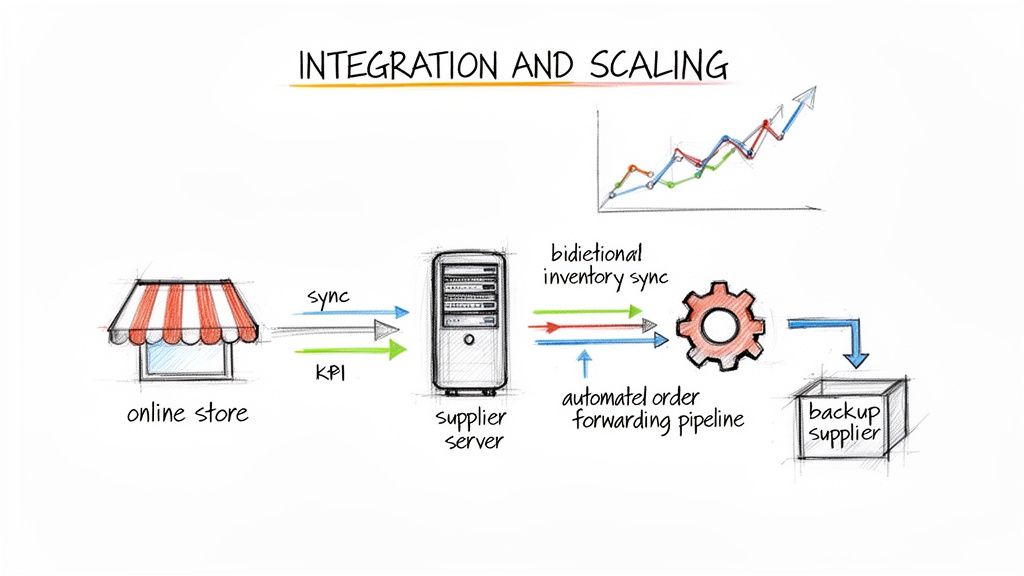
The first, most critical task is getting your product and inventory data synced up. Trying to manually update stock levels is a fast track to chaos and angry customers. You absolutely need an automated system, usually through an API connection or a dedicated app, that keeps your inventory levels updated in real time. Without it, you'll inevitably sell products you don't have, leading to canceled orders and a major hit to your store's reputation.
At the same time, you need to automate how orders get from your store to your supplier. When a customer clicks "buy," that order information should fire off to your supplier instantly. This completely removes manual data entry, cuts down on costly errors, and gets the fulfillment process started without any delay.
The Soft Launch and Keeping a Close Watch
Before you open the floodgates, I always recommend a "soft launch." Start by sending a small number of real orders their way—maybe for just your top 5-10 products. Think of it as a dress rehearsal. This gives you a chance to spot and fix any little hiccups in the process, from order transmission to those "your order has shipped" notifications, before you're dealing with serious volume.
Once you're fully live, you have to track performance like a hawk. Decide on your most important metrics—your Key Performance Indicators (KPIs)—and watch them obsessively.
- Order Accuracy Rate: Are the correct items being shipped every single time? What's your error percentage?
- Fulfillment Speed: How fast are they getting an order packed and out the door after you send it?
- Shipping Time: Once it leaves their warehouse, how long does it actually take to reach your customer?
Look, even the best suppliers hit bumps in the road. By constantly watching these numbers, you can spot trouble before it snowballs. If fulfillment speed suddenly drops or you see a spike in wrong orders, that's your cue to get on the phone with your supplier and figure out what's going on.
It’s a tough world out there. Something like 90% of dropshippers don't make it past their first year, and a huge part of that comes down to supplier reliability. With massive niches like fashion expected to hit $802.33 billion by 2027, you need a partner who can keep up. A rock-solid technical integration is what lets you actually take advantage of those trends. You can dig deeper into dropshipping market trends over at SellersCommerce.
One last piece of hard-won advice: always have a Plan B. Never, ever put all your eggs in one basket. Keep a second, fully-vetted supplier on standby for your best-selling products. It might seem like extra work upfront, but this nimbleness means your business doesn't grind to a halt if your main partner suddenly has stock issues or a warehouse disaster.
Frequently Asked Questions About Finding Suppliers
Even with a solid playbook, you're bound to hit some roadblocks when you're actually in the trenches finding and vetting suppliers. Let's tackle some of the most common questions that pop up for new dropshippers.
Can I Really Start Dropshipping With Zero Money?
Look, it's technically possible, but it’s a tough road. The biggest plus of dropshipping is that you don't have to buy inventory upfront. That’s a massive cost off your plate.
But you still have some unavoidable expenses: your e-commerce platform fees, a domain name, and—most importantly—a marketing budget. Plus, there's a cash flow gap to consider. You'll need to pay your supplier for an order before the customer's payment actually hits your bank account.
So while the startup costs are low, thinking you can do it with absolutely no cash is setting yourself up for failure. A small budget is a much more realistic starting point.
Do I Need a Business License To Get Started?
This really comes down to where you live and operate. Your city, state, or country's regulations will dictate the specifics.
That said, most legitimate wholesalers and manufacturers, especially those in the US, won't even talk to you without a business license and an EIN (Employer Identification Number). They need it to open a wholesale account for you.
My advice? Just set up a formal business entity like an LLC from the get-go. It gives you personal liability protection and shows potential suppliers that you're a serious professional, not just a casual seller.
Don't view a business license as a hurdle. See it as a key that unlocks access to better, more professional suppliers who won't work with just anyone. It’s a competitive advantage.
How Many Suppliers Should I Juggle?
If you're just starting out, keep it simple. Work with one primary supplier for your main products. This lets you really learn their system, build a solid relationship, and avoid getting overwhelmed by managing multiple contacts, portals, and shipping schedules.
However, you should absolutely have at least one vetted backup supplier for your best-selling products. You never want a single supplier's stockout to completely halt your sales. Once you're more established and have a feel for the business, you can start to strategically bring on more partners to expand your catalog or improve shipping times.
Stop wasting thousands on individual software subscriptions. With EcomEfficiency, you get consolidated access to 50+ premium e-commerce tools for product research, SEO, and ads—all for one low monthly price. Unlock everything you need to find winning products and scale your store today. Find out more at https://ecomefficiency.com.