How to find winning products for dropshipping: A Quick Guide
Ask any seasoned dropshipper, and they'll tell you the secret to success isn't luck—it's having a solid, repeatable system for finding and validating products. It's all about digging into what customers actually need, catching trends just as they're starting to crest, and picking items that have real profit potential and a bit of that "wow" factor that makes people stop and look.
Your Blueprint for Finding Bestselling Products
Forget the get-rich-quick fantasy of stumbling onto some magical, untapped product. The pros build their businesses on a strategic framework, one designed to consistently unearth and test new opportunities. It's a method that takes you far beyond aimlessly scrolling through supplier sites and into the world of real market demand.
At its heart, this strategy is about being a problem-solver. A genuinely winning product does one of three things: it fixes a nagging problem, it taps into a deep-seated desire, or it offers a new level of convenience that makes life easier. So, instead of asking, "What can I sell?" start asking, "What problem can I solve?"
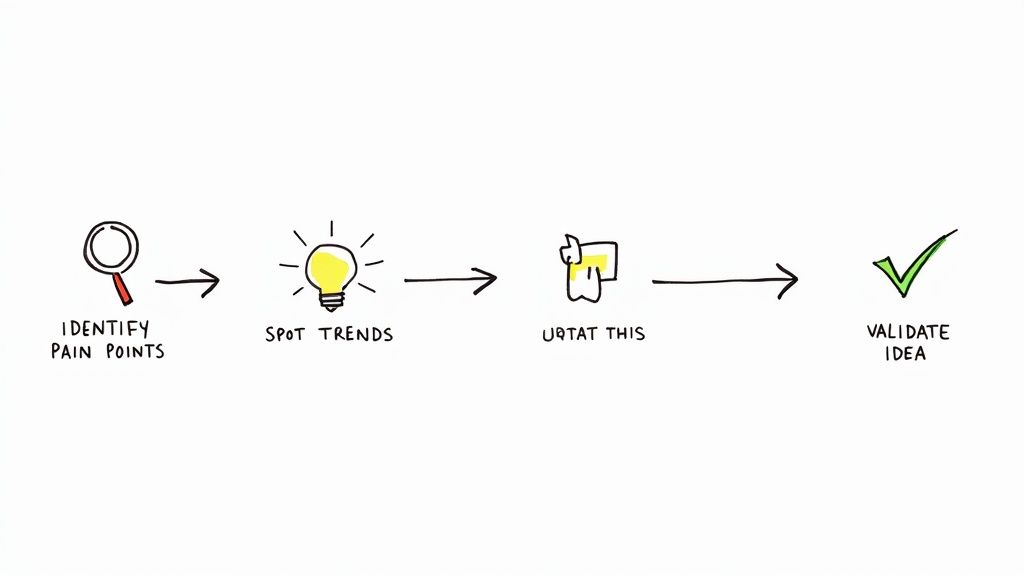
This whole process, from initial idea to a fully validated product, follows a logical flow.
As you can see, you can't just jump ahead. Coming up with creative ideas is the fun part, but it means nothing without the hard work of research and data-backed validation that follows. Skipping a step here is the fastest way to sink your money into a product nobody actually wants.
The Traits of a Winning Product
Let's be clear: not all products are created equal. A true "winner" almost always has a few key traits that make it so much easier to market and, most importantly, sell at a healthy profit. Before you even start your research, you need to know what to look for.
Here’s what I always keep an eye out for:
- High Perceived Value: The item needs to feel more expensive than it is. This is crucial for setting a price that gives you a solid profit margin without scaring customers away.
- The "Wow" Factor: It has to be interesting or unique enough to stop a person mid-scroll on their social media feed. Think about products that look great in a short video—that’s your gold standard.
- Reliable Supplier Access: A brilliant product idea is completely worthless if you can't find a dependable supplier. You need someone who can handle shipping, keep quality consistent, and actually communicate with you.
A winning product isn't just something that sells; it's something that solves a specific problem for a defined audience and can be sourced reliably to maintain customer satisfaction and profitability.
To help you stay on track, I've put together a quick checklist. Use this to run any potential product idea through the wringer before you get too invested.
Winning Product Characteristics Checklist
| Characteristic | Why It Matters | Evaluation Question |
|---|---|---|
| Problem-Solving | Products that solve a pain point have built-in demand. | Does this product fix a common frustration or fulfill a strong need? |
| "Wow" Factor | Uniqueness grabs attention, making social media marketing easier. | Is this product visually interesting, unique, or demonstrable in a video? |
| High Perceived Value | Allows for healthy profit margins without appearing overpriced. | Can I sell this for at least 3x the cost and still have it feel like a deal? |
| Not Easily Available | If customers can't find it locally, they'll buy it online. | Is this product hard to find in local retail stores? |
| Reliable Suppliers | Good suppliers ensure product quality and fast shipping. | Are there multiple, well-reviewed suppliers available for this item? |
| Good Profit Margins | Your business needs profit to survive and grow. | After product cost and marketing, is there enough margin left over? |
| Evergreen Potential | Products with year-round demand provide consistent income. | Can this product be sold effectively outside of a specific season or holiday? |
Running through these questions is a simple but powerful way to filter out the duds from the true contenders early on.
Thriving in a Growing Market
The opportunity in dropshipping is absolutely massive. We're looking at a global market projected to explode from $372.47 billion in 2024 to $476.1 billion by 2026. That explosive growth means more online shoppers than ever before, but it also means more competition.
To cut through the noise, you need a methodical approach that sets you apart. You can read more about these dropshipping statistics and trends to get a fuller picture of the landscape. This guide is designed to give you that exact blueprint for success.
Uncovering Gems with Manual Research
While data tools are powerful, don't underestimate the value of good old-fashioned digital detective work. Honestly, some of my biggest wins have come from this hands-on approach. It helps you build a market intuition that no software can truly replicate.
Think of yourself as a market anthropologist. You're immersing yourself in the digital spaces where your future customers hang out, share ideas, and—most importantly—complain. Your mission is to listen for patterns of frustration and desire.
Tap Into Social Commerce Trends
Platforms like TikTok are basically massive, real-time product discovery engines. That #TikTokMadeMeBuyIt hashtag isn't just a gimmick; it's a live focus group with billions of views, showing you exactly what grabs people's attention.
But your job isn't to just copy what's already viral. That’s a race to the bottom. Instead, you need to dig into the why behind a product's success.
- Analyze the format: What's working? Is it the unboxing videos? The problem-solution clips? Those oddly satisfying "before and after" reveals? The format itself is a clue.
- Read the comments: This is where the real gold is. I can't stress this enough. Look for comments like, "I wish it came in blue," or "It's awesome, but it broke after a week." These are direct product requests and pain points you can solve.
- Look for adjacent needs: Let's say a specific portable blender is trending. Great. But what about the accessories? People might need special cleaning brushes, custom carrying cases, or even recipe e-books. That's your opening.
This same logic applies everywhere. I've found incredible ideas by browsing Pinterest for home decor trends and lurking in niche Facebook Groups where hobbyists openly complain about their gear.
Mine Customer Reviews for Opportunities
Think of Amazon as one of the world's biggest product databases, packed with brutally honest consumer feedback. The trick is to skip the 5-star raves and head straight for the 2 and 3-star reviews of popular products in your niche.
This is where you'll find the classic "it's good, but..." feedback. For example, while researching kitchen gadgets, you might find a best-selling garlic press where dozens of people say, "I love how it works, but it's a nightmare to clean." That single, repeated complaint is your golden ticket. Find a supplier with a garlic press designed for easy cleaning, market it with that exact benefit, and you'll immediately stand out.
The most powerful product ideas often come not from inventing something new, but from improving something that already exists. A competitor's weakness is your roadmap to a winning product.
Validate Interest with Google Trends
Once you've got a few promising ideas, you need a quick reality check. This is where a simple tool like Google Trends becomes your best friend. It shows you the search interest for a topic over time, helping you spot the difference between a fleeting fad and a stable, growing trend.
For instance, here's what a typical Google Trends graph looks like, showing how search volume changes.
This simple chart tells you if a product's demand is seasonal (like pool floats), on the decline, or showing steady growth. That's critical information to have before you invest a dime. By combining this high-level data with your on-the-ground social listening, you move from a gut feeling to a data-informed decision.
Data Tools: Your Secret Weapon for Finding Winners
Manual research is great for developing a feel for the market, but let's be honest—relying on gut feelings alone is a fast track to a failed store. The real pros back up their instincts with hard data. This is where you shift from guessing what might sell to knowing what's already flying off the virtual shelves.
Think of specialized data platforms as giving you an almost unfair advantage. They pull back the curtain on your competition, showing you their sales data, ad performance, and all the metrics that actually matter. Instead of just hoping a product has an audience, you can see its sales velocity in near real-time.
See What’s Actually Selling with Product Research Tools
One of the most powerful moves you can make is to peek inside a competitor's store and see which products are their bestsellers. This isn't guesswork; tools like Dropship.io are designed for exactly this. You just plug in a Shopify store's URL, and it spits out a ranked list of their top products, complete with estimated daily, weekly, and even monthly sales numbers.
This kind of data is an absolute goldmine. It completely removes the need to guess which of the dozens of products in a competitor's catalog are their bread and butter. You instantly see what's connecting with customers, which validates a product's potential before you ever risk a single dollar on ads.
Take a look at what this looks like inside Dropship.io.
This dashboard gives you an immediate snapshot of estimated monthly revenue and sales. It's a clear benchmark for that product's performance in the market. Seeing hard numbers like these confirms there's a real, paying audience for an item, which dramatically de-risks your decision to test it yourself.
This data-first approach is at the heart of modern e-commerce. The most successful dropshippers are glued to real-time analytics, constantly monitoring trends on platforms like TikTok, and using software to stay one step ahead. If you're curious about the numbers behind the industry, these dropshipping industry statistics show just how critical this mindset has become.
Uncover What People Want to Buy with SEO Tools
Product research tools are fantastic for showing you what's hot right now. But SEO tools like Ahrefs or Semrush show you something even more valuable: what people are actively searching for with the intent to buy. It's a subtle difference, but a crucial one. It helps you find untapped demand and learn the exact words your future customers are typing into Google.
Let's say you're thinking about selling a portable, silent mini-dehumidifier. An SEO tool can tell you exactly how people are searching for it.
- "small dehumidifier for closet" — This isn't just a search; it's a specific problem (musty closets) looking for a solution.
- "quiet dehumidifier for bedroom" — This tells you a key feature people care deeply about is low noise.
- "best portable dehumidifier for RV" — Boom. You've just uncovered a passionate niche audience you might not have considered.
By looking at search volume and keyword difficulty, you can pinpoint product ideas that have high demand but haven't been saturated by competitors. This data doesn't just help you pick a product; it helps you write your ads and product descriptions using the exact language your customers use.
When you put these two approaches together, you create a powerful system. You spot a trending product with a sales tracker, then you jump over to an SEO tool to confirm there's genuine, long-term search demand for it. This two-pronged attack ensures you’re not just chasing fads, but building a business around products with both immediate buzz and sustainable, organic interest.
How to Validate Your Product Idea Smartly

Alright, you've done your research, the data looks promising, and you're pretty sure you've landed on a winner. That’s a great start, but an idea is still just an idea until a real person is willing to buy it.
This is the make-or-break stage. So many aspiring dropshippers get excited and go all-in, only to discover their "sure thing" isn't in demand. The goal here isn't to launch your full-scale business; it's to find out, as cheaply and quickly as possible, if people will actually pull out their wallets.
Test Demand with Lean Methods
Before you even think about ordering inventory or building out a complex store, you need a simple way to test the waters. We're going to create a minimal "storefront" designed for one thing and one thing only: measuring purchase intent.
This is all about a lean, data-driven approach. Here are a couple of my favorite ways to do it without breaking the bank:
Launch a "Coming Soon" Page: Use a simple builder like Carrd or even a basic Shopify theme to create a single landing page. Feature your product with great images and persuasive text, then add an email signup form for launch notifications. If people are willing to give you their email, that's a powerful signal they're genuinely interested.
Run a Micro Ad Campaign: This is where the rubber meets the road. Set up a simple conversion campaign on a platform like TikTok or Facebook with a tiny daily budget—think $10 to $20. Drive that traffic to a basic product page and see what happens. This isn't about making sales yet; it's about collecting real-world data on how your audience responds.
Key takeaway: Your initial validation budget is an investment in data, not profit. Spending $100 to find out an idea is a dud is a massive win compared to wasting $2,000 on inventory and ads for a product that was never going to sell.
Interpreting Your Test Results
After a week or so, you'll have some data to dig into. But high traffic numbers don't tell the whole story. You need to look at what people do once they arrive.
Let's walk through a classic scenario: your ad gets a fantastic click-through rate (CTR), but your "Add to Cart" numbers are dismal, and you have zero sales. What does that mean? It often signals a disconnect. Your ad was catchy enough to get the click, but something on your product page—the price, the shipping times, the product description—scared them away.
To help you decide where to start, here's a quick look at a few common validation methods. Each has its place, depending on your product and budget.
Product Validation Method Comparison
| Validation Method | Cost | Time Investment | Best For |
|---|---|---|---|
| "Coming Soon" Page | Low ($10-$50) | Low (1-2 days) | Gauging initial interest for a unique or new product before sourcing. |
| Small Ad Campaigns | Medium ($100-$300) | Medium (1 week) | Testing impulse-buy products with real purchase-intent data. |
| Social Media Polls | Free | Low (A few hours) | Getting quick feedback on product variations (e.g., color) from an existing audience. |
Ultimately, this process is your safety net. It lets you fail small and fast. By testing your ideas this way, you can confidently kill the ones that don't work and double down on the ones that do. This is how you shift from gambling to making calculated, strategic decisions.
Securing Suppliers and Ensuring Profitability
It’s an incredible feeling to find a product with massive demand, but that’s really only half the job done. A brilliant product is useless if your supplier is a nightmare. This is the point where you have to switch gears from product hunter to operations manager.
Getting this part right is what separates the flash-in-the-pan stores from the ones that stick around. It all comes down to finding a reliable supplier and knowing your numbers cold.
My Personal Supplier Vetting Checklist
Partnering with a solid supplier isn't just a recommendation; it's the bedrock of your business. You'll see platforms like CJdropshipping or Zendrop thrown around, and they have huge catalogs. But don't just pick the first one you see.
A supplier who is slow, sends out junk, or just doesn't communicate will sink your brand before it even has a chance to float. Over the years, I've developed a simple checklist to weed out the bad ones. It has saved me more times than I can count.
Before I ever commit, I put every potential supplier through these four checks:
- Communication Test: I fire off a few basic questions about the product. How fast do they reply? Is the English understandable and actually helpful? If I don't hear back within 24 hours, I'm out.
- Warehouse Location: This is a big one. I ask if they have warehouses in the countries I'm targeting, like the US or in Europe. Shipping from a local warehouse is a game-changer for delivery speed.
- Packaging Options: Do they do custom or at least unbranded packaging? Nothing screams "I'm a dropshipper" louder than a package showing up with another company's logo all over it. It's just unprofessional.
- The "What If" Policy: I get straight to the point: What's their policy for damaged items or lost packages? A supplier with a vague or unfair return policy is a massive red flag.
Think of your supplier as your silent business partner. They handle the physical product and the delivery—two of the most critical parts of the customer experience. You need to choose them just as carefully as you would someone you were starting a company with.
Calculating Your True Profit Margin
Okay, let's get into the numbers. To know if a product is a real "winner," you absolutely must understand your profit margin. And I don’t mean just subtracting the product cost from your selling price.
You have to account for every single cost associated with getting that product into the customer's hands.
The formula I live by is for net profit per sale:
(Retail Price) – (Product Cost + Shipping + Payment Fees + Ad Cost) = Net Profit
Let's walk through a real-world example with that "Portable Pet Water Bottle" we talked about.
- Retail Price: You've priced it at a sweet spot of $29.99.
- Product + Shipping Cost: Your supplier's all-in cost is $8.00.
- Payment Gateway Fee: You can count on services like Shopify Payments or Stripe taking about 2.9% + $0.30 per transaction. For this sale, that’s roughly $1.17.
- Ad Spend Per Sale (CPA): Let's say your ads are converting well and it costs you $10.00 to get one customer to buy.
Let's plug it all in: $29.99 - ($8.00 + $1.17 + $10.00) = $10.82 Net Profit.
This isn't just busywork; it's crucial. This calculation tells you exactly how much room you have to play with on your ad spend. Without knowing this number, you're essentially flying blind. You could be making sales all day long and still be losing money.
Common Questions About Product Research
https://www.youtube.com/embed/QJDR1_I1aYU
Even with a solid game plan, questions are going to pop up. Product research isn't a straight line—it’s full of twists and turns, and knowing how to handle the common bumps in the road can make or break your success. Here are some of the most frequent questions I get from dropshippers, with my straight-up advice to help you keep moving forward.
One of the first things to get a handle on is where you're selling, because that's just as important as what you're selling. For example, in 2024, North America made up nearly 33% of the entire global dropshipping market. The U.S. alone is expected to grow at a massive compound annual rate of 20.2% between 2025 and 2030.
But don't ignore other regions. The Asia-Pacific market is actually the biggest player, holding a 35.2% market share. Knowing these kinds of regional trends is crucial for finding products that actually connect with people. You can dig deeper into this data by checking out the global dropshipping market trends on Grandviewresearch.com.
How Do I Know if a Niche Is Too Saturated?
A saturated niche usually leaves pretty obvious clues. You’ll see a ton of established stores with polished branding, thousands of glowing reviews, and huge social media followings. Just run a quick search for your product idea on Google or TikTok—pay close attention to the ads and the stores ranking at the top.
If your screen is flooded with slick, professional-looking stores that have clearly been in the game for a while, you're probably looking at a crowded market. But that doesn't mean you should give up. It just means you have to get smarter by "micro-niching." Instead of diving into the massive "pet supplies" niche, for instance, you could zero in on something super specific like "eco-friendly travel gear for small dogs."
Should I Focus on High-Ticket or Low-Ticket Products?
Honestly, both can work. It really comes down to your business goals, your budget, and how much risk you're comfortable with.
- Low-ticket items (under $50): These are perfect when you're just starting out. They’re classic impulse buys and don't require a huge ad budget to see if they'll sell. The catch? The profit margins are paper-thin, so you need to sell a lot of them to make real money.
- High-ticket items (over $200): This is where you find those juicy profit margins on every single sale. The trade-off is that you need a much more sophisticated marketing strategy, a bigger ad spend, and you have to work a lot harder to build trust with your customers before they'll pull the trigger.
For most new sellers, I recommend the sweet spot right in the middle: the $50 to $150 range. It usually offers a great balance between decent profit margins and a manageable cost to acquire a customer.
How Much Money Do I Need to Start Testing Products?
You don't need to empty your savings account. A realistic starting budget to test your first product is somewhere around $300 to $500. That's enough to cover your Shopify plan for a month or two, a simple store theme, and a small daily ad budget of about $10 to $20.
This gives you a solid two-week window to run some ads on TikTok or Facebook. Remember, the goal with this initial money isn't to get rich overnight. It's to gather enough data to prove people actually want your product before you start pouring more cash into it.
Finding winning products is all about data, and having the right tools makes all the difference. Instead of trying to manage a dozen expensive subscriptions, EcomEfficiency brings together over 50 top-tier SEO, AI, and ad-spy tools into one affordable package. See what your competitors are selling, track real sales data, and find your next bestseller—all for one low price. Start your product research with the ultimate toolkit at https://ecomefficiency.com.