10 E-Commerce Inventory Management Best Practices for 2026
In the fast-paced world of e-commerce, your inventory is not just a collection of products, it is the lifeblood of your business. Mishandling it leads directly to stockouts, lost sales, and capital trapped in slow-moving items. The most successful DTC, Shopify, and Amazon sellers understand this critical link. For them, effective inventory management is the secret weapon that transforms potential chaos into a predictable engine for growth and customer satisfaction. The difference between a struggling brand and a scaling enterprise often comes down to the systems you implement to control your stock.
The goal is to scale without dubious shortcuts and without hurting your credibility.
This guide moves beyond generic advice. We will provide 10 actionable inventory management best practices specifically designed for modern e-commerce operators. Forget vague theories; this is a practical framework for turning your inventory into a strategic asset. You will learn how to implement specific, proven techniques that directly impact your bottom line.
Inside this comprehensive list, you will discover how to:
- Leverage ABC analysis to prioritize your most valuable products.
- Implement precise safety stock calculations to prevent costly stockouts.
- Use cycle counting to maintain perpetual inventory accuracy without shutting down operations.
- Synchronize stock levels across all your sales channels, from your Shopify store to TikTok Shop.
From leveraging predictive analytics for demand forecasting to implementing dynamic pricing that clears old stock, these strategies will help you optimize cash flow, boost profitability, and build a more resilient business. Each point is crafted to give you the exact steps needed to gain control over your inventory, stop guessing, and start scaling with confidence.
1. Real-Time Inventory Tracking and Visibility
One of the most foundational inventory management best practices for any DTC brand is establishing a single source of truth for your stock levels. Real-time inventory tracking provides a live, unified view of your products across every sales channel, warehouse, and fulfillment center. Instead of relying on manual counts or delayed reports, this system automatically updates inventory quantities the moment a sale is made, a return is processed, or new stock arrives.
This instantaneous synchronization is critical for preventing stockouts and overselling, especially during high-velocity sales events or viral moments on platforms like TikTok Shop. It empowers you to make quick, data-driven decisions about merchandising, marketing spend, and reordering, ensuring you never disappoint a customer with an out-of-stock notice after they’ve already paid.
Why It’s a Best Practice
Real-time visibility eliminates the guesswork that leads to costly inventory errors. For businesses dealing with global suppliers, maintaining this visibility even extends to inbound shipments; mastering the art of tracking international packages is paramount to accurately forecast receiving dates and update your available-to-sell stock levels. By centralizing data, brands can confidently sell the same SKU on Shopify, Amazon FBA, and in-person POS systems without risking overselling.
How to Implement It
- Integrate Your Channels: Use a multichannel management platform or inventory management software (like Inventory Planner or TrackStock) that connects directly with your e-commerce platforms (Shopify, Amazon Seller Central) and your 3PL or warehouse system.
- Set Low-Stock Alerts: Configure automated notifications to trigger when a SKU’s inventory level drops to a specific threshold, such as 25% of its safety stock level. This gives you a crucial heads-up to reorder before you run out.
- Synchronize Before Campaigns: Before launching a major promotion or marketing campaign, perform a manual sync across all channels to ensure every platform reflects the exact same starting inventory count. This prevents launch-day discrepancies.
- Audit High-Velocity SKUs: For your fastest-selling products, conduct daily or frequent spot-checks to confirm that physical counts align with the system's data, catching any potential discrepancies early.
2. ABC Analysis and SKU Rationalization
Not all products contribute equally to your bottom line, and one of the most effective inventory management best practices is to treat them accordingly. ABC analysis is a method of inventory categorization that segments products based on their value and sales volume, typically following the Pareto principle (80/20 rule). It classifies SKUs into three tiers: A-items (high-value, top 20% of products driving 80% of revenue), B-items (moderate value and volume), and C-items (low-value, high-volume, often the bottom 50% of products contributing only 5% of revenue).
This strategic segmentation allows you to focus your capital, time, and warehouse space on the products that matter most. Instead of applying a one-size-fits-all approach to reordering and stock control, you can allocate resources more intelligently. This is crucial for dropshippers identifying "winning" products to scale and for established DTC brands looking to optimize profitability by discontinuing underperforming SKUs that tie up valuable cash and resources.
Why It’s a Best Practice
ABC analysis provides a clear framework for SKU rationalization, the process of deciding which products to keep, invest in, or discontinue. It prevents capital from being locked in slow-moving "C" items and ensures your best-selling "A" items are always in stock, maximizing sales opportunities. For Amazon sellers, this means prioritizing FBA inventory for top performers to avoid stockouts during peak seasons and minimize long-term storage fees on laggards.
How to Implement It
- Analyze Sales Data: Use your e-commerce platform's reporting (like Shopify Analytics) or specialized tools to rank all SKUs by revenue or sales velocity over a specific period, such as the last 6-12 months.
- Segment Your SKUs: Apply the 80/20 rule to categorize your products. Your top 15-20% of SKUs are your 'A' items, the next 20-30% are 'B' items, and the remaining 50-60% are 'C' items.
- Tailor Your Strategy: For A-items, use more rigorous tracking, set higher safety stock levels, and perform frequent cycle counts. For C-items, consider a just-in-time (JIT) ordering model or even discontinuing them if they are unprofitable.
- Review and Reclassify: Your product lifecycle is dynamic. Re-run your ABC analysis quarterly or after major sales events (like BFCM) to account for changing trends, seasonality, and new product launches.
3. Demand Forecasting and Predictive Analytics
Moving beyond reactive reordering, one of the most powerful inventory management best practices is to proactively predict future customer demand. Demand forecasting uses historical sales data, market trends, seasonality, and predictive analytics to estimate how many units of each product you will sell in a future period. This foresight allows you to order the right amount of stock at the right time, preventing both costly overstock and frustrating stockouts.
For modern DTC brands, especially those on platforms like Shopify or TikTok Shop where trends can explode overnight, accurate forecasting is the key to capitalizing on viral moments without being caught unprepared. It transforms inventory planning from a guessing game into a data-backed strategy, ensuring you align your stock levels with anticipated market needs, whether for a seasonal rush or a planned product drop.
Why It’s a Best Practice
Effective demand forecasting directly impacts your bottom line by minimizing capital tied up in slow-moving inventory and preventing lost sales from stockouts of popular items. It’s particularly crucial for Amazon FBA sellers preparing for high-stakes events like Prime Day or Q4, where miscalculating demand can lead to significant storage fees or missed revenue. For dropshippers, forecasting helps identify which trending products to focus on before they reach peak saturation.
How to Implement It
- Analyze Historical Data: Start by analyzing at least 12-24 months of sales data to identify baseline demand, seasonality, and growth trends for your core products.
- Layer in External Signals: Combine your internal data with external factors. Use trend-spotting tools to identify emerging product categories or monitor social media for shifts in consumer interest that could impact future sales.
- Adjust for Marketing Activities: Your forecasts must account for planned promotions, ad spend increases, or influencer campaigns. A significant marketing push will create a demand uplift that historical data alone won't predict.
- Segment Your SKUs: Don't apply a one-size-fits-all forecast. Use an ABC analysis to create more granular and aggressive forecasts for your A-list, high-velocity products while being more conservative with your C-list items.
- Review and Refine: Forecasting is not a set-it-and-forget-it activity. Regularly measure your forecast accuracy (actual sales vs. forecasted sales) and refine your models and assumptions each month to improve their predictive power.
4. Just-In-Time (JIT) Inventory Management
Just-In-Time (JIT) is a lean methodology where inventory is ordered and received only as needed to fulfill customer demand, rather than being held in a warehouse. This approach minimizes holding costs, reduces waste, and frees up capital that would otherwise be tied up in unsold stock. For DTC brands with predictable demand and reliable suppliers, JIT can be a powerful strategy to improve cash flow and operational efficiency.
This method thrives on precision and strong supplier relationships. Instead of forecasting months in advance and buying in bulk, a brand using JIT might receive daily or weekly shipments that directly correspond to recent sales volumes. It’s particularly effective for dropshipping stores using print-on-demand services or Amazon FBM (Fulfilled by Merchant) sellers who can quickly restock from local distributors.
Why It’s a Best Practice
JIT directly attacks one of the biggest drains on an e-commerce business: excess inventory. By ordering stock only when there is a clear demand, you drastically cut costs associated with warehousing, insurance, and potential obsolescence. This makes it one of the most capital-efficient inventory management best practices, allowing smaller brands or those with high-velocity products to scale without massive upfront investment in stock. It forces a disciplined approach to supplier management and sales forecasting.
How to Implement It
- Forge Strong Supplier Partnerships: Negotiate firm lead times, service level agreements (SLAs), and reliability guarantees with your suppliers. Your JIT system is only as strong as its weakest supply chain link.
- Use Real-Time Sales Data: Implement a system where sales data from your Shopify or TikTok Shop automatically triggers purchase orders to your supplier once a certain sales velocity is confirmed.
- Start with A-Items: Initially apply JIT principles only to your fastest-selling, most predictable products (your A-items from an ABC analysis). Use traditional safety stock for new or slower-moving SKUs.
- Maintain Backup Suppliers: For your most critical SKUs, establish relationships with at least one backup supplier. This provides an essential contingency plan for unexpected stockouts or disruptions from your primary source.
- Monitor Performance Relentlessly: Continuously track supplier performance metrics like on-time delivery rates and order accuracy. Be prepared to replace underperforming partners quickly to protect your customer experience.
5. Inventory Turnover Optimization and Velocity Analysis
Knowing how much stock you have is only half the battle; knowing how fast it sells is what drives profitability. Inventory turnover is a critical financial metric that measures how many times your inventory is sold and replaced over a specific period, typically a year. A high turnover rate indicates efficient capital use, strong sales, and low carrying costs, while a low rate can signal overstocking, poor demand, or obsolete products tying up your cash.
For DTC brands, optimizing turnover is one of the most direct inventory management best practices for improving cash flow. Instead of letting capital sit idle on warehouse shelves, you are constantly converting inventory back into cash that can be reinvested into growth, marketing, or new product development. This is especially vital for businesses on platforms like TikTok Shop, where product life cycles can be extremely short and capitalizing on viral trends requires rapid stock movement.
Why It’s a Best Practice
Optimizing inventory turnover prevents the slow drain of capital caused by holding costs, such as storage fees, insurance, and potential obsolescence. It forces a disciplined approach to purchasing and marketing, ensuring you invest in products that customers actually want. For Amazon sellers, a strong turnover rate (tracked as the Inventory Performance Index or IPI score) directly impacts your storage limits and fees, making velocity analysis a non-negotiable part of a successful FBA strategy.
How to Implement It
- Calculate Turnover by Channel: Don't rely on a single, blended turnover rate. Calculate it separately for each sales channel (Shopify, Amazon, TikTok) to identify where products are moving fastest and allocate stock accordingly.
- Set Category-Specific Targets: Not all products sell at the same speed. Establish target turnover rates by category, for example, aiming for 8-12x annually for fast-fashion apparel but 4-6x for more evergreen home goods.
- Use Velocity Data to Guide Marketing: Direct your ad spend and promotional efforts toward your high-velocity SKUs to accelerate their sales even further. Use this data to identify which products are prime candidates for a flash sale or a featured spot in your next email campaign.
- Create a Liquidation Strategy: For slow-moving or aging inventory, have a clear plan. Implement clearance pricing, bundle it with best-sellers, or use a discount strategy to convert it back to cash rather than letting it accumulate dust and fees.
6. Safety Stock Calculation and Buffer Planning
Beyond simple forecasting, one of the most critical inventory management best practices is building a strategic buffer against uncertainty. Safety stock is the extra inventory you hold to mitigate the risk of stockouts caused by unpredictable demand spikes or unexpected supplier delays. It acts as a crucial insurance policy, balancing the cost of holding more inventory against the much higher cost of lost sales and disappointed customers.
This buffer is not a random guess; it's a calculated quantity designed to maintain a specific service level, ensuring you can fulfill orders even when sales outperform forecasts or a shipment is held up in customs. For DTC brands, especially those with products prone to viral moments on TikTok, having a well-defined safety stock strategy is the difference between capitalizing on a trend and being forced to watch potential revenue disappear.
Why It’s a Best Practice
Safety stock directly protects your revenue and customer experience. A stockout on a key platform like Amazon FBA can not only cost you sales but also harm your product's organic ranking and Buy Box eligibility. Strategically holding buffer stock ensures operational continuity, allowing your marketing campaigns to run without the fear of immediate depletion and giving you the flexibility to navigate supply chain disruptions without halting sales.
How to Implement It
- Use a Standard Formula: A common starting point is the formula: Safety Stock = (Maximum Daily Sales × Maximum Lead Time) - (Average Daily Sales × Average Lead Time). This accounts for variability in both demand and supply.
- Segment Your Products: Set different service level targets for different product categories. Your high-margin, fast-selling A-items might warrant a 98% service level (higher safety stock), while slower-moving C-items could be set at 85% to minimize holding costs.
- Account for Supplier Reliability: If a supplier has a history of inconsistent lead times, increase the safety stock for the products they provide. Conversely, highly reliable suppliers may require a smaller buffer.
- Review and Adjust Seasonally: Recalculate safety stock levels before peak seasons or major promotional events like Black Friday. Begin building this additional buffer 2-3 months in advance to ensure it's in place before the demand surge hits.
- Factor in Demand Volatility: For products with unpredictable sales patterns, like those trending on social media, review and adjust safety stock more frequently, perhaps on a monthly basis, using the latest sales data to inform your calculations.
7. Supplier Relationship Management and Diversification
Your inventory management strategy is only as strong as its weakest link, which is often a single, over-relied-upon supplier. Strategic supplier relationship management involves cultivating robust partnerships with your vendors, while diversification means establishing a network of primary and secondary suppliers. This dual approach creates a resilient supply chain that can withstand unexpected disruptions, from factory shutdowns to shipping delays.
For e-commerce brands, especially those reliant on dropshipping or just-in-time models, the supplier relationship directly dictates profitability, product quality, and customer satisfaction. A strong partnership can unlock better pricing, priority order fulfillment during peak seasons like BFCM, and collaborative problem-solving. Meanwhile, having vetted backup suppliers on standby is your insurance policy against stockouts caused by issues beyond your control, a critical element of modern inventory management best practices.
Why It’s a Best Practice
Relying on a single supplier creates a significant single point of failure. If that supplier raises prices, experiences quality control issues, or goes out of business, your entire operation is at risk. By diversifying, you not only mitigate this risk but also create competitive tension that helps you negotiate better terms and maintain high standards. This strategy ensures business continuity and protects your brand's reputation by preventing stockouts that disappoint customers.
How to Implement It
- Establish Clear SLAs: Define Service Level Agreements (SLAs) with each supplier, outlining key performance indicators (KPIs) for lead time, order accuracy, and defect rates. This turns expectations into contractual obligations.
- Conduct Quarterly Reviews: Schedule regular performance reviews to discuss what's working and what isn't. Provide constructive feedback and share your future sales forecasts so they can plan capacity accordingly.
- Negotiate Favorable Terms: As your relationship and order volume grow, negotiate for better payment terms (like Net 30 or Net 60) to improve your cash flow. You can also negotiate better per-unit costs or lower minimum order quantities (MOQs).
- Keep Backup Suppliers "Warm": Don't just identify backup suppliers; engage them. Place small, occasional orders with your secondary suppliers to maintain the relationship and ensure they are ready to scale up quickly if your primary source fails.
8. Cycle Counting and Physical Inventory Accuracy
Relying on a single annual stocktake to verify your inventory is a high-risk strategy that allows discrepancies to fester for months. A more effective and modern approach is cycle counting, a method of continuous, periodic physical inventory checks. Instead of a disruptive year-end audit, your team regularly counts small, specific sections of your inventory, ensuring your system data constantly aligns with what’s actually on the shelves.
This process is a cornerstone of maintaining high data integrity, which is essential for accurate forecasting and reordering. For e-commerce brands, especially those managing high-velocity SKUs in a warehouse or using a 3PL, cycle counting catches issues like damage, mis-shipments, or theft early. This prevents the costly ripple effects of selling phantom stock or disappointing customers with unexpected cancellations, making it one of the most critical inventory management best practices for operational excellence.
Why It’s a Best Practice
Cycle counting transforms inventory verification from a once-a-year headache into a manageable, routine operational task. It provides a constant feedback loop that improves the accuracy of your inventory management system over time. By frequently reconciling physical stock with digital records, you build a more reliable foundation for every other inventory-related decision, from setting safety stock levels to planning promotional campaigns on Shopify or TikTok Shop.
How to Implement It
- Segment Your Inventory: Classify your products using an ABC analysis. Schedule counts for high-value A-items weekly or bi-weekly, B-items monthly, and lower-value C-items quarterly.
- Use Technology: Implement barcode or RFID scanners to minimize manual data entry errors during counts. This dramatically increases both the speed and accuracy of the process.
- Investigate Variances Immediately: Establish a tolerance threshold (e.g., 2% variance). Any discrepancy above this level should trigger an immediate investigation to identify the root cause, whether it's a receiving error, damage, or a system glitch.
- Schedule for Low Activity: Conduct counts during off-peak hours, such as early mornings or after daily shipments have been processed, to minimize disruption to fulfillment operations.
- Document Everything: Maintain a log of all cycle counts, discrepancies found, and the corrective actions taken. This documentation is invaluable for identifying recurring problems and refining your processes.
9. Dynamic Pricing and Clearance Strategy
A sophisticated approach to inventory management best practices involves treating pricing not as a static number but as a dynamic lever. A dynamic pricing and clearance strategy means adjusting product prices based on real-time data like inventory levels, demand signals, competitor pricing, and product age. This allows brands to maximize revenue on high-demand items and efficiently clear slow-moving stock before it becomes obsolete or incurs hefty carrying costs.
For e-commerce operators, especially those with seasonal products or diverse catalogs, this strategy is crucial for maintaining healthy margins and optimizing working capital. It transforms inventory from a passive asset into an active driver of profitability, whether by automatically dropping prices on TikTok Shop to move excess units or by raising them during a viral sales surge to capitalize on demand without instantly selling out.
Why It’s a Best Practice
Static pricing leaves money on the table and creates dead stock. By dynamically adjusting prices, you can react to market conditions in real-time. For example, fashion brands can implement a tiered clearance model (e.g., 30% off after 60 days, 50% off at 90 days) to systematically liquidate last season's styles. This proactive approach prevents the accumulation of aged inventory that ties up cash and warehouse space, directly impacting your bottom line.
How to Implement It
- Establish Automated Pricing Rules: Use pricing apps on platforms like Shopify (e.g., Rebuy) or built-in repricing tools on Amazon to set rules. For instance, automatically discount a SKU by 15% once its inventory level exceeds its 90-day sales velocity.
- Monitor Competitor Pricing: Use tools like Semrush or Prisync to track competitor prices on your key SKUs. Set up alerts to notify you of significant changes, allowing you to adjust your strategy within hours, not weeks.
- Create Tiered Clearance Schedules: Define clear timelines for discounting aging inventory. For example, a product unsold after 60 days gets a 20% discount, escalating to 40% at 90 days, and 60% at 120 days to ensure it moves.
- Use Bundles for Slow Movers: Pair slow-moving "C-items" with popular "A-items" in a bundle. This increases the perceived value of the bundle and helps clear out the less desirable stock without resorting to deep, standalone discounts.
10. Omnichannel Inventory Synchronization and Unified Stock Management
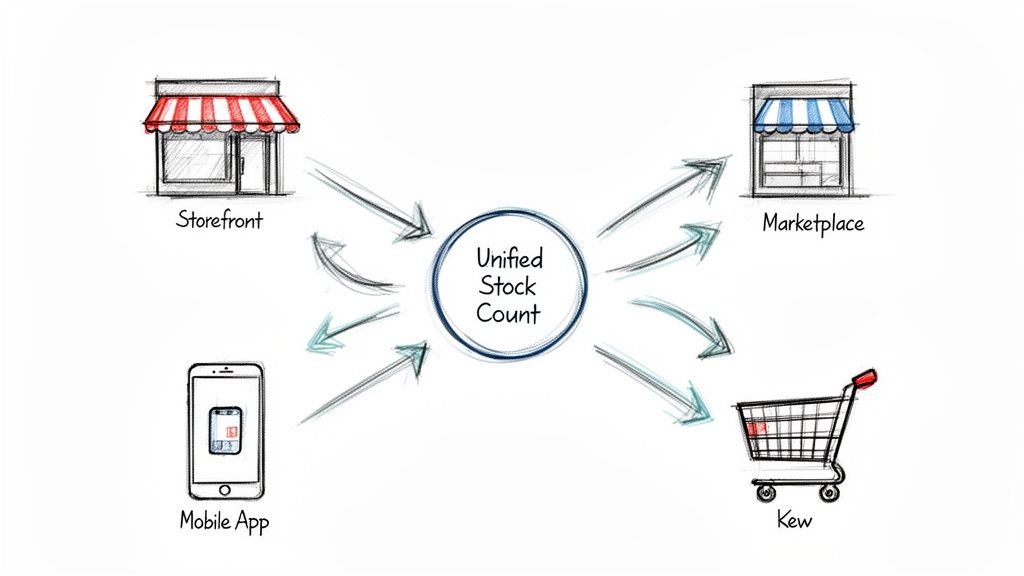
For modern DTC brands selling across multiple platforms, unified stock management is a non-negotiable best practice. This approach establishes a single, synchronized inventory pool that serves every sales channel, from your Shopify store and Amazon listings to TikTok Shop and physical retail locations. When a product sells on one channel, the available quantity is instantly and automatically updated across all others.
This real-time synchronization is the only way to reliably prevent overselling, a critical error that damages customer trust and brand reputation. It ensures that every customer, regardless of where they shop, sees accurate stock information. This unified view empowers you to allocate inventory efficiently across channels, maximizing sales opportunities without the risk of fulfilling an order with a product you no longer have.
Why It’s a Best Practice
Omnichannel synchronization eliminates the need for manual inventory reconciliation between siloed channels, a process prone to human error and delays. Brands using tools like Linnworks or InventoryLab can confidently run promotions on both their website and a marketplace simultaneously, knowing the central stock count is accurate. This practice is foundational to providing a seamless customer experience and scaling operations efficiently, turning a complex multi-platform presence into a manageable, unified commerce engine.
How to Implement It
- Start with a Core Integration: Begin by connecting your two most important sales channels, such as your Shopify store and your Amazon Seller Central account. Master this connection before adding more complexity.
- Use Inventory Holds: Configure your system to automatically place an "inventory hold" on an item the moment it's added to a cart or an order is initiated. This prevents another customer from buying the same last unit on a different channel a few seconds later.
- Establish a Channel Hierarchy: Set rules for inventory allocation, especially for low-stock items. You might prioritize your high-margin DTC channel (Shopify) over lower-margin marketplaces to maximize profitability.
- Test and Monitor Syncs: Before a major sales event, thoroughly test your channel integrations to ensure they are working flawlessly. Set up alerts for sync failures so you can manually intervene if an issue arises, preventing widespread overselling.
10-Point Inventory Management Best Practices Comparison
| Item | 🔄 Implementation Complexity | ⚡ Resource Requirements | 📊 Expected Outcomes | ⭐ Ideal Use Cases & Effectiveness | 💡 Quick Tip |
|---|---|---|---|---|---|
| Real-Time Inventory Tracking and Visibility | High — multi-API integrations and mapping | Medium–High — inventory platform, middleware, monitoring staff | Prevents overselling; improved fulfillment accuracy; faster reorder decisions | Best for DTC multi-location & multi-channel sellers — ⭐⭐⭐⭐ | Integrate POS and set alerts at 20–30%; tune alerts to avoid fatigue |
| ABC Analysis and SKU Rationalization | Medium — data segmentation and rules setup | Low–Medium — sales/cost data + analytics tool | Focuses resources on high-impact SKUs; reduces working capital tied to slow movers | Ideal for large catalogs or many SKUs — ⭐⭐⭐ | Reclassify quarterly; keep higher safety stock for A-items |
| Demand Forecasting and Predictive Analytics | High — models, data pipelines, continuous tuning | High — historical data, forecasting tools/ML, analyst time | Reduced stockouts and excess inventory; better purchasing and launch planning | Best for seasonal brands & DTC with historical data — ⭐⭐⭐⭐ | Combine internal sales with external trend signals; review accuracy monthly |
| Just-In-Time (JIT) Inventory Management | Medium–High — requires tight supplier coordination | Low inventory on-hand but high supplier reliability and automation | Dramatically lowers carrying costs but increases supply risk | Suited to high-velocity SKUs and reliable suppliers — ⭐⭐⭐ | Use only for A-items; maintain backup suppliers and contingency plans |
| Inventory Turnover Optimization & Velocity Analysis | Medium — reporting and KPI setup | Medium — analytics, pricing/marketing alignment | Higher turnover, improved cash flow, fewer aging SKUs | Useful for fast-fashion and multi-SKU sellers — ⭐⭐⭐ | Set category-specific turnover targets; monitor top 20% weekly |
| Safety Stock Calculation & Buffer Planning | Medium — statistical formulas and SKU-level setup | Low–Medium — demand/lead-time data and calculation tools | Fewer stockouts; higher service levels at the cost of carrying inventory | Critical for unpredictable demand or multi-channel sellers — ⭐⭐⭐⭐ | Use Z-score formula; set service levels by SKU value and margin |
| Supplier Relationship Management & Diversification | Medium — sourcing, contracting, KPI processes | Medium — supplier onboarding, relationship management resources | Reduces single-source risk; improves lead times and negotiation leverage | Essential for global sourcing and risk-averse operations — ⭐⭐⭐⭐ | Maintain 1–2 warm backups; define SLAs and quarterly reviews |
| Cycle Counting & Physical Inventory Accuracy | Medium — ongoing process design and schedule | Medium — labor, scanners, scheduling tools | Continuous accuracy; faster variance detection; better forecasting inputs | Best for warehouses and high-volume fulfillment centers — ⭐⭐⭐⭐ | Count A-items weekly/bi-weekly; use barcode scanning and root-cause logs |
| Dynamic Pricing & Clearance Strategy | Medium–High — pricing rules, channel consistency | Medium — price-monitoring tools, automation, margin oversight | Moves slow stock faster; optimizes revenue during demand peaks; margin risk | Effective for seasonal catalogs and competitive categories — ⭐⭐⭐ | Apply to inventory above safety stock; test elasticity incrementally |
| Omnichannel Inventory Synchronization & Unified Stock Management | High — cross-channel API integrations and allocation rules | High — unified platform, integration engineering, monitoring | Single stock view; eliminates oversells; enables strategic allocation | Must-have for sellers on many platforms (Shopify, Amazon, TikTok) — ⭐⭐⭐⭐ | Start with top two channels; set allocation hierarchy and monitor sync failures |
From Inventory Chaos to Operational Excellence
Navigating the complexities of modern e-commerce requires more than just a great product and clever marketing; it demands a robust, intelligent approach to managing your most critical asset: inventory. The journey from inventory chaos to operational excellence is not a single leap but a series of deliberate, well-executed steps. By embracing the ten inventory management best practices detailed in this guide, you are building a framework for sustainable growth, enhanced profitability, and superior customer satisfaction.
We've explored how real-time tracking provides foundational visibility and how ABC analysis allows you to prioritize your efforts on the products that matter most. We delved into the power of predictive forecasting to anticipate customer demand and the efficiency of Just-In-Time (JIT) to minimize carrying costs. Each practice, from optimizing turnover velocity and strategically calculating safety stock to nurturing supplier relationships and ensuring physical inventory accuracy through cycle counts, represents a critical lever you can pull to refine your operations.
Synthesizing Strategy into Action
The true power of these concepts emerges when they are integrated into a cohesive system. Dynamic pricing strategies become more effective when informed by accurate demand forecasts. Omnichannel synchronization prevents stockouts and over-selling, but it relies on pristine, real-time data from all your sales channels. Mastering these individual components is essential, but weaving them together is what transforms your business.
Your immediate next steps should be targeted and manageable. Don't attempt to overhaul your entire system overnight. Instead:
- Start with an Audit: Begin with a thorough physical count and implement cycle counting to establish a baseline of inventory accuracy. You cannot manage what you do not accurately measure.
- Prioritize with ABC: Immediately perform an ABC analysis on your product catalog. This single exercise will provide immense clarity on where to focus your forecasting, marketing, and reordering efforts.
- Review Your Tech Stack: Assess your current tools. Are they providing real-time data? Can they sync across Shopify, Amazon, and TikTok Shop? If not, upgrading your software is a high-leverage move.
The Broader Impact of Masterful Inventory Management
Ultimately, adopting these inventory management best practices transcends simple stock control. It directly impacts your bottom line by reducing storage fees, minimizing dead stock, and preventing lost sales due to stockouts. It enhances your brand reputation by ensuring products are available when customers want them. Moreover, it frees up your capital and your time, allowing you to focus on scaling your business, exploring new markets, and developing new products.
Effective inventory management is the operational backbone that supports every other aspect of your e-commerce venture. When your inventory is optimized, your fulfillment process becomes smoother and more reliable. In fact, implementing comprehensive e-commerce fulfillment strategies is paramount for transitioning from inventory chaos to operational excellence, streamlining the journey from warehouse to customer. This synergy between inventory and fulfillment creates a seamless experience that builds customer loyalty and drives repeat business. The path forward is clear: treat inventory not as a cost center, but as a strategic driver of growth and competitive advantage.
Ready to arm your business with the data needed to implement these best practices without breaking the bank? EcomEfficiency bundles over 20 premium e-commerce tools, including market research leaders like Helium10 and Semrush, into one affordable subscription. Make smarter forecasting, sourcing, and pricing decisions by visiting EcomEfficiency today.