Majestic SEO vs Semrush: The Clear Tool Comparison (majestic seo vs semrush)
When you're running an e-commerce business, every tool in your stack has to justify its cost. Choosing the right SEO platform is a huge decision, and it really comes down to one thing: Majestic is a highly specialized tool for deep-diving into historical backlink data, making it fantastic for understanding a domain's long-term authority. On the other hand, Semrush is a comprehensive marketing toolkit, built for everything from keyword research and site audits to competitor tracking.
Choosing the Right SEO Tool for E-Commerce Growth
The Majestic vs. Semrush debate is really a question of focus versus breadth. As an e-commerce brand, you're juggling a lot more than just backlinks. You need to uncover profitable keywords for your product pages, make sure your Shopify or BigCommerce site is technically sound, and stay one step ahead of your competitors.
This guide looks at the comparison through that specific lens. We’re not just listing features; we're figuring out which platform actually helps a direct-to-consumer operator hit their goals. This infographic gives a great high-level snapshot to get us started.
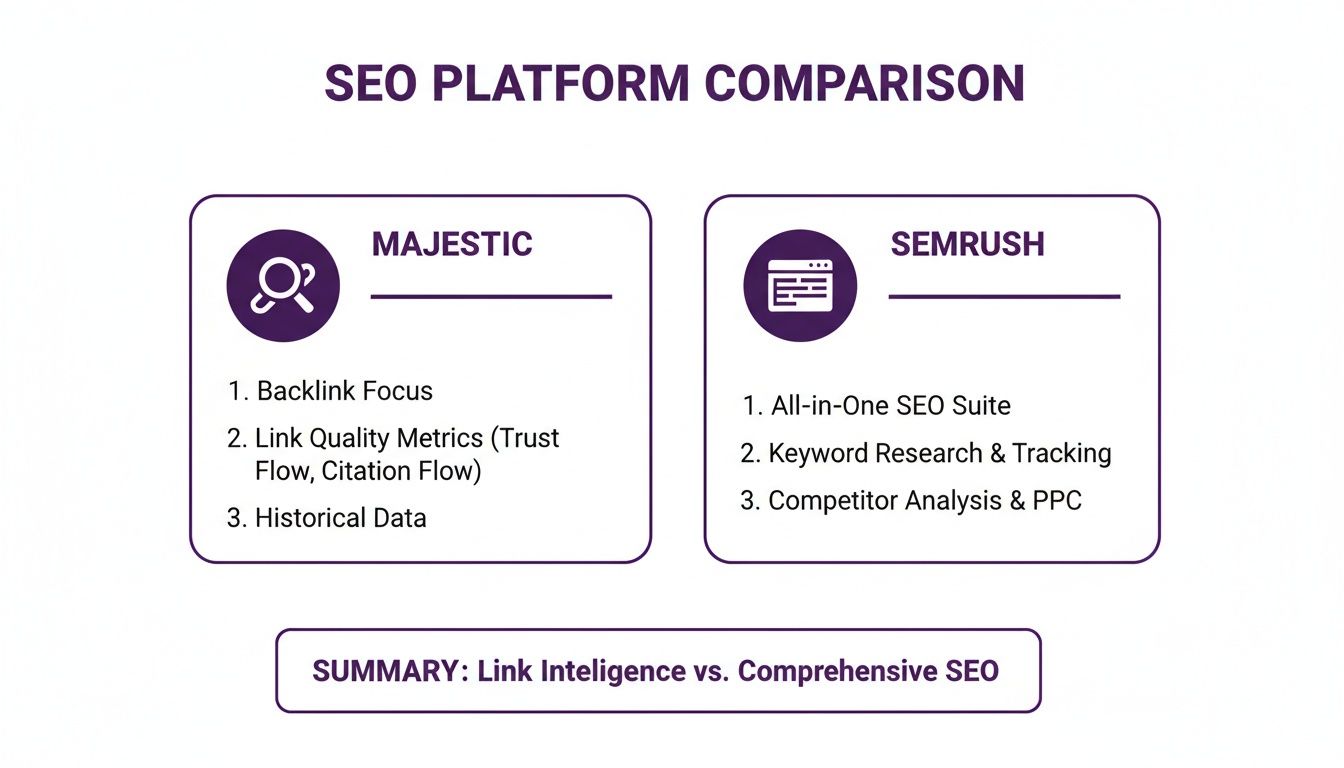
As you can see, Majestic has a laser focus on link intelligence, while Semrush offers a dashboard that covers the entire marketing spectrum. This visual really sets the stage for a deeper look at what each one can do for you.
Majestic vs Semrush At a Glance
To give you a quick sense of where each platform shines, here’s a high-level summary of their core strengths and who they're built for.
| Feature | Majestic SEO | Semrush |
|---|---|---|
| Primary Function | Specialized backlink analysis | All-in-one marketing platform |
| Ideal User | SEO specialists, link builders | E-commerce owners, marketers |
| Keyword Research | Limited (based on anchor text) | Extensive (25B+ keyword database) |
| Site Audit | Not available | Comprehensive technical audits |
| Unique Strength | Historical backlink index | Complete marketing toolkit |
This table shows just how different their approaches are. For anyone considering an all-in-one solution, it's also worth exploring other Semrush alternatives to get a full picture of the market before making a final call.
Key Takeaway: Your choice really depends on your main objective. If you need a scalpel for link-building surgery, Majestic is your go-to. If you need a Swiss Army knife to manage your entire marketing strategy, Semrush is the obvious pick for most e-commerce businesses.
7. Backlink Analysis: A Deep Dive Into Capabilities
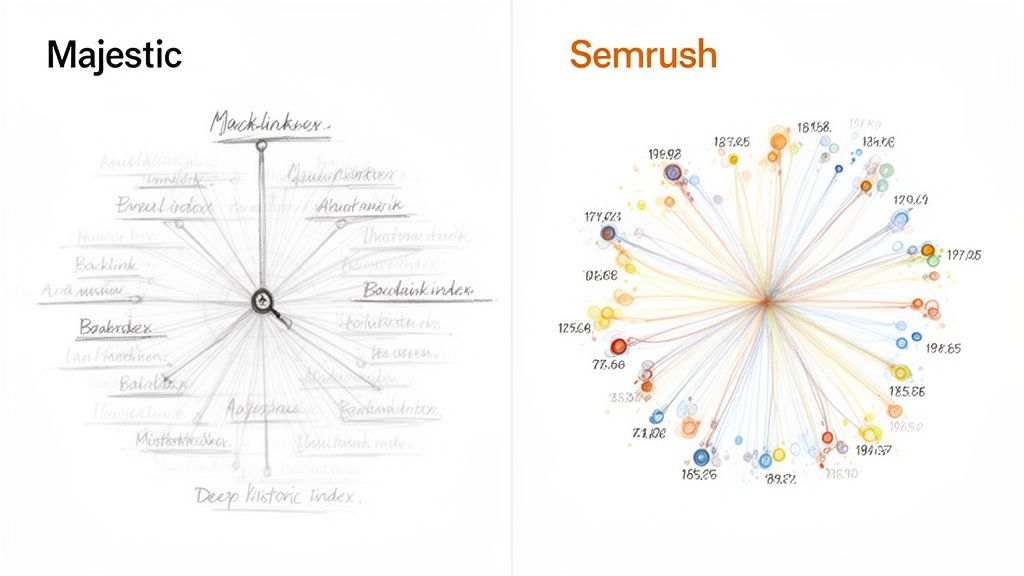
This is where the real fight between Majestic SEO vs Semrush begins. The two tools approach backlink analysis from completely different angles. Majestic is a pure specialist, built from the ground up for one thing: deep link intelligence. Its crown jewel is the Historic Index, a massive database that gives you an incredible look back in time at a domain's link history.
If you're an e-commerce store trying to figure out how a long-time competitor got to where they are, this historical context is pure gold. You can literally watch how their link profile was built over the years, spot their foundational links, and decode their long-term SEO game plan. The secret sauce is in Majestic’s unique metrics.
Unpacking Majestic's Unique Metrics
Majestic doesn't just give you a simple authority score; it provides a much more textured picture of link quality. To really understand backlinks, you have to speak its language.
- Trust Flow: This metric is all about quality. It gauges how trustworthy the sites linking to you are by measuring their proximity to a hand-picked list of trusted seed sites.
- Citation Flow: This one is about quantity. It measures the sheer volume of "link juice" flowing to a site, without really judging the quality of those links.
- Topical Trust Flow: For any e-commerce brand, this is arguably the most valuable metric of the bunch. It sorts referring domains by topic, so you can see at a glance how relevant a competitor's backlink profile is to your niche.
Using these metrics together, you're not just measuring the raw power of a link profile. You're assessing its thematic relevance and overall health—which is exactly what you need to build an SEO strategy that lasts.
Key Differentiator: While Semrush gives you a single "Authority Score," Majestic's split between Trust Flow and Citation Flow is like getting a second opinion from a specialist. A high Citation Flow paired with a low Trust Flow is an instant red flag, often pointing to spammy, low-effort link building.
Semrush's Focus on Freshness and Accessibility
On the other side of the ring, Semrush comes out swinging with a colossal, constantly updated index of over 43 trillion backlinks. This makes it the better tool for keeping an eye on things in real time. If you want to see the immediate impact of a competitor's latest PR campaign or a new product launch, Semrush's data will be more current.
But here’s the kicker: it comes down to accessibility and cost. Majestic gives you its deep historic index for free on its $99/month Pro plan, letting you trace a site's link history back for well over a decade. Semrush, however, locks its historical data (which only goes back to 2012) behind its pricier $249.95 Guru plan.
This makes Majestic a backlink research powerhouse, especially for e-commerce teams focused on building authority with smart link-building. You also get unique tools like the Topical Trust Flow and the ability to run a backlink gap analysis against 10 domains—double what Semrush allows. You can find more detail on how these features compare in practice.
The choice becomes pretty clear. For deep, historical competitive research on a budget, Majestic is the undisputed specialist. But for monitoring what's happening right now as part of a wider marketing strategy, Semrush offers the fresher data—if you're willing to pay up for the historical view.
2. Keyword Research: Finding What Your Customers Actually Search For
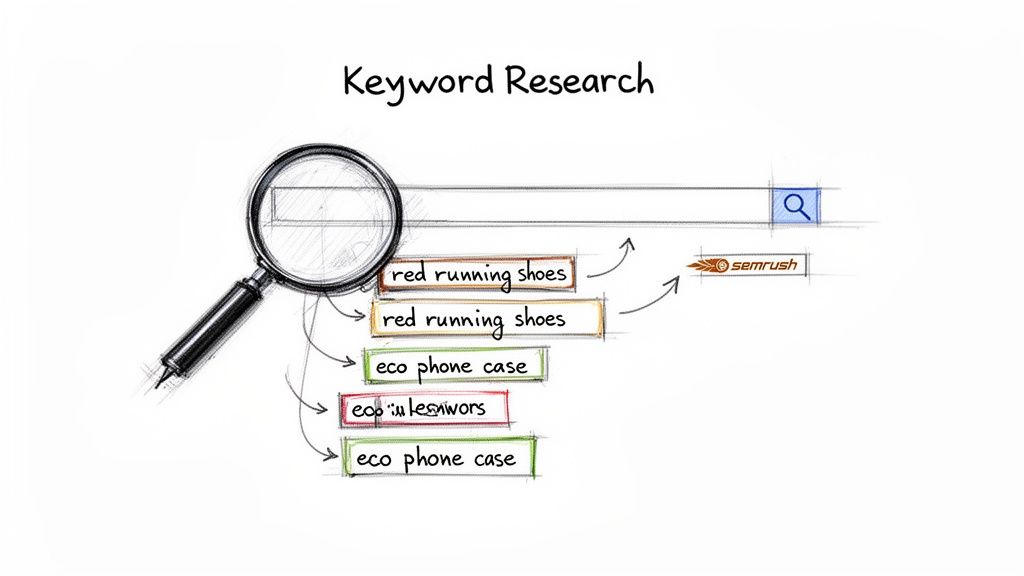
For any e-commerce brand, knowing what your customers are typing into Google is everything. It’s the foundation of product discovery, category pages, and blog content. When we pit Majestic against Semrush in this area, it’s not even a fair fight. Semrush is built from the ground up for deep keyword analysis, while Majestic’s approach feels like an afterthought.
Semrush's strength lies in its absolutely massive keyword database—we're talking 25.3 billion keywords as of 2025. This isn't just a big number; it's a direct line into the mind of the consumer. It lets e-commerce operators, from Shopify store owners to DTC brands, uncover high-intent keywords for their products, find untapped dropshipping niches, and even spot rising TikTok Shop trends.
Majestic, on the other hand, doesn't really do keyword research in the modern sense. It infers potential keywords by looking at the anchor text of backlinks. This is a very indirect, old-school way of looking at things. It shows you how other sites link to a page, not what actual customers are searching for.
Semrush: The Clear Winner for E-Commerce
Let's make this practical. Say you're launching a new line of sustainable yoga mats on your Shopify store. Firing up Semrush’s Keyword Magic Tool would instantly give you thousands of relevant search terms.
From there, you can slice and dice the data to find pure gold:
- High-Intent Keywords: Pinpoint long-tail phrases like “best non-toxic cork yoga mat” that show someone is ready to buy, not just browse.
- Question-Based Queries: Discover what your audience is asking, like “how to clean a cork yoga mat.” This is perfect fuel for blog posts and FAQs that draw in organic traffic.
- Low-Difficulty Opportunities: Find those emerging keywords with less competition, giving your new product pages a fighting chance to rank quickly.
Trying to do this with Majestic is nearly impossible. Its anchor text analysis might show you that a competitor is getting links with the text “yoga mats,” but it won’t reveal the hundreds of valuable, long-tail variations that actually drive sales.
The E-Commerce Takeaway: Using Majestic for keyword research is like trying to learn about your customers by only listening to what other businesses say about them. Semrush lets you listen directly to your customers' search queries—an absolute necessity for writing product titles, descriptions, and ad copy that converts.
How DTC Brands Can Put This into Action
This isn't just theory. A dropshipper can use Semrush to validate a new niche in minutes, checking search volume trends to see if interest is growing or fading. A seller on TikTok Shop can spot a product going viral by tracking search queries and quickly create content to ride the wave.
To get the most out of these tools, you need a solid process. For a great walkthrough, check out this guide on how to do keyword research effectively.
Bottom line: Majestic simply can’t deliver the actionable, data-driven insights needed for modern e-commerce. For any operator serious about growth, Semrush isn't just the better tool for keyword strategy—it's the only one that truly gets the job done.
Optimizing Your Store with Technical Site Audits
For an e-commerce store, a slow-loading product page or a broken link isn't just a minor glitch—it's a lost sale. The technical health of your site directly shapes user experience, conversions, and how you rank in search results. This is one area where the Majestic SEO vs Semrush comparison shows a massive gap in functionality.
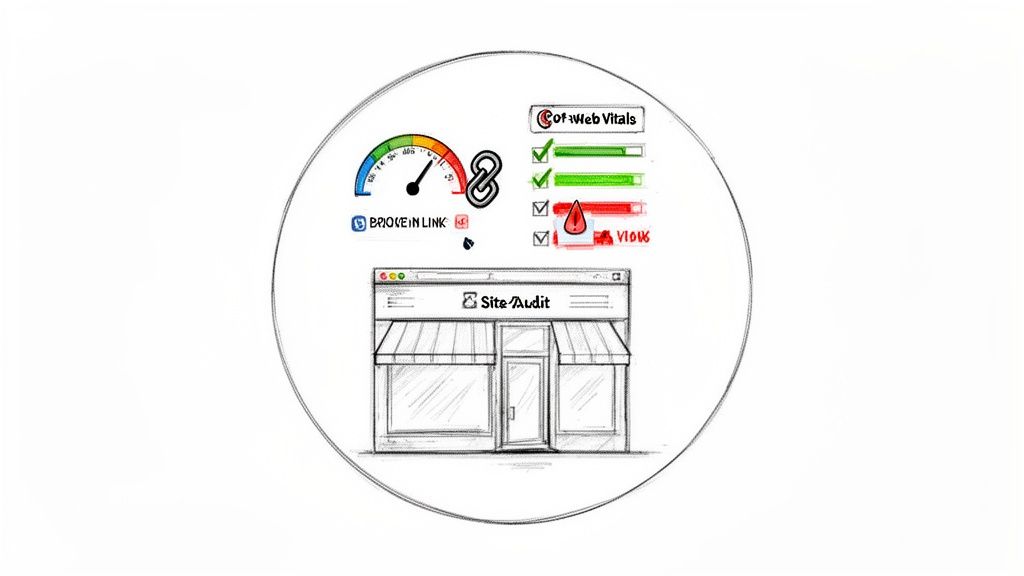
Semrush comes equipped with a powerful and comprehensive Site Audit tool that essentially acts as a health check for your entire store. It automatically scans your site for hundreds of potential technical and on-page SEO issues, then hands you a prioritized to-do list. For any brand running on platforms like Shopify or BigCommerce, this isn't a nice-to-have; it's a must-have.
Semrush’s Diagnostic Power for E-Commerce
Let's say a few of your product pages are loading slowly. Semrush's Site Audit doesn't just flag them as "slow." It digs deeper to tell you why. You'll get insights into oversized images, clunky JavaScript, or other Core Web Vitals bottlenecks that are killing the experience for your mobile shoppers.
The tool is fantastic at pinpointing critical errors that can quietly sabotage your store, such as:
- Crawlability Issues: It finds pages that search engines can't even see, making them completely invisible in search results.
- Internal Linking Problems: It catches broken links to products or orphaned category pages that confuse customers and dilute your SEO authority.
- On-Page SEO Errors: It flags common mistakes like missing meta descriptions or duplicate title tags that hold your rankings back.
For a DTC brand, a clean site audit isn't just about SEO—it's about customer trust. Semrush’s ability to find and help fix these problems ensures a smoother, faster shopping experience that encourages visitors to complete their purchase.
Majestic’s Absence in On-Site SEO
This part of the comparison is pretty simple: Majestic does not offer a site audit feature. The tool is built almost exclusively for off-page analysis, zeroing in on backlinks. While it’s brilliant at understanding the links pointing to your site, it offers nothing to help you analyze or fix what's happening on your site.
For any e-commerce operator looking for an all-in-one platform, this is a dealbreaker. You simply can't build a successful online store without keeping a close eye on its technical health. When it comes to diagnosing on-site problems, Semrush is the clear and only choice here, while Majestic serves a completely different, highly specialized purpose.
Comparing Pricing Plans and Overall Value
When you're looking at Majestic vs. Semrush, the sticker price is just the beginning of the story. For an e-commerce brand, what really matters is the return you get on that investment and which tool delivers the most bang for your buck.
On the surface, Majestic seems like the more affordable choice. Its entry-level "Lite" plan kicks off at $49.99 per month, giving you a powerful, focused set of backlink analysis tools. If your one and only mission is deep link intelligence, this is an incredibly accessible starting point.
Semrush, on the other hand, comes in with a "Pro" plan starting at $139.95 per month. It's easy to get sticker shock from that number, but you have to look at what's actually packed into that price.
Breaking Down the True Cost
The real difference is scope. Majestic is a specialist. It does one thing, link analysis, exceptionally well. To get the same full-spectrum functionality that Semrush offers, you'd need to bolt on other tools.
A Majestic user would have to find and pay for separate subscriptions to handle things like:
- In-depth keyword research
- Technical site audits
- Daily rank tracking
- Content optimization and marketing
Those subscriptions add up fast. Before you know it, you could be paying way more than you would for a single Semrush plan. For a growing online store, Semrush’s all-in-one approach isn't just a convenience; it's a genuine value proposition.
Think of it this way: consolidation is about more than just cost savings. It’s about efficiency. Instead of hopping between different tools and trying to stitch together reports, your team operates in one cohesive environment. That saves a ton of time and makes everything simpler.
What This Means for Your E-Commerce Store
For anyone running an e-commerce site, the higher price of Semrush usually pays for itself in strategic value. Majestic is brilliant for its niche, but its utility is narrow. It tells you everything about your link profile but won't help you discover keywords for a new product line, optimize your category pages, or fix a technical glitch on your Shopify store that's killing conversions.
Semrush, however, is built to drive growth across your entire marketing funnel. You can use its Keyword Magic Tool to find your next best-selling product or run its Site Audit to catch a technical bug that's costing you sales. This direct link to revenue-generating activities makes its higher cost a smart, often more profitable, long-term investment.
Ultimately, in the Majestic SEO vs Semrush debate, the scales tip heavily in favor of Semrush for any brand that needs a complete marketing toolkit, not just a single screwdriver.
Making the Final Decision for Your Business
When you're weighing Majestic SEO against Semrush, the final call really boils down to your day-to-day role and what you're trying to achieve. This isn't a simple case of one tool being better than the other; it’s about picking the right tool for the job at hand. Are you looking for a high-powered microscope or a complete Swiss Army knife?
Majestic is an absolute powerhouse for a very specific type of user. If your world revolves around SEO, domain investing, or running a link-building agency, its historical backlink index is second to none. The granular metrics like Trust Flow and Citation Flow are invaluable for deep, forensic link analysis. Its intense focus is its greatest asset.
But for most e-commerce and DTC businesses, the story is quite different.
The Verdict for E-Commerce Growth
As a Shopify store owner, a DTC brand manager, or an in-house marketer, your plate is full of tasks that go way beyond link building. You’re juggling product keyword research, optimizing category pages, squashing technical site errors, and keeping a close eye on what the competition is up to. Semrush was designed from the ground up for exactly this kind of multi-faceted role.
Semrush is simply the more practical and essential platform for e-commerce growth. It brings together the jobs of several different tools into one unified dashboard, tackling the real-world challenges of selling online—from finding new customers to improving your site’s conversion rate.
To put it plainly, here’s how to make your choice:
- Choose Majestic if: You're a hardcore SEO pro who lives and breathes backlink audits, competitive link intelligence, or evaluating aged domains. Your primary mission is link-centric analysis, period.
- Choose Semrush if: You're a business owner or marketer driving overall growth. You need one reliable hub to handle keyword research, content strategy, technical SEO, and market analysis without switching between ten different tools.
For the vast majority of e-commerce operators, the all-in-one nature of Semrush delivers a much stronger return on investment. And with platforms like EcomEfficiency, getting access to Semrush alongside dozens of other premium tools is more straightforward and affordable than ever.
Got Questions? We've Got Answers
When you're weighing Majestic SEO vs Semrush, a few key questions always come up, especially for e-commerce store owners. Let's clear the air and get you the answers you need.
Can Majestic Really Replace Semrush for an Online Store?
In a word? No. While Majestic is a powerhouse for diving deep into backlink history, it’s a specialist tool. It just doesn't have the broad feature set that an e-commerce business needs to actually grow.
Think of it this way: Semrush is your entire marketing toolkit in one place. Majestic is a single, very specialized instrument.
With Majestic, you'd be missing out on essentials like:
- Deep Keyword Research: Semrush has a massive keyword database that's non-negotiable for finding new product and category search terms.
- Technical Site Audits: The Semrush Site Audit tool is your first line of defense against on-site issues that kill conversions and tank your rankings.
- Daily Rank Tracking: You need to know how your product and collection pages are performing. Semrush handles this; Majestic doesn't.
For any online store, Semrush provides the holistic view you need—from getting traffic in the door to optimizing the user experience.
How Much Faith Should I Put in Majestic's Trust Flow?
Majestic's Trust Flow is one of the most respected metrics in the SEO world for a reason. It’s an excellent gauge of a website's quality, measuring how closely it's linked to a hand-picked list of authoritative sites.
Trust Flow is a strong clue about a link profile's quality, but remember it's not a direct Google ranking factor. Think of it as a trusted advisor, not the final word on SEO value. It’s perfect for vetting potential link partners.
What's the Smartest Way to Find Product Keywords in Semrush?
Your best bet is the Keyword Magic Tool. Don't just type in a product name; start with a broader category like "bamboo sheets." The real magic happens when you start applying filters to zero in on those low-competition keywords that signal a buyer is ready to pull out their wallet.
Here’s a quick strategy to uncover those hidden gems:
- Filter by "Questions": This is a goldmine for creating product FAQs and blog content that answers what your customers are already asking.
- Filter by "Keyword Difficulty (KD%)": Set this to "Easy" or "Very Easy." Why fight an uphill battle? Go after the terms you can actually rank for fast.
- Filter by "Intent": This is crucial. Select "Transactional" or "Commercial" to see the exact phrases people use when they’re ready to buy, not just browse.
This focused approach helps you find the specific, high-intent phrases that actually lead to sales.
At EcomEfficiency, we bundle Semrush with 50+ other premium e-commerce tools, giving you a complete growth stack for a fraction of the cost. Start saving and scaling with our all-in-one subscription.