TikTok Ads vs Facebook Ads A Strategic Comparison
Here's the fundamental difference in a nutshell: Facebook Ads gives you a massive, data-rich toolkit for pinpointing specific demographics and interests. It's the go-to for campaigns laser-focused on conversions. On the other hand, TikTok Ads is your ticket to capturing younger audiences with authentic, trend-driven video, offering a shot at viral reach and massive engagement. The choice boils down to what you value more: granular control or explosive, entertainment-first marketing.
Defining Your Advertising Battleground
Deciding between TikTok Ads and Facebook Ads isn't about crowning a champion. It’s about aligning a platform's unique strengths with your specific business goals. Each platform is its own world, complete with distinct user behaviors, creative expectations, and strategic upsides. Getting a firm grasp on these differences is the first real step toward building a social advertising strategy that actually makes you money.
This guide will break it all down for you. We'll go beyond the obvious to dig into audience intent, creative demands, targeting power, and cost structures. The goal is to give you the clarity you need to put your ad budget where it will work hardest.
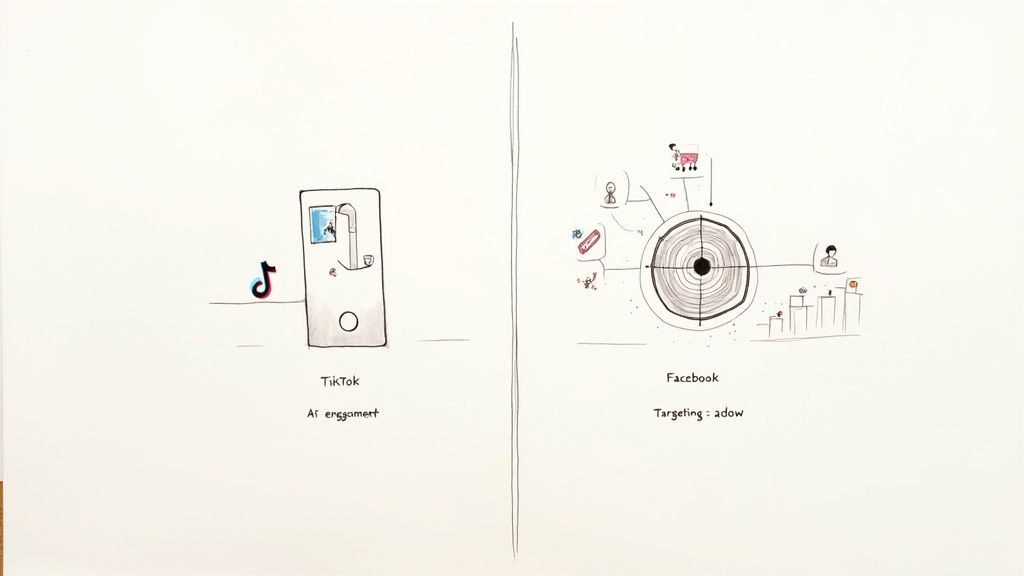
High-Level Platform Comparison
First, let's zoom out and look at the big picture. This table gives you a quick snapshot of what defines each platform, setting the stage for a deeper dive into how these differences play out in real-world campaigns.
| Attribute | TikTok Ads | Facebook Ads |
|---|---|---|
| Primary Audience | Gen Z & Millennials (Ages 16-34) | Broad Demographics (Ages 25-55+) |
| User Intent | Entertainment, Discovery, Trend Participation | Connection, Community, News Consumption |
| Content Style | Authentic, Lo-fi, User-Generated (UGC) | Polished, Professional, Versatile Formats |
| Targeting Strength | Algorithmic Discovery, Broad Interests | Granular Demographics, Life Events, Lookalikes |
| Ad Environment | Immersive, Sound-On, Full-Screen Video | Integrated into Feeds, Stories, and more |
| Best For | Brand Awareness, Viral Marketing, Trend-Based Sales | Lead Generation, Direct Conversions, Retargeting |
Strategic Considerations for E-Commerce
If you're running an e-commerce brand, this decision is a big deal. Your product, your ideal customer, and your team's creative bandwidth will all point you toward the platform that can deliver a better Return on Ad Spend (ROAS).
The core distinction is simple: Facebook often asks for an 'ad,' while TikTok asks for a 'TikTok.' This highlights the need for native, entertaining content on TikTok, which may require a completely different creative workflow than a traditional direct-response ad.
Here’s a good way to think about it. Facebook is like setting up a high-tech storefront in a massive digital mall; you get precise tools to attract specific shoppers who are already there to browse. TikTok, in contrast, is like staging a flash mob in a packed city square. The goal is to grab attention with pure entertainment, draw a massive crowd, and then convert them with infectious energy.
Both strategies can be wildly effective, but they demand completely different playbooks to win.
Digging into Audience and Engagement
When you're weighing TikTok Ads against Facebook Ads, you have to look past the raw user numbers. The real story is in the mindset of the people on each platform. Why are they there? What are they looking to do? The answer to that question completely changes how your ads will land.
Facebook is like a digital town square. It’s huge, diverse, and people are there primarily to connect with friends, family, and groups they belong to. They’re catching up on news, following brands they already like, and joining discussions. It's a "lean-back" environment where users scroll with a social purpose.
This makes it a goldmine for advertisers who need to find people based on specific, well-defined traits. Think about a B2B company targeting users by job title, or a local shop reaching people in a five-mile radius who just got engaged. Facebook’s power comes from its massive database of who people are and what they’ve told the platform they like.
TikTok's Entertainment-First Vibe
Now, let's flip over to TikTok. It’s a totally different world. Users don't open the app to see what their aunt is up to; they open it to be entertained. They're looking for the next trend, the next laugh, the next song to get stuck in their head. This is a "lean-forward," fully immersive experience—full screen, sound on, and ready to be captivated.
Because users are actively seeking out great content, your ads have to be great content. That slick, polished corporate video that does numbers on Facebook? It’ll get swiped away in a heartbeat on TikTok. To win here, you need to think like a creator. Your ads have to be authentic, creative, and feel like they belong in the user's "For You" feed.
The core difference in user mindset is crucial. On Facebook, you find an audience based on their data profile. On TikTok, your creative finds the audience for you through the algorithm. This shifts the strategic focus from granular targeting to compelling, native-style content.
Imagine an e-commerce fashion brand. On TikTok, they can build a whole campaign around a trending sound or a viral dance challenge. By joining the fun instead of interrupting it, they can tap into the platform’s culture and see explosive growth.
Where Do Users Spend Their Time?
How long people stick around is a massive tell for advertisers. It shows how attentive they are, and this is where TikTok really shines. On average, users spend a whopping 95 minutes a day on the app. That’s not just background noise; it's active, focused screen time, which means more chances for your ads to be seen by people who are actually paying attention. You can dive deeper into TikTok's powerful marketing statistics to see just how much it's changing the game.
TikTok’s own marketing perfectly captures this philosophy.
This simple phrase, "Don't Make Ads. Make TikToks," is the best advice you can get. It's a reminder to think like a creator, not a corporation.
So, Which Audience Is Right for You?
Choosing between the two platforms really comes down to your brand and your specific goals. Here’s a quick breakdown to help you decide.
- For Detailed Demographic Targeting: If your perfect customer is defined by things like life events ("just moved"), specific hobbies ("kayaking"), or their job title, Facebook's powerful targeting tools are your best bet. It’s built for reaching niche audiences with laser precision.
- For Broad, Trend-Driven Reach: If your product has mass appeal, especially with a younger crowd, or if it’s something that could take off with a creative video, TikTok is the place to be. Its algorithm is an engine for virality, pushing great content to millions.
- For Community-Based Marketing: Brands that want to build a loyal following and spark genuine conversations should lean into Facebook. The Groups feature is an incredible tool for engaging directly with your biggest fans.
- For User-Generated Content Campaigns: If your strategy is all about showing off real people using your product, there's no better place than TikTok. It’s the natural home for authentic user-generated content (UGC), and ads that look like customer videos perform incredibly well.
Ultimately, Facebook gives you a detailed map to find your customer. TikTok gives you a stage and asks you to put on a show so good that your customers find you.
Comparing Ad Formats and Creative Requirements
The creative you run is just as important as the audience you target. When comparing TikTok ads vs Facebook ads, you’re dealing with two completely different creative worlds. Each platform speaks its own language, and if you don't speak it fluently, you're just throwing money away.
Facebook offers a wide, versatile creative canvas. It’s a mature platform that has room for almost everything—classic static images, multi-product carousels, and highly polished video ads. This flexibility makes it a go-to for brands with an established library of marketing assets.
Because users see a mix of personal updates, news, and group posts in their feeds, they’re generally more accepting of traditional advertising. A clean, professional-looking ad with a direct call-to-action can work wonders, especially in retargeting campaigns where the user already knows who you are.
Facebook’s Polished and Diverse Formats
Facebook’s real strength is its variety. It lets you test and optimize a ton of different approaches to figure out what truly clicks with your audience. This makes it an ideal testing ground for different messages and visuals without needing to completely reinvent your creative strategy.
You have a lot of options on Facebook, but the key formats include:
- Image Ads: Simple, effective, and fast to produce. They’re perfect for calling attention to a single product or a big promotion.
- Video Ads: From short, snappy clips to longer narrative stories, video is incredibly engaging and works great across Feeds, Stories, and Reels.
- Carousel Ads: Let you show off multiple products or features in a single, swipeable ad. These are a goldmine for e-commerce brands.
- Collection Ads: A mobile-first format that opens into a full-screen experience, letting users browse a product catalog without ever leaving the app.
TikTok’s Authentic, Entertainment-First Approach
In stark contrast, TikTok is not the place for a traditional ad. The entire platform is built on a foundation of authenticity, entertainment, and user-generated content (UGC). A polished, corporate video that screams "advertisement" will get skipped in a heartbeat. The goal here is to blend in, not to interrupt.
The name of the game is short-form, sound-on vertical video. The ads that crush it on TikTok often look and feel just like organic posts, using trending sounds, popular editing styles, and relatable creators. It’s not about high production value; it’s about cultural relevance and raw, unpolished appeal.
A critical distinction to remember is this: Facebook wants an "ad," but TikTok demands a "TikTok." This simple idea highlights the platform's core creative requirement—your content must entertain first and sell second.
This means your creative process for TikTok might look completely different. Instead of tasking a design team with creating slick graphics, you’ll likely find yourself collaborating with creators to produce authentic UGC-style videos that show your product being used in a real-world setting.
Adapting One Concept for Both Platforms
So, how can a small business advertise on both platforms without doubling the work? The trick is to start with a core concept and then adapt the execution for each platform’s unique environment.
Let's say you're a DTC brand selling a new skincare product.
- Core Concept: The product gives users clear, glowing skin in just one week.
- Facebook Execution: You could run a Carousel Ad with compelling before-and-after photos, paired with a polished video testimonial from a happy customer. The ad copy would be direct, highlighting the benefits and featuring a clear "Shop Now" button.
- TikTok Execution: Here, you'd partner with a creator for a "Get Ready With Me" style video. The creator would naturally work the product into their routine, talking about how great it is while a trending song plays in the background. It feels like a genuine tip from a friend, not a sales pitch.
By adapting the execution—not the core message—you can create assets that feel native to each platform and give yourself the best shot at connecting with both audiences.
Evaluating Targeting and Optimization Capabilities
The real muscle behind any ad platform is its ability to put your message in front of the right people at the right time. When you look at TikTok ads vs Facebook ads, you're really comparing two different philosophies: one built on years of meticulously collected user data, and another driven by a world-class content discovery algorithm.
The best platform for you hinges on a simple question: Do you need the surgical precision of a scalpel, or the explosive, far-reaching power of a firework?
Facebook: The Master of Granular, Data-Driven Targeting
Facebook's ad platform is the seasoned veteran in this fight, and its age is its advantage. Over the years, it has amassed an incredible depth of user-provided information, creating a powerful toolkit for advertisers who know exactly who they’re trying to reach.
This granular control is where Facebook still holds a clear edge, especially if you have a well-defined customer avatar.
You can build audiences with an almost unnerving level of detail, going far beyond basic demographics. It’s this ability to layer specific attributes that makes it so indispensable for campaigns demanding precision.
Here are a few of its standout features:
- Custom Audiences: This lets you upload your own data—think email lists or website visitor logs—to retarget people who already know your brand. It's a foundational tool for moving customers down the funnel.
- Lookalike Audiences: This is where the platform really shines. Facebook can analyze your best customers and then go find a massive new audience of people who share similar traits. It's one of the most effective ways to find high-quality cold traffic.
- Detailed Targeting: This is the deep end of the pool. You can layer targeting options like life events (think "newly engaged" or "new parents"), job titles, employers, and thousands of specific interests to pinpoint your ideal buyer.
For a local business like a plumber or a real estate agent, Facebook's hyperlocal targeting is practically unbeatable. The power to target users in a specific zip code who have also shown interest in "home buying" is a killer combination that TikTok's broader system just can't match with the same accuracy.
The Meta Business Suite reflects this data-centric approach. It's a dashboard built for marketers who love to dig into the numbers and fine-tune every variable.
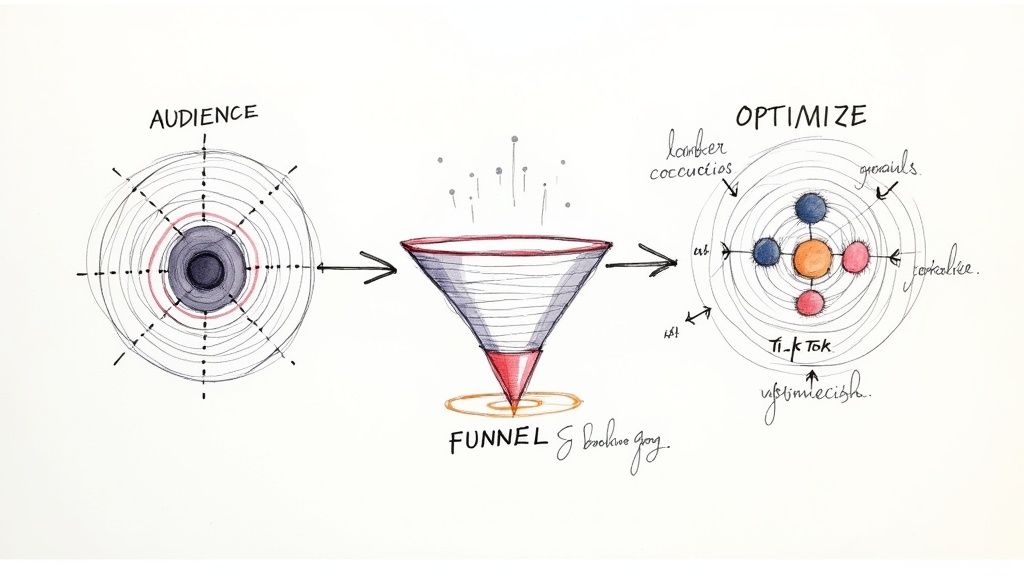
This professional, analytical interface is designed for precise campaign management and appeals to advertisers who want total control.
TikTok: Riding the Wave of Algorithmic Discovery
TikTok plays a completely different game. While it offers standard interest and behavioral targeting, its secret weapon is the algorithm itself. Instead of asking you to build the perfect audience from scratch, TikTok's system is engineered to let great creative find its own audience.
Here’s how it works: you feed the algorithm a compelling ad and some broad signals, like an interest in "beauty" or "gaming." The system then shows it to a small test group. Based on real-time engagement data—like watch time, shares, and comments—it rapidly learns who loves your ad and then scales delivery to a massive, lookalike-style audience of similar users.
This process often uncovers customer segments you would never have targeted on your own. Imagine an e-commerce brand selling a niche kitchen gadget. TikTok's algorithm might discover it resonates with both professional chefs and college students in dorms—a connection a marketer might have easily missed.
Here’s a head-to-head breakdown of their targeting philosophies:
| Targeting Feature | Facebook Ads | TikTok Ads |
|---|---|---|
| Foundation | User Data: Built on demographics, declared interests, and life events. | Content Engagement: Built on in-app behavior and video interactions. |
| Precision | High: Perfect for niche audiences and specific geographic targeting. | Broad: Best for mass-market products and discovering new audiences. |
| Best For | Defined Personas: When you know exactly who your customer is. | Undiscovered Segments: When your product has wide appeal and could go viral. |
| Key Strength | Lookalike Audiences: Unmatched for scaling based on your existing customer data. | The "For You" Algorithm: The best in the business at organic-style ad discovery and reach. |
Ultimately, Facebook asks you to bring the map, and it will help you find your treasure. TikTok asks you to bring a great show, and it will fill the seats for you. The right choice depends entirely on how well you already know your audience versus how much you trust your creative to find them on its own.
Understanding Cost and Performance Benchmarks
When you get down to it, the conversation about TikTok Ads vs Facebook Ads always comes back to the bottom line. This is where we look at the hard numbers—cost, conversions, and Return on Ad Spend (ROAS)—to figure out which platform is actually making you money. But here’s the thing: just staring at a spreadsheet of raw data can lead you astray. The story behind the numbers is what really matters.
A lower cost-per-click (CPC) isn't an automatic win. Think about the user's mindset. A click from a Facebook user often signals a genuine interest in a product they were already considering. A click from a TikTok user? That might be pure curiosity sparked by a hilarious, entertaining video. Different intent, different value.
Deconstructing Core Advertising Costs
The price you pay for attention varies wildly between these two platforms. Facebook, being the more established and saturated marketplace, generally comes with a higher price tag. The ad auction is crowded, and if you’re trying to reach a popular audience, be prepared for your costs to climb.
TikTok, on the other hand, is still the go-to for cost-effective, top-of-funnel marketing. The cost per mille (CPM)—what you pay to get your ad in front of 1,000 people—is often significantly lower. This makes it a beast for brands who need to generate massive reach and build awareness without torching their budget. If you're launching a new product, for instance, you can get way more eyeballs on TikTok for the same amount of money you'd spend on Facebook.
While TikTok’s low CPM is great for making a big splash, Facebook’s mature ad system usually delivers a more predictable and stable ROAS for direct-response goals. It's the difference between casting a wide, affordable net (TikTok) and fishing with a precise, more expensive lure (Facebook).
Comparing Key Performance Benchmarks
So, what happens after you've paid for the impression or the click? This is where performance metrics like click-through rates (CTR) and conversion rates (CVR) come in, and they tell a fascinating story about audience behavior on each platform.
TikTok ads, for example, report conversion rates between 1.1% and 2.4%, which is right in line with, or even better than, the industry average for social media. This is especially impressive when you consider its incredibly low average CPC of just $0.22. It suggests you can acquire customers for a fraction of what you might pay elsewhere. For a deeper dive, check out some of the performance data for TikTok ads on SingleGrain.com.
To make this crystal clear, let's break down the typical cost and performance metrics you can expect.
Advertising Cost and Performance Metrics
Here’s a side-by-side look at the average costs and performance benchmarks for both platforms. Remember, these are just averages—your own results will depend heavily on your industry, audience, and creative.
| Metric | TikTok Ads (Average) | Facebook Ads (Average) |
|---|---|---|
| CPM (Cost Per 1,000 Impressions) | ~$6 - $10 | ~$12 - $15 |
| CPC (Cost Per Click) | ~$0.22 - $1.00 | ~$0.97 - $2.50 |
| CTR (Click-Through Rate) | 0.5% - 1.5% | 0.9% - 1.6% |
| CVR (Conversion Rate) | 1.1% - 2.4% | 1.5% - 9.21% |
As you can see, TikTok often wins on upfront costs like CPM and CPC, making it cheaper to get in front of people and drive initial traffic. Facebook, however, tends to pull ahead with higher click-through and conversion rates, especially for businesses with a well-defined audience and strong sales funnel.
Contextualizing ROAS and Intent
At the end of the day, ROAS is the metric that truly counts. While Facebook might require a bigger upfront investment, its sophisticated retargeting capabilities and data-rich environment often produce a stronger, more reliable return for direct sales. It’s a master at converting warm leads and driving repeat business from existing customers.
TikTok's ROAS, in contrast, often plays out over a longer game. It's a phenomenal engine for filling the top of your funnel with low-cost traffic and building a genuine connection with a new audience. Success here requires a different mindset. A user might see your viral video today, follow your account tomorrow, and finally buy something a week later after seeing a retargeting ad—maybe even one you served them on Facebook.
Which Platform Is Right For Your Business?
Deciding between TikTok Ads and Facebook Ads isn't about crowning a champion. It’s about picking the right tool for the job. Your business model, who you're trying to reach, and what you want to achieve will ultimately point you to the right platform—or a smart combination of both.
Let’s get practical. If you run a local service business, like a plumbing company or a dental practice, Facebook is almost always your go-to. Its hyperlocal targeting is incredibly powerful, letting you zero in on users in specific zip codes who've shown interest in things like homeownership or healthcare. That kind of local precision is something TikTok’s broader, discovery-focused algorithm just can't compete with right now.
D2C and B2B Scenarios
For a national direct-to-consumer (D2C) brand, the choice gets a bit more interesting. If your product is visual and resonates with a younger crowd (think Gen Z and Millennials), TikTok should be your first stop. The platform's algorithm is a master at creating viral trends and building massive brand awareness at the top of the funnel, often for a much lower cost.
On the other hand, if you're a B2B company selling software or professional services, you’ll find more reliable wins on Facebook and its professional sibling, LinkedIn. The ability to target people by their job title, industry, or company size gives you a direct path to the decision-makers you need to reach. That’s an invaluable advantage in the B2B world.
This decision tree gives you a clear visual for where to start, depending on your main advertising goal.
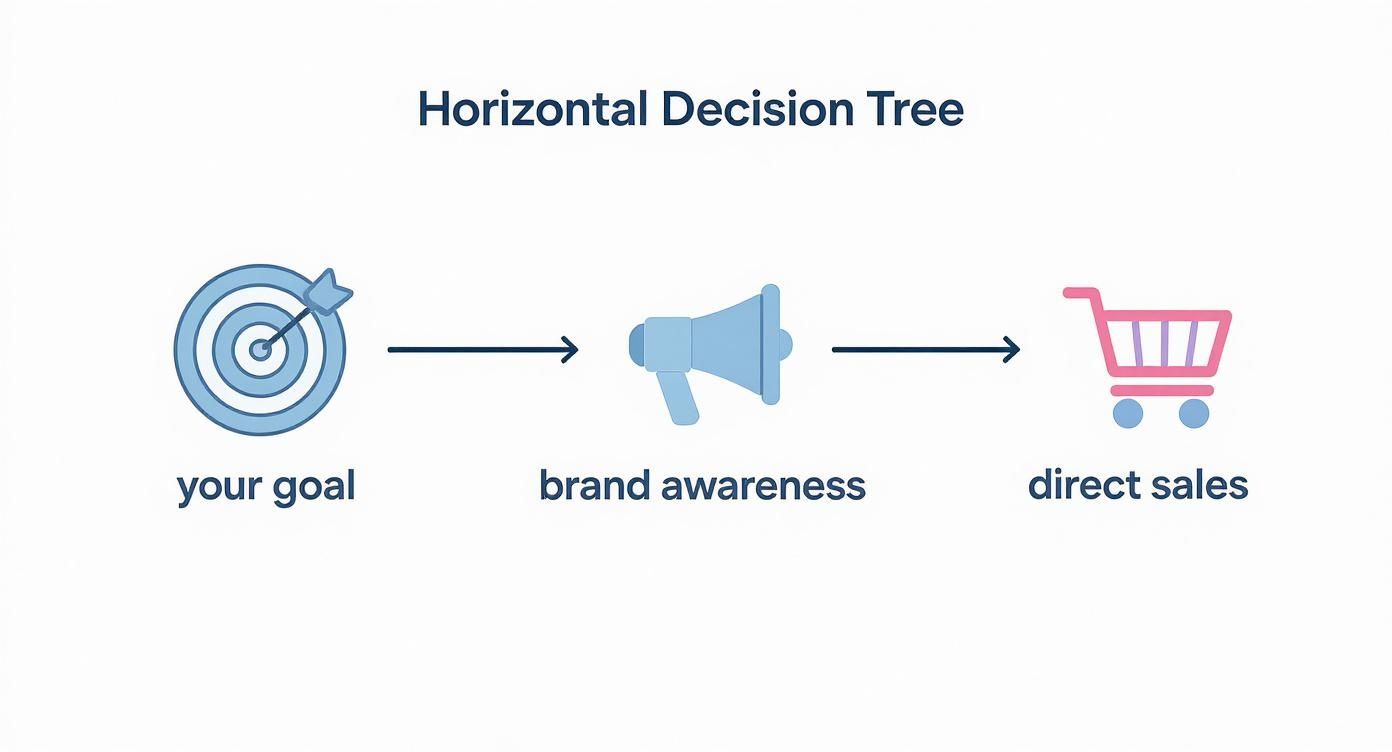
As you can see, campaigns focused on building awareness often find a natural home on TikTok, while those aiming for direct sales are usually better off using Facebook's tried-and-true conversion tools.
A Powerful Synergistic Strategy
The smartest advertisers I know don't just pick one; they use both platforms together. This approach plays to the unique strengths of each, creating a multi-touch customer journey that first captures attention and then closes the deal.
Here’s a simple breakdown of how this synergistic strategy works:
- Build Awareness on TikTok: Kick things off with low-cost, high-reach video ads on TikTok. The goal here isn't to get sales right away. It's about building brand recognition and driving traffic to your website with fun, authentic content that feels native to the platform.
- Drive Conversions on Facebook: Next, use the Facebook Pixel to create a Custom Audience of everyone who clicked through from your TikTok campaigns. Now you can hit that warm, engaged audience with highly targeted retargeting ads on Facebook and Instagram to drive conversions.
This two-step strategy is incredibly effective. You're using TikTok for what it does best—generating cheap, top-of-funnel attention—and then letting Facebook's powerful retargeting engine do the heavy lifting to close sales and boost your Return on Ad Spend (ROAS).
This blended approach just makes sense in today's advertising world. TikTok’s ad revenue is projected to climb to $23.1 billion—a 17.5% jump from the year before—which shows just how much confidence advertisers have in the platform. And while Facebook still commands 38% of the $94 billion global social ad market, its slower growth rate makes it clear that TikTok is a serious contender. You can find more social media ad statistics on sqmagazine.co.uk.
Ultimately, the TikTok Ads vs. Facebook Ads debate isn't about a rivalry. It’s about smart, strategic integration. When you understand how and when to use each platform, you can build a much more resilient and effective advertising machine for your business.
Common Questions, Answered
When you're weighing TikTok Ads against Facebook Ads, a few key questions always pop up. Let's get right into the practical answers you need to make the right call for your brand.
What's a Realistic Starting Budget for Each Platform?
For Facebook Ads, you can genuinely start small. We're talking $5 to $10 per day for an ad set. This makes it incredibly accessible for small businesses just dipping their toes in, letting you test the waters and see what works without a hefty price tag.
TikTok plays a slightly different game. To really give its algorithm the data it needs to find your people, you'll want to commit a bit more. While you can run auction ads for less, a good starting point is around $50 per day. Think of it as giving the platform enough fuel to really get your campaign off the ground and start optimizing properly.
Can B2B Brands Really Make TikTok Work?
It's a fair question. Facebook and LinkedIn are the traditional go-to spots for B2B, but writing off TikTok completely would be a missed opportunity. The key is to change your approach. Forget the hard sell.
Instead of a direct pitch for your software, think about creating a TikTok series sharing killer industry hacks. Or show the human side of your company with behind-the-scenes content or even funny skits about everyday office life. You're not selling a product; you're building a brand people actually like and remember.
This strategy is all about building top-of-funnel awareness. You're connecting with professionals in a place they go to unwind, making your brand more relatable and establishing authority in a low-pressure way.
How Quickly Can I Expect to See Results?
This really depends on your goals and the platform's DNA. With Facebook, if you've dialed in your audience and have a compelling offer, it's not unusual to see leads or sales rolling in within the first few days of a conversion campaign.
TikTok is more of a slow burn that can suddenly catch fire. Sure, a video could go viral overnight and create a massive awareness spike, but tangible business results often take a bit more patience. Plan for a "learning phase" of about 2-4 weeks. This gives the algorithm time to figure out who loves your content and lets your team learn what creative angles actually connect.
Ready to dominate on both platforms? EcomEfficiency bundles 50+ premium ad-spy, AI, and SEO tools—like Pipiads, Semrush, and Midjourney—into one affordable subscription. Stop juggling expensive tools and start building winning campaigns with the ultimate e-commerce toolkit. Learn more about EcomEfficiency.