What Is a Good Click Through Rate for Your Business
So, what is a good click-through rate? The honest answer is… it depends. It’s a frustrating answer, I know, but it’s the truth. Your target CTR shifts dramatically based on your industry and, more importantly, the marketing channel you're using.
An average CTR of 4-6% might be a fantastic goal for a Google Search Ad campaign. But for a display ad, a "good" CTR could be as low as 0.5%, while a perfectly segmented email campaign could hit 10% or more. They all tell a different story.
Defining Your Target Click-Through Rate

I always think of CTR like a shop's window display on a busy street. The total number of people who walk past your store is your impressions. The number of people who actually stop, look at your display, and decide to walk inside? Those are your clicks.
Your CTR is simply the percentage of window shoppers who were intrigued enough by what they saw to step through the door.
A toy store's window will naturally pull in a different crowd than a high-end jewelry store next door. In the same way, your ad's CTR will vary. A flashy, fun ad might get tons of clicks but fewer buyers, while a very specific, technical ad might get fewer clicks but attract highly qualified leads. A "good" CTR, therefore, isn't just one magic number; it’s a benchmark that tells you you're catching the eye of the right people.
If you're still getting familiar with the metric, this guide on What Is Click Through Rate and Why It Matters is a great primer. At the end of the day, the goal isn't just about getting clicks—it's about getting the right clicks from people who are genuinely interested in what you have to offer.
Benchmarks Across Different Channels
Your target CTR is highly dependent on the "league" you're playing in. The mindset of someone actively searching for a solution on Google is completely different from someone casually scrolling through their Instagram feed.
A strong CTR is a measure of relevance. It tells you how well your message—whether it's an ad, an email subject line, or a search result—resonates with a specific audience at a specific moment.
To set realistic goals, it helps to have a high-level overview of what's "normal" for each platform. The table below gives you a quick snapshot of average CTRs to use as a starting point.
Average CTR Benchmarks Across Key Marketing Channels
| Marketing Channel | Average CTR Range | Key Influencing Factor |
|---|---|---|
| Paid Search (Google Ads) | 3% - 6% | Ad relevance and keyword intent |
| Organic Search (SEO) | 2% - 5% (Varies by rank) | Ranking position and title tag appeal |
| Social Media Ads | 0.9% - 1.6% | Creative quality and audience targeting |
| Email Marketing | 2.5% - 4% | Subject line and list segmentation |
| Display Advertising | 0.3% - 0.7% | Visual design and ad placement |
Remember, these are just averages. Your specific industry, audience, and the quality of your creative can push these numbers up or down. Think of them as a compass, not a rigid map.
Paid Search Advertising CTR Benchmarks
When someone types a search into Google, they have a problem they want solved, right now. This is a high-intent moment, and it’s why paid search is such a competitive arena. Your click-through rate here is more than just a metric; it's a direct report card on how well your ad meets that immediate need.
Think of it like this: your ad is an answer to a person's question. A high CTR means your answer was so relevant and compelling that they picked you over everyone else on the page. In paid search, a "good" CTR isn't just for show—it's a powerful signal of relevance that platforms like Google actively reward.
Why Quality Score and CTR Are So Tightly Connected
You can't really talk about CTR in paid search—especially on a platform like Google Ads—without bringing up Quality Score. This is Google's internal rating of how relevant your keywords, ads, and landing pages are to the user. It's a massive factor in determining where your ad shows up and what you end up paying for a click.
A higher CTR is one of the biggest contributors to a strong Quality Score. When lots of people click your ad, it tells Google, "Hey, this is a really helpful result for this search." In return, Google often gives you a few perks:
- Higher Ad Rankings: A killer Quality Score can help you outrank competitors, even if their bid is higher than yours.
- Lower Costs: A better Quality Score almost always leads to a lower cost-per-click (CPC), which means your budget goes a lot further.
Basically, a high CTR proves to the search engine that you deserve better placement at a better price. It creates a positive feedback loop: relevance gets you more clicks, and more clicks improve your overall performance.
What Is a Good CTR for Google Ads?
So, what's a number to aim for? Industry benchmarks are a decent starting point, but they come with a huge asterisk. What’s considered "good" swings wildly from one industry to another. The search intent and competitive pressure for a local pizza shop are worlds apart from a B2B SaaS company.
Recent marketing data suggests a good click-through rate for Google Search Ads is generally somewhere between 4% and 6%. But remember, that's a very broad average. Niches with super high intent can blow that out of the water. For instance, the Arts & Entertainment sector can see an average CTR of 13.1%, while technology and B2B are often closer to 2.09% and 2.41%, respectively. You can dive deeper into these numbers by checking out these click-through rate statistics by industry.
The key takeaway is that your CTR goal has to be grounded in the context of your own industry. A 2.5% CTR might be a massive win in a cutthroat B2B space, while a 7% CTR could be lagging in a high-interest consumer category.
Factors That Influence Paid Search CTR
A few key levers determine whether your paid search CTR climbs or stalls. Nailing these is the difference between a successful campaign and a forgotten one.
- Keyword Relevance: Are you bidding on keywords that perfectly match what the user is actually looking for? An ad for "vegan leather boots" is going to fall flat if it shows up for a broad search like "winter shoes."
- Compelling Ad Copy: Does your headline actually grab attention? Does your description clearly state the benefit and end with a strong call-to-action (CTA)? Generic, boring copy is the fastest way to be ignored.
- Use of Ad Extensions: Sitelinks, callouts, and structured snippets literally make your ad bigger and more informative. They take up more screen real estate and can give your CTR a significant boost.
- Audience Targeting: Are you showing the right ads to the right people? Layering on audience segments lets you serve tailored ads to specific groups, like people who've visited your site before or users with known interests.
Organic Search CTR in the Age of AI
Unlike paid ads where you can just buy your way to the top, organic search is all about earning your spot. For years, the holy grail of SEO has been getting on the first page of Google. But just showing up isn't the win it used to be. The real victory is your organic click-through rate—the percentage of people who actually see your result and feel compelled to click it.
Think of the search results page as a crowded shelf at the supermarket. Ranking #1 gets you on the top shelf at eye level, giving you the best shot. But if your packaging (your title and description) is boring or doesn't promise what the customer is looking for, they'll just scan right past it. A healthy organic CTR is proof that your "packaging" is working. It shows your title tag and meta description are hitting the mark and telling searchers, "Hey, the answer you need is right here."
How Ranking Position Dominates Clicks
It's no secret that the higher you rank, the more clicks you get. But what's really shocking is how brutally steep the drop-off is from one position to the next. Landing in one of the top three spots is a whole different world than ranking anywhere else on page one. People just instinctively trust the top results more, and that trust translates directly into clicks.
The latest data really brings this home. The number one organic result on Google pulls in a massive 39.8% CTR. That’s a slight bump from the previous year, proving that even with all the changes to search, the top spot is still king. The second position gets a respectable 18.7%, but the cliff is steep after that. By the time you get down to positions eight, nine, and ten, the CTRs have tanked to just 2.1%, 1.9%, and 1.6%. You can dig deeper into the numbers in this analysis of Google click-through rates.
The New Challenge: AI Overviews and SERP Features
Google’s search engine results page (SERP) is no longer a simple list of ten blue links. It's a dynamic, almost chaotic, mix of featured snippets, "People Also Ask" boxes, video carousels, and the biggest disruptor of all: AI Overviews. All of these features are designed to give users answers right there on the results page, often making a click to your website unnecessary.
This is a huge new hurdle for organic CTR. If a user gets their answer from an AI-powered summary at the very top of the page, why would they bother scrolling down and clicking on your link?
AI Overviews and other SERP features are basically new competitors for your clicks—even when they’re pulling information from your own website. This is fuel for the rise of the "zero-click search," where a person's search journey starts and ends on Google.
For instance, someone searching "what is the capital of Australia" will see an AI Overview that just says "Canberra." They've got their answer and they're gone. Zero clicks for any of the websites that Google used to generate that answer. The impact is pretty stark: for search queries that trigger an AI overview, the average organic CTR drops to a tiny 0.61%.
This chart puts into perspective how much CTRs can vary across different channels and industries. Context is everything.
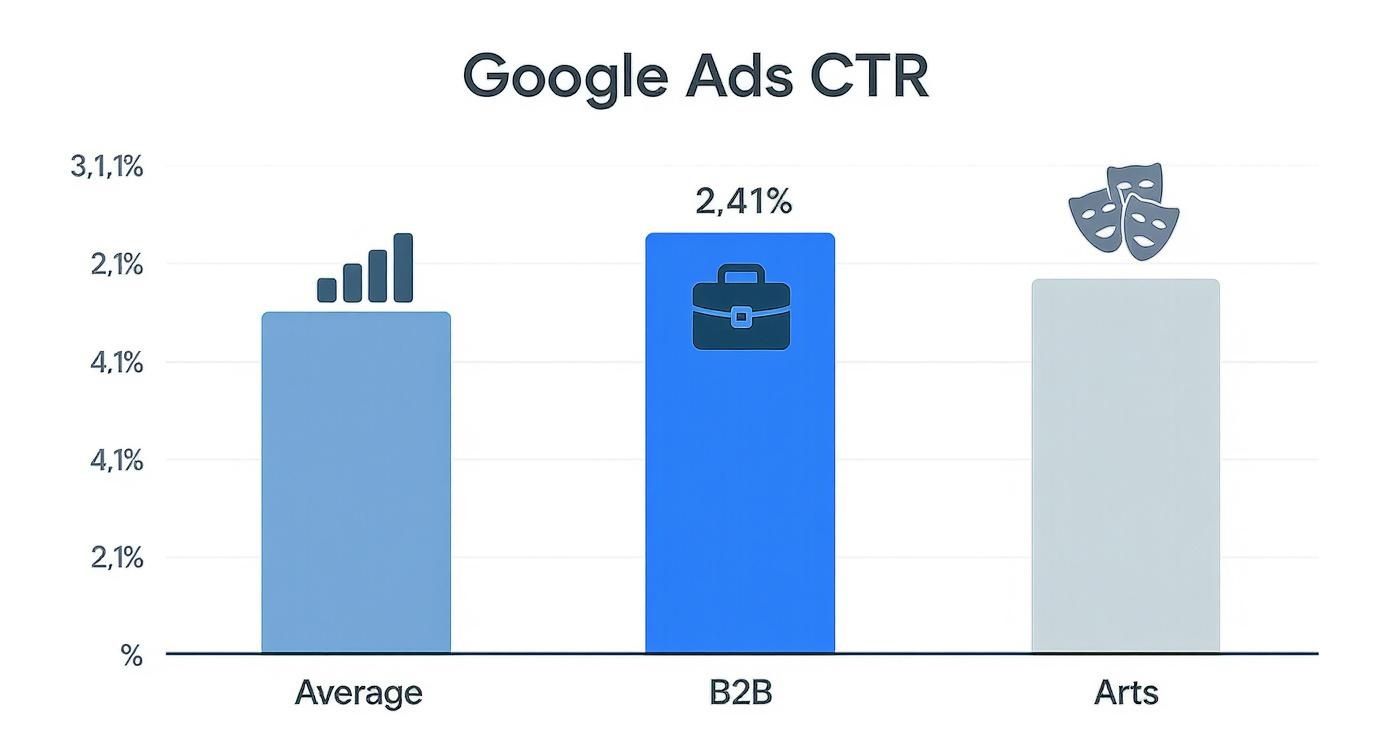
As you can see, an industry with high-intent users like Arts & Entertainment can naturally see much higher CTRs than a more research-focused sector like B2B.
Adapting Your SEO Strategy for Higher Clicks
In this new search landscape, just ranking high isn't going to cut it. Your SEO strategy has to be laser-focused on earning the click, not just the impression.
Here are a few ways to adapt:
- Optimize for Featured Snippets: Go after question-based keywords. Structure your content to provide clear, direct answers right at the top. Nabbing that "Position 0" spot can grab a ton of attention, even if it sometimes answers the query without a click.
- Create Magnetic Title Tags: Your title is your #1 sales pitch on the SERP. Make it irresistible. Use numbers, brackets, and compelling words to spark curiosity and make your result stand out from the crowd.
- Write Compelling Meta Descriptions: Don't let this be an afterthought. Treat your meta description like ad copy. It needs to back up the promise of the title, speak to the user's problem, and gently nudge them to click.
- Leverage Schema Markup: This is a big one. Implementing structured data (schema) can unlock rich snippets in the search results, like star ratings or FAQ dropdowns. These make your listing bigger, more informative, and way more visually appealing, which directly helps boost CTR.
Setting Your Sights on Social Media and Email CTR
Once we step away from search engines, the whole game changes. On social media, you’re not answering a question somebody just asked. You’re trying to interrupt their endless scroll. That shift in user intent is everything, and it completely reshapes what a “good” CTR looks like.
I like to think of social media as a busy city street. People are just walking by, chatting with friends, and looking at interesting things. Your ad is like a street performer trying to get them to stop and watch. A click means you were interesting enough to pull them out of their routine, even for a moment.
What's a Good CTR for Social Media Ads?
Because people on social media are just hanging out, not actively looking for something, the average click-through rates are naturally lower than in search. Honestly, hitting a 1% CTR on a Facebook or Instagram ad is a pretty solid start. But that number is just a starting point—it gets pushed and pulled by your ad creative, your industry, and how dialed-in your targeting is.
The definition of "good" can swing wildly depending on the platform:
- Facebook Ads: The overall average tends to float around 0.9%. But don't get too attached to that number. I've seen legal and B2B clients struggle to hit that, while e-commerce brands with hot products can blow past it.
- Instagram Ads: Instagram is all about the visuals. A stunning video or a striking image can really grab attention, often pushing CTRs to 1% or even higher for campaigns that nail the creative.
- LinkedIn Ads: This is a totally different beast. People are in a professional mindset, so the overall CTR is usually lower, maybe around 0.5%. The trade-off is that each click is often from a much more qualified, high-value lead, especially in the B2B world.
The big takeaway here is that your social media CTR is a direct report card on two things: your ad's "stopping power" and the quality of your audience targeting. A bland ad blasted out to a generic audience is doomed from the start.
Cracking the Code on Email Marketing CTR
Email is probably the most personal channel you've got. A click-through rate here isn't just a number; it's a direct signal of trust from your most loyal audience. When someone opens your email and then clicks a link, they’re consciously acting on the relationship you've built with them.
Unlike paid ads where you're competing for attention, email is more about delivering on the promise you made in the subject line. The open is the first hurdle; the click is proof that your message actually delivered.
Your email CTR is a vital sign for the health of your subscriber list. A high open rate followed by a dismal CTR is a huge red flag. It tells you the subject line wrote a check that the email content couldn't cash.
For email marketing, a healthy CTR generally lands somewhere between 2.5% and 4%. But this is super dependent on your list quality. A targeted campaign to a hyper-segmented list of repeat buyers could easily see a 10% CTR or more. On the flip side, a generic newsletter blasted to a cold, unengaged list might not even break 1%.
The real levers you can pull to improve email CTR are:
- List Health and Segmentation: Sending the right message to the right people is the most powerful thing you can do. Period.
- A Killer Subject Line: You can't get a click without an open, and the subject line is what earns that open.
- A Crystal-Clear Call-to-Action (CTA): Don't make them think. Your email needs one obvious, compelling next step for the reader to take.
Ultimately, your CTR goals for social and email need a different mindset. On social, you’re fighting to earn attention. In email, you’re working to nurture a relationship. Your benchmarks should reflect those very different jobs.
How to Measure Your CTR Performance
Knowing your click-through rate is one thing. Understanding what it's actually telling you about your business is a whole different ballgame. A raw, site-wide CTR is interesting, I suppose, but it's far too broad to be useful. The real magic happens when you start slicing that number into smaller pieces.
To get those insights, you have to go straight to the source. Most marketing and analytics platforms have built-in reporting that makes finding your CTR pretty simple. The trick is knowing where to look and, more importantly, how to segment that data once you’ve found it.
Finding Your CTR in Key Platforms
Your click-through rate lives in a few different spots depending on which channel you're analyzing. Get comfortable with these dashboards, and you’ll be on your way to turning raw data into a clear story about what’s working and what isn’t.
Here’s where you’ll typically track down your CTR:
- Google Search Console: This is mission control for all things organic search. Just head over to the "Performance" report. There, you’ll see impressions, clicks, and the average CTR for your entire site, specific pages, and even individual search queries.
- Google Ads: For your paid campaigns, CTR is a core metric displayed right on the "Campaigns," "Ad Groups," and "Keywords" tabs. This lets you drill down into performance at every level of your account.
- Social Media Ad Managers: Platforms like Facebook Ads Manager or LinkedIn Campaign Manager feature CTR prominently in their reporting columns, making it easy to analyze at the campaign, ad set, or individual ad level.
Tools included in a subscription like EcomEfficiency can pull all this data together, helping you analyze everything from a single dashboard for a much clearer picture.
The Power of Segmenting Your Data
An aggregate CTR is a vanity metric. Seriously. A 5% site-wide organic CTR might sound great on paper, but it hides all the important details.
What if mobile users are clicking at 8%, but desktop users are only clicking at 2%? All of a sudden, that "great" 5% average has revealed a clear problem you need to solve on desktop.
That’s where segmentation comes in. By slicing your data into smaller, more meaningful groups, you can uncover hidden opportunities and diagnose problems that a top-level number would completely gloss over.
For example, this Google Analytics dashboard shows traffic broken down by acquisition channel.
This simple view immediately lets you compare organic search against paid search, social, and other channels to see where your best clicks are really coming from.
True understanding doesn't come from knowing your overall CTR. It comes from knowing which segments are overperforming, which are underperforming, and asking "why?"
Key Segments to Analyze
To get started, break down your CTR reports by these critical dimensions. This process is what takes you from simply knowing your numbers to truly understanding the story they tell about your audience.
- By Device: Are people on mobile, desktop, or tablet clicking at different rates? A low mobile CTR could mean your page titles are getting cut off on small screens or your site isn't as mobile-friendly as you think.
- By Location: Does your ad copy hit differently in certain countries, states, or even cities? This can uncover regional preferences you can lean into for more targeted—and effective—campaigns.
- By Audience: In your ad platforms, segment by demographics like age and gender, or by specific interests. You might just find that one specific group is driving the lion's share of your high-quality clicks.
- By Query (in Search Console): This one is huge. Don't just look at your site's average organic CTR. Dive into the CTR for individual keywords. A page that gets tons of impressions but has a pitiful CTR for its main target keyword is practically begging for a title and meta description rewrite.
Actionable Strategies to Improve Your CTR

Knowing your CTR is one thing, but actually improving it is where the real growth happens. Boosting your click-through rate isn't about throwing things at the wall and seeing what sticks. It's about smart, methodical testing across every single channel.
Think of each part of your message—the headline, the ad copy, the email subject line—as a lever. Your job is to pull the right ones to make people want to click. It’s amazing how a few small, strategic tweaks can lead to a huge jump in traffic and engagement.
Optimize Your Organic Search Appearance
For organic search, the Google results page is your digital storefront. Your title tag and meta description are the window display, and they have to grab someone’s attention while they’re scanning a dozen other options.
A boring title like "Digital Marketing Services" just blends in. But what about something like "Digital Marketing Services [Get a Free Audit]"? Now you've added a clear call-to-action that sparks curiosity.
- Write Magnetic Title Tags: Try adding numbers, brackets, or powerful adjectives. Instead of "How to Improve Your SEO," test "11 Actionable SEO Tips for 2024 [Checklist Included]." It feels more concrete and valuable.
- Craft Compelling Meta Descriptions: Don't just summarize the page; treat this space like ad copy. Speak directly to the searcher's problem and promise a solution.
- Implement Schema Markup: This is a game-changer. Adding structured data can unlock rich snippets like star ratings, FAQs, or event details right in the search results. These visual bells and whistles make your listing pop and can seriously improve CTR.
A well-optimized SERP listing doesn't just rank; it persuades. It answers the user's unspoken question: "Why should I click this result over all the others?"
Refine Your Paid Advertising Campaigns
When it comes to paid ads, your CTR is a direct reflection of how well your message matches your audience. If your CTR is low, it’s a big red flag that there's a disconnect. Maybe your targeting is off, or maybe your copy just isn't resonating.
Continuous A/B testing is how you close that gap. For instance, you could pit two headlines against each other—one focused on a discount ("Save 25% on All Sneakers") and another highlighting a benefit ("Experience All-Day Comfort"). The winner tells you exactly what motivates your customers.
Also, don't sleep on ad extensions. They are one of the fastest ways to boost your paid search CTR. They make your ad physically larger and pack in more useful info, giving people more reasons to click. Once you have a handle on your numbers, you can dig into more actionable strategies to improve your click-through rates to start hitting your goals.
Supercharge Your Email Subject Lines
In email marketing, your subject line has one job and one job only: get the open. No open, no click. It’s that simple. The best ones feel personal, create a little urgency, or make you curious.
Think about the difference here:
- Before: "Company Newsletter - October"
- After: "Sarah, Your Exclusive October Deals Are Inside"
The second one feels personal and hints at real value, making it way more compelling. Don't be afraid to test different tones, lengths, and even emojis to see what your specific audience responds to. What works for a B2B software company probably won't fly for a fashion brand.
High-Impact A/B Testing Ideas to Boost CTR
Not sure where to start? A/B testing is your best friend for making data-driven improvements instead of just guessing. Here are a few high-impact ideas you can try across different channels.
| Element to Test | Channel Application (Search, Social, Email) | Potential Impact |
|---|---|---|
| Headline/Title Tag | Search: Test numbers, questions, or brackets. Social: Try different emotional hooks or lengths. | High |
| Call-to-Action (CTA) | Email: "Shop Now" vs. "See the Collection." Social: "Learn More" vs. "Get Your Free Trial." | High |
| Visuals (Images/Videos) | Social: Lifestyle photo vs. product shot. Display: Animated GIF vs. static image. | High |
| Ad/Email Copy | All: Test long-form vs. short copy. Focus on benefits vs. features. Use a different tone. | Medium-High |
| Personalization | Email: Using the subscriber's name. Social: Targeting based on recent website activity. | Medium-High |
| Emojis & Symbols | Email: In the subject line. Social: In the ad copy. | Medium |
These tests can give you powerful insights into what makes your audience tick. Start with one element, measure the results, and let the data guide your next move.
Answering Your Top CTR Questions
As you start digging into your click-through rate, a few common questions always seem to pop up. Let's tackle them head-on so you can move forward with confidence and make smarter decisions.
Is a High CTR Always a Good Thing?
Not always. While a high CTR can feel like a big win, it’s only a good thing if it’s bringing the right people to your site.
Imagine you're selling high-end, custom-built gaming PCs. You run an ad with the headline, "Get Your Dream Computer Today!" You might get an incredible 15% CTR, but if those clicks are coming from people looking for a cheap laptop for school, none of them will convert. You end up with wasted ad spend and a sky-high bounce rate.
A high CTR paired with a low conversion rate is a classic red flag. It tells you that your ad or title did its job of grabbing attention, but it either set the wrong expectation or attracted a totally unqualified audience. The goal isn't just any click; it's the right click.
How Does CTR Relate to Conversion Rate?
Think of them as two separate, but connected, hurdles in the customer journey.
CTR measures the success of your very first impression—the ad, the email subject line, the search result. It answers one simple question: "Was my message interesting enough to make someone click?"
Conversion rate, on the other hand, measures what happens after that click. It answers the next question: "Did the landing page deliver on the promise and convince the visitor to take action?" You need both to succeed. A great CTR gets people in the door, but a strong conversion rate is what actually turns that traffic into customers.
How Much Data Do I Need for a Reliable CTR?
This is a critical question, especially when you're A/B testing. Making a call based on a handful of clicks is a recipe for disaster.
While there's no single magic number, a solid rule of thumb is to wait until you have at least 100 clicks for each version you’re testing. For campaigns or pages with less traffic, aiming for a minimum of 1,000 impressions per variation is a good starting point.
This gives you a large enough sample size to trust the results and ensure you're not just looking at random noise. Acting on "thin" data is one of the easiest ways to make a bad optimization decision.
Ready to streamline your marketing and boost your e-commerce performance? With EcomEfficiency, you get access to 50+ premium AI, SEO, and ad-spy tools in one affordable subscription. Stop juggling dozens of expensive tools and start making data-driven decisions that grow your business. Explore the EcomEfficiency toolkit today.