What Is Competitor Analysis in Marketing to Outperform Rivals
In marketing, competitor analysis is simply the act of figuring out who you're up against and what they're doing. It’s like a reconnaissance mission for your business, helping you understand their strategies, pinpoint their strengths, and—most importantly—exploit their weaknesses.
This process is what helps you spot gaps in the market, get ahead of trends, and make smart, informed decisions that actually grow your business.
Understanding Competitor Analysis in Marketing
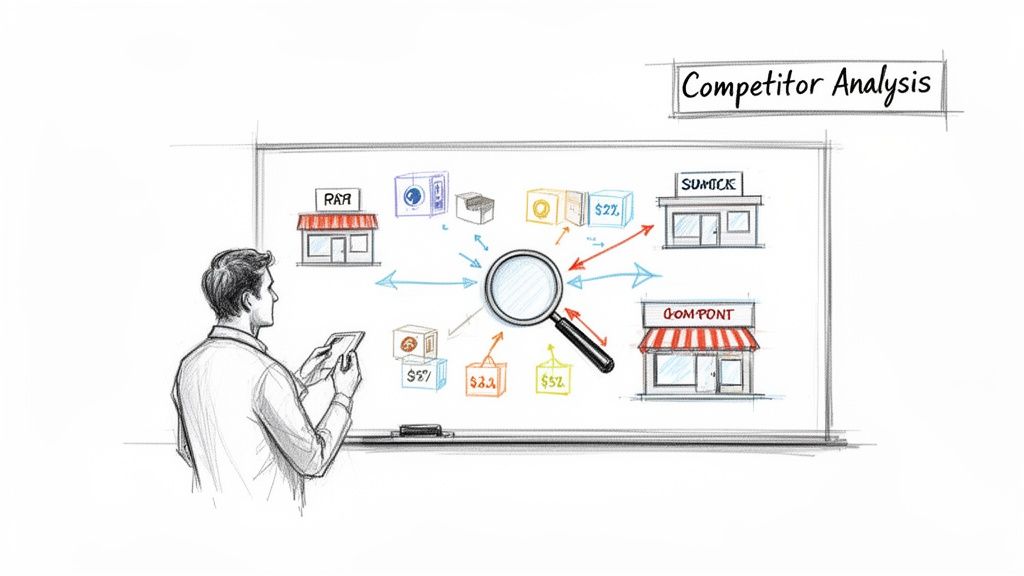
Think of it like coaching a sports team for a championship game. You wouldn't just tell your players to go out there and "play their best." You'd spend hours studying the other team's game tapes, breaking down their best plays, and identifying their weakest links.
That's exactly what competitor analysis in marketing is. It's your game tape. It’s the structured process of taking apart your rivals' entire playbook—from their product features and pricing to their ad campaigns and customer service.
This isn’t just about playing defense and keeping an eye on what everyone else is doing. It’s about building a powerful offensive strategy to grab market share and win the loyalty of your customers. For anyone selling on Shopify, Amazon, or TikTok, this isn't just a nice-to-have; it's essential.
Beyond Simple Observation
A real analysis is much more than a quick look at a competitor's homepage. It’s a deep, systematic review of everything that makes their business tick, giving you a complete picture of where they stand in the market. To really get a handle on this and see the steps involved, this guide on how to conduct competitive analysis effectively is a great resource.
The whole point is to find clear answers to some critical questions about your rivals:
- Product Strategy: What exactly are they selling? What are the standout features, and what's the general perception of their quality?
- Pricing Models: How are they pricing things? Are they a discount brand, do they offer subscriptions, or is their pricing based on value?
- Marketing Channels: Where are they getting their customers? Are they killing it on social media, dominating Google search results, or running a killer email list?
- Customer Reputation: What are real customers saying about them in reviews and social media comments?
By answering these questions, you move from just knowing who your competitors are to truly understanding them. This is where you find your strategic advantage, allowing you to predict their next move instead of just reacting to it.
Why This Process Matters for Growth
At the end of the day, competitor analysis isn't about blindly copying what others are doing. It's about finding the opportunities they’ve completely missed.
Maybe their customer support is notoriously slow, which opens the door for a brand that makes fast, friendly service its top priority. Or perhaps their social media presence is bland and uninspired, leaving a huge opening for more engaging and creative campaigns.
By carefully sizing up the competition, you uncover these "white space" opportunities. This is how you differentiate your brand, sharpen your unique selling proposition, and build a stronger, more resilient business that can outlast and outperform the competition.
Why E-commerce Sellers Need Competitor Analysis
Let's be honest, the world of e-commerce is a battlefield. Whether you're on Shopify, Amazon, or TikTok, you're not just selling products; you're fighting for attention, clicks, and every single sale. Competitor analysis is your secret weapon in this fight—it's what helps you cut through the noise.
Think of it as the difference between guessing what might work and knowing what actually does. It stops you from blindly throwing money at ad campaigns that go nowhere and instead helps you aim your resources with precision. This is how you find hidden opportunities and sidestep the costly mistakes your rivals have already made for you.
Find Your Unique Edge in a Crowded Market
When you systematically break down what your competitors are doing, you start seeing the things they aren't doing. You can spot untapped product niches, sharpen your unique selling proposition (USP), and get a crystal-clear picture of the customer pain points they’re completely missing. This is how you carve out a space that's truly yours.
Imagine you're running a Shopify store. Using a tool like Pipiads, you could spot a competitor's TikTok ad that's absolutely crushing it. With that intel, you can figure out why it works and launch a campaign that’s even better, grabbing a bigger piece of that audience.
Or say you're an Amazon seller. A platform like Helium10 can show you exactly how a top-ranking competitor tweaks their pricing in real-time. Suddenly, you're not just guessing anymore—you can adjust your own strategy to win the Buy Box and drive more sales.
Competitor analysis transforms your strategy from reactive to predictive. You’re not just keeping up; you're anticipating market shifts and positioning your brand to take full advantage of them before anyone else.
The value here isn't just theoretical. The market for competitive intelligence software among small and mid-sized businesses is exploding, set to jump from $2.56 billion in 2023 to an estimated $6.02 billion by 2030. This surge is fueled by sellers just like you needing to track everything from a rival's pricing to their latest ad creative. For a closer look at what's driving this, you can explore more insights on competitive analysis trends.
Translate Insights Into Profit
At the end of the day, understanding your competitors is about one thing: building a more profitable, sustainable business. Every piece of data you collect should point toward an action you can take to improve your own performance.
The benefits are direct and you can feel them on your bottom line:
- Avoid Costly Mistakes: See which product launches fizzled out or which marketing campaigns fell flat for your competitors, so you don't waste your own time and money making the same errors.
- Optimize Ad Spend: Pinpoint the exact channels and ad styles that are already proven to work for others. This means your marketing budget gets spent where it will have the biggest impact.
- Price Smarter: Get a firm grasp of the market's pricing sweet spot. This lets you position your products for maximum profit without scaring away potential buyers.
- Identify Market Gaps: Discover what customers are asking for but not getting. This is where you can swoop in with new products and create entirely new revenue streams.
This whole process gives you a clear roadmap. It turns the often-chaotic world of e-commerce into a landscape of strategic opportunities, helping you move from just surviving to truly thriving.
The Four Pillars of Competitor Analysis
To get a real handle on your competitors, you can’t just poke around their website and call it a day. You need a game plan. Without a solid framework, you'll end up with a messy pile of random data, not the actionable insights that actually move the needle.
I like to break it down into four core pillars. Think of it as a systematic way to deconstruct a competitor's entire strategy, piece by piece. This approach turns a daunting task into a manageable checklist, revealing their strengths, weaknesses, and—most importantly—the opportunities they’ve left wide open for you.
Pillar 1: Product and Pricing Strategy
First things first, let's talk about what they're actually selling. This pillar is all about getting to the heart of their business: their products and how they price them. It’s more than just a product list; it’s about understanding their position in the market.
Here’s what to zero in on:
- Product Quality and Features: What’s their claim to fame? Are they the durable option, the one with cool new features, or the premium, high-end choice?
- Pricing Model: Are they the cheapest on the block, or do they command higher prices by promising better quality? Keep an eye out for how they use discounts, product bundles, and subscription offers to sweeten the deal.
- Unique Selling Proposition (USP): Every brand has that one thing they shout about. What's theirs? This is the core message they build their entire brand around.
Pillar 2: Marketing and Sales Channels
Next up, how are they getting customers in the door? This pillar is all about reverse-engineering their marketing engine to figure out which channels are actually driving sales and growth. By dissecting their marketing, you can see exactly where their audience hangs out and which messages get them to click "buy."
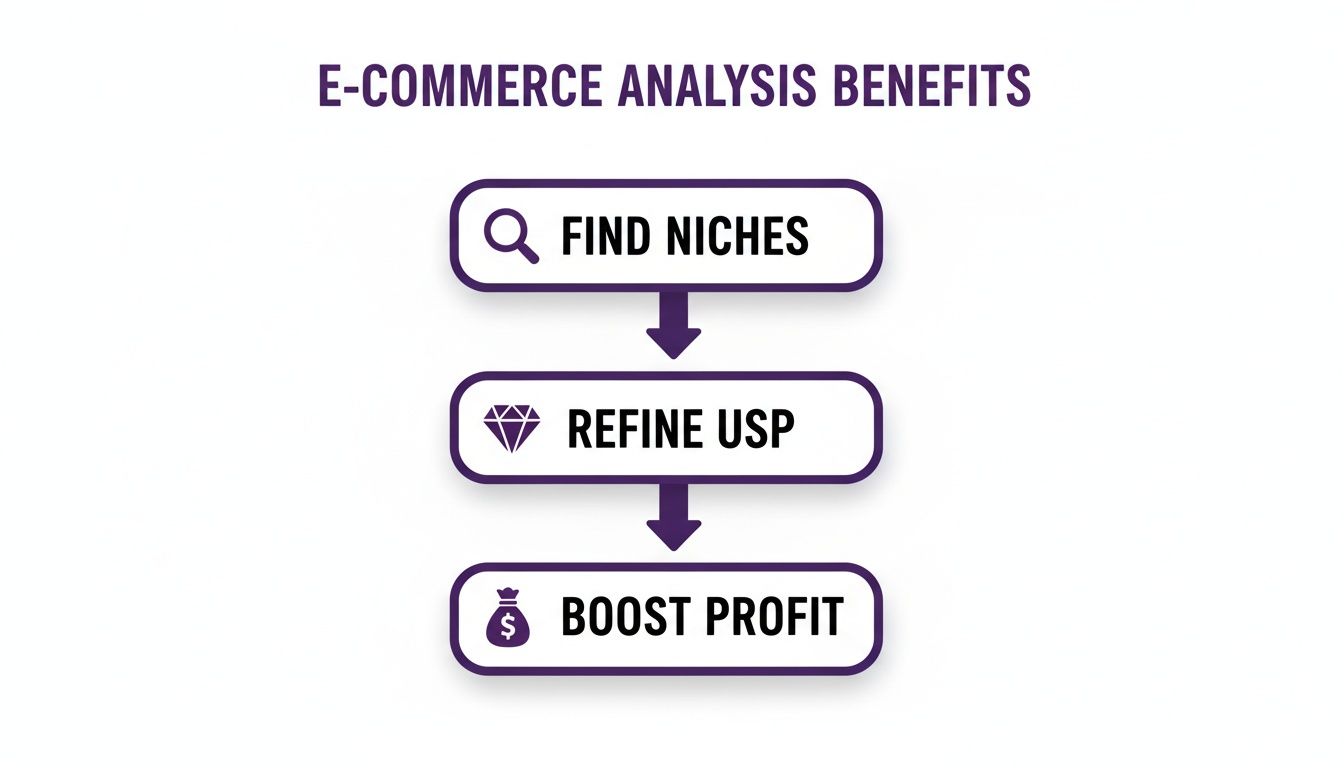
The image above shows how this all connects. It starts with finding those market gaps and leads directly to a healthier bottom line.
Pillar 3: Customer Experience and Brand Reputation
What a brand thinks of itself is one thing; what customers actually say is what truly matters. This third pillar is about becoming a fly on the wall and listening to real customer feedback. Their unfiltered comments on reviews, forums, and social media are a goldmine of intel on your competitor’s biggest wins and face-plants.
By analyzing customer sentiment, you can quickly identify gaps in their service that your brand can fill. A pattern of complaints about slow shipping, for example, is a clear opportunity to highlight your own fast and reliable delivery.
Pillar 4: Business Operations and Strengths
Finally, let’s zoom out and look at the big picture. This pillar is about sizing up their overall business health, market standing, and any potential weak spots. Getting a sense of their operational backbone helps you anticipate their next move and figure out if they’re in it for the long haul. Look at things like their market share, recent funding, or even the size of their team to gauge their resources and ambition.
Taking this four-pillar approach gives you a complete 360-degree view. It's not just a "nice to have," either. Upcoming 2025 marketing trends show that businesses that consistently analyze their competition see conversion boosts of 20-35%. This is about getting smart. For example, if a major rival is completely ignoring TikTok, you have a golden opportunity to dominate that channel and achieve 50% higher reach. You can dive deeper into the latest marketing statistics on HubSpot.
To tie it all together, here's a quick-reference table summarizing the key metrics you should be tracking for each pillar.
Key Competitor Metrics to Track Across E-commerce Pillars
| Analysis Pillar | Key Metrics to Track | Example Insight |
|---|---|---|
| Product & Pricing | Product assortment size, average price point, discount frequency, key features, USP | Competitor A discounts their top-selling item by 20% on the last weekend of every month. |
| Marketing & Sales | Top traffic sources (SEO, PPC, Social), social media engagement rates, email newsletter frequency, ad spend estimates | Competitor B gets 60% of their traffic from organic search, focusing heavily on long-tail keywords. |
| Customer Experience | Average review ratings (Google, Trustpilot), common complaints/praises, shipping/return policy clarity | Customers frequently praise Competitor C's packaging but complain about slow customer service response times. |
| Business Operations | Estimated market share, number of employees, recent funding announcements, technology stack (e.g., Shopify, Magento) | Competitor D just hired 10 new software engineers, suggesting a push towards a new tech feature or app. |
This table acts as a great starting checklist. As you get more advanced, you can add more specific metrics tailored to your industry, but these four pillars provide a rock-solid foundation for any e-commerce brand.
A Step-By-Step Guide to Your First Competitor Analysis
Okay, now that you've got the core concepts down, it's time to roll up our sleeves and get practical. A structured workflow is what separates a one-off research project from a powerful, repeatable habit that fuels your strategy. This five-step process will give you a clear path from identifying your rivals to making your next move.
Following a consistent framework is the secret sauce here. It makes sure you're not just collecting random facts, but gathering the right data and knowing exactly what to do with it.
Step 1: Identify Your Real Competitors
First things first: you need to know who you’re actually up against. Not all competitors are the same, and trying to watch everyone is a recipe for disaster. The key is to sort them into different leagues so you can focus your energy where it counts.
- Direct Competitors: Think of these as the brands in your weight class. They sell nearly identical products to the same people you do. If you have a Shopify store selling premium leather dog collars, your direct competitor is another online shop with a similar line of fancy collars.
- Indirect Competitors: These businesses are solving the same problem, just with a different solution. For that dog collar brand, an indirect competitor might be a company selling rugged nylon collars or even high-tech GPS tracking tags. The customer need is the same—a great collar—but the product is different.
- Aspirational Competitors: These are the big fish. The leaders you admire. They might not be your direct rival today, but studying what makes them successful gives you a brilliant blueprint for your own growth.
Step 2: Select Your Intelligence-Gathering Tools
You can't analyze what you can't see. The right tools are like your personal reconnaissance drones, giving you a bird's-eye view of your competitor's entire operation. A good toolkit doesn't have to break the bank; it just needs to cover the essential bases.
For most e-commerce sellers, a solid starting stack usually includes:
- SEO & Web Traffic Tools: Platforms like Semrush or Similarweb are fantastic for this. They'll show you where your competitor's website traffic is coming from, the keywords they rank for, and how their online footprint stacks up against yours.
- Ad Intelligence Platforms: If you’re active on TikTok, a tool like Pipiads is a game-changer. It lets you peek behind the curtain to see the exact ad creatives your rivals are running, get an idea of their ad spend, and see which campaigns are crushing it.
- Sales & Store Trackers: For Amazon or Shopify sellers, tools such as Helium10 or ShopHunter can give you solid estimates on a competitor's sales volume and reveal which of their products are bestsellers.
Step 3: Collect Data Across the Four Pillars
With your tools fired up, it’s time to start gathering intel. Use that four-pillar framework we talked about earlier (Product, Marketing, Customer Experience, Business Operations) to keep everything organized. This prevents your research from spiraling out of control.
This organized approach is your best defense against data overload. Instead of ending up with a jumbled mess of facts, you’ll have a neat, structured profile for each rival, making it way easier to compare them side-by-side and spot the patterns that matter.
Step 4: Run a SWOT Analysis
Okay, you've got the data. Now what? This is where the classic SWOT analysis comes in—it’s how you turn all that raw information into actionable insights. It’s the perfect framework for spotting where you can attack.
For each of your main competitors, map out their:
- Strengths: What are they genuinely great at?
- Weaknesses: Where are their obvious gaps, flaws, or failures?
- Opportunities: What market trends or changes could they take advantage of?
- Threats: What external factors could knock them off their game?
Your golden opportunity is almost always hiding in the gap between their strengths and their weaknesses.
Step 5: Turn Insights Into Action
This is the final and most important step. An analysis without action is just expensive trivia. It's time to create a prioritized to-do list for your own brand.
Look at your SWOT findings and ask yourself one simple question: "Based on everything we just learned, what are the top three things we can do right now to get ahead?"
That’s it. You’ve just turned a mountain of data into a clear, actionable roadmap for growth.
Building Your E-commerce Intelligence Toolkit
Trying to manually dig up competitor data is like trying to map the ocean with a bucket and spade. It's slow, exhausting, and you’ll only ever see what’s happening on the surface. To do competitor analysis right, you need a modern toolkit. These platforms are your sonar, revealing the hidden currents of your rivals' strategies with speed and precision.
The right software stack isn’t just a time-saver; it unlocks data that would otherwise be completely invisible. Think of each tool as a specialist on your intelligence team, bringing a unique piece of the puzzle to the table. When you combine their insights, you get a powerful, 360-degree view of the competitive battlefield, turning guesswork into a real strategic advantage.
Key Tool Categories For E-commerce Sellers
For any e-commerce brand, a solid intelligence toolkit usually covers four critical areas. Each category helps you unpack a specific part of your competitor’s business, from how they get customers in the door to how much they’re actually selling.
SEO & Keyword Analysis Tools: Platforms like Semrush are non-negotiable for understanding a competitor's organic search strategy. They show you exactly which keywords your rivals rank for, where their traffic is coming from, and how strong their backlink profile is. This is how you find those golden keyword gaps to target with your own content.
Ad Intelligence Tools: If you want to dissect a competitor's paid social media strategy, you need an ad spy tool. A platform like Pipiads lets you see the exact video ads they're running on TikTok, giving you a front-row seat to their best creatives, ad copy, and campaign angles.
Sales & Store Tracking Tools: Ever wonder how much your competitors are really selling? Tools such as Helium10 (for Amazon) or ShopHunter (for Shopify) provide data-driven estimates of a rival's sales volume, best-selling products, and revenue trends. This is crucial for benchmarking your own performance against the market leaders.
Market Trend Research Tools: Getting ahead means spotting opportunities before everyone else does. Services like Exploding Topics analyze millions of searches and online conversations to flag emerging trends, products, and consumer interests long before they go mainstream.
Building a complete toolkit isn't about having the most tools—it's about having the right tools. The goal is to create a cost-effective stack that provides a comprehensive, multi-layered view of your competitors' every move, from their marketing funnels to their sales performance.
A great way to get started is by comparing the heavy hitters to see which ones fit your specific needs and budget.
Competitor Analysis Tool Comparison
This table breaks down the main categories of tools, giving you a clearer picture of what each one does and the kind of information you can expect to get from it.
| Tool Category | Example Tools | Primary Use Case | Key Insight Example |
|---|---|---|---|
| SEO & Keywords | Semrush, Ahrefs | Uncovering organic search strategies and content opportunities. | "My competitor gets 20% of their organic traffic from a blog post about 'sustainable packaging alternatives'." |
| Ad Intelligence | Pipiads, AdSpy | Analyzing paid ad campaigns on social media and search. | "My top rival has been running the same TikTok ad for 3 months; it must be a winner. Let's analyze it." |
| Store & Sales Data | ShopHunter, Koala Inspector | Estimating Shopify store revenue and product performance. | "Their best-selling product is the 'Deluxe Coffee Grinder,' which generates an estimated $50,000/month." |
| Market & Trend Research | Exploding Topics, Google Trends | Identifying emerging consumer interests and product demand. | "Searches for 'mushroom coffee' have grown by 300% in the last 6 months. This could be a new product line." |
Choosing the right combination of software ultimately empowers your brand to make smarter, data-driven decisions that fuel real growth. For a more detailed breakdown of options, check out guides like this one covering the 12 Best Competitive Analysis Tools for Marketers.
Common Questions About Competitor Analysis
As you start digging into competitor analysis, you're bound to have a few questions. That's perfectly normal. Let's clear up some of the most common ones so you can move forward with a solid plan. Think of this as your quick-start guide to the tricky bits.
How Often Should I Analyze Competitors?
There's no single right answer, but it's all about finding a rhythm that works. For a deep-dive analysis, aim for quarterly. This is frequent enough to catch important shifts in their marketing, pricing, or product catalog, but not so often that you’re just chasing noise.
That said, you also need a more casual, ongoing check-in. This could be a weekly glance at their social media ads or new product drops. In super fast-paced spaces like TikTok Shop, you might even peek at your biggest rivals daily. The point is to never be caught off guard by a major move they make.
Think of it like checking the weather. You glance at the daily forecast for today's plans, but you look at the seasonal forecast to plan your wardrobe for the months ahead. Your competitor analysis needs both tempos.
Direct vs. Indirect Competitors Explained
Knowing who you're up against is critical. You don't want to waste time analyzing a brand that isn't actually a threat.
- Direct Competitors: These are the brands you go head-to-head with every day. They sell a very similar product to the exact same audience. If you sell premium, eco-friendly yoga mats, another brand doing the same thing is your direct competition.
- Indirect Competitors: These businesses solve the same core problem for your customer, just with a different product. For that yoga mat seller, an indirect competitor might be a company selling high-end yoga towels or even a popular app for at-home yoga classes. They're both competing for the same customer's "wellness" budget.
When you're starting out, put 80% of your focus on direct competitors. Their moves will affect your sales most directly.
How Do I Analyze a Rival's Social Media Strategy?
Looking at a competitor's social media is about more than just counting followers. You have to figure out the why behind what they're posting. A good way to start is by asking three simple questions:
- What’s their content mix? Try to categorize their posts. Is it 50% slick product shots, 30% user-generated content, and 20% behind-the-scenes videos? This tells you their priorities.
- What content actually works for them? Look for the posts with the most engagement. Are videos getting more love than static images? Do customer stories get more comments than influencer collabs? This is a huge clue about what their audience wants to see.
- What are they spending money on? Use an ad library tool to see the actual ads they're running. This is the ultimate signal. If they're putting cash behind an ad, it's because it's working.
Can This Help Me Find New Product Ideas?
Absolutely. This is one of the most powerful—and underrated—uses of competitor analysis. The gold is hidden in your competitors' customer feedback and complaints.
Go through their product reviews, social media comments, and community forums. Look for patterns. If you see dozens of people saying, "I love this, but I wish it came in a travel size," you’ve just stumbled upon a validated market gap. By collecting these little nuggets of feedback from across your competitors, you can build a data-driven list of your next big product ideas.
Ready to stop guessing and start winning? EcomEfficiency bundles over 50 premium e-commerce tools for SEO, ad intelligence, and product research into one simple subscription. Get the insights you need to dominate your market without the crippling software costs. Start analyzing your competitors like a pro today. Learn more at EcomEfficiency.