What Is Search Intent In SEO A Guide For E-Commerce

Search intent is simply the "why" behind what someone types into a search bar. It's the core reason for their search. Are they looking to learn something new, find a specific website, or are they ready to pull out their credit card and buy something right now?
The goal is to scale without dubious shortcuts and without hurting your credibility.
Getting this right is what separates content that climbs the rankings from content that just sits there, collecting digital dust.
Why Search Intent Is The Heartbeat Of Modern SEO
Think of your e-commerce store like a real-world, brick-and-mortar shop. You'll have people who are just browsing, others who are carefully comparing your products to the store next door, and a few who walk straight to the counter, cash in hand. Search intent is just the digital version of understanding what each person wants the moment they arrive.
It wasn't always this way. In the early days of SEO, ranking was all about keyword density. If you wanted to rank for "running shoes," you just stuffed that phrase onto your page as many times as you could. But Google got a whole lot smarter.
Today, its algorithm doesn't just see words; it understands purpose. It knows someone searching "how to clean white running shoes" needs a helpful guide, not a product page trying to sell them a new pair.
This shift is now the absolute foundation of effective SEO. In fact, pages that get the intent wrong can see bounce rates skyrocket past 70%. On the flip side, content that perfectly matches what the user is looking for keeps them engaged three to four times longer.
"Think of search intent as the unspoken question a user is asking Google. Your job is to provide the most direct, satisfying, and helpful answer. When you succeed, Google rewards you with higher rankings because you've helped them achieve their primary goal: user satisfaction."
For an e-commerce business, this isn't just theory—it's your direct line to more revenue. When you unlock sales by aligning content with customer intent, you're building a bridge between the products you sell and what your customers are actively searching for.
The Four Primary Search Intents At A Glance
To put this into practice, you first need to get a handle on the main types of "shopping missions" your customers are on. Just about every keyword you target will fit into one of four primary categories. Learning to spot them is the first real step in building an SEO strategy that actually works.
Here’s a quick breakdown to get you started.
| Intent Type | What The User Wants | Example Keyword |
|---|---|---|
| Informational | To learn something or find an answer to a specific question. | "how to choose a coffee maker" |
| Navigational | To find a specific website or a particular page on that site. | "EcomEfficiency login" |
| Commercial | To research and compare products before making a purchase. | "best drip coffee maker reviews" |
| Transactional | To complete a purchase or take immediate action. | "buy Breville coffee maker sale" |
Getting familiar with these categories lets you think like your customer, not just a marketer. It helps you build the right kind of page—be it a blog post, a product comparison, or a category page—that gives the user exactly what they came for. That alignment is what turns organic traffic into predictable growth for your store.
Decoding The Four Main Types of Search Intent
To really get a handle on search intent, you need to understand the four main "missions" a user is on when they type something into Google. Think of it like a physical retail store: some people are just browsing and learning, others are looking for a specific aisle, some are comparing prices between two brands, and a few are at the checkout counter, ready to buy.
This mind map nails down why matching intent is so critical. It visually connects the why behind a search to real-world business results, like better rankings and, ultimately, more sales.
As you can see, giving the searcher exactly what they need is the most direct path to the SEO wins every e-commerce business is after. Let’s break down the four intent types that make this happen.
Informational Intent: The Knowledge Seeker
Users with informational intent are in pure learning mode. They’ve got a question or a problem and are turning to Google for an answer—they aren't looking to buy anything just yet.
Imagine someone is just getting into running. Their searches might look something like this:
- "how to choose running shoes"
- "what is pronation in running"
- "benefits of minimalist running shoes"
These folks are at the very top of your sales funnel. They’re gathering information and building awareness. Trying to force a product on them now would be like a store clerk shoving a shoe in the face of someone who just walked in to ask for directions. It’s a bad look.
For these users, your goal is to be the most helpful expert in the room. By providing clear, comprehensive answers, you build trust and establish your brand as a credible authority, making it more likely they will return when they are ready to buy.
The right play here is to publish high-quality blog posts, how-to guides, and detailed articles that genuinely answer their questions without a hard sales pitch.
Navigational Intent: The Destination Finder
Next up is navigational intent, which is by far the most straightforward. The searcher already knows exactly where they want to go online and is just using Google as a fast pass to get there.
You’ll see searches like:
- "EcomEfficiency login"
- "Nike returns policy"
- "Amazon account page"
Ranking for your own brand name should be a given. The real lesson here is that trying to hijack another brand's navigational search is a fool's errand. Someone typing "Facebook" wants to go to Facebook, not your blog post about it. Just focus on your own turf.
Commercial Investigation: The Comparison Shopper
This is where it starts to get really interesting for e-commerce. A user with commercial investigation intent is seriously thinking about buying but hasn't pulled the trigger. They are squarely in the middle of the funnel, comparing their options, digging through reviews, and hunting for the best possible solution.
These searches often include words that signal they're weighing their options:
- "best running shoes for flat feet"
- "Asics vs Brooks running shoes"
- "Hoka Clifton 9 review"
This person is a savvy shopper who wants detailed guides, honest reviews, and side-by-side comparisons to feel confident in their choice. They’re so close to buying but just need that last bit of validation. Content like "best of" lists, in-depth product reviews, and comparison articles are pure gold for capturing this high-value traffic.
Transactional Intent: The Ready-to-Buy Customer
Finally, we have transactional intent. This is the moment every e-commerce store owner lives for. The user has done their homework, made up their mind, and is ready to take action. They have their wallet out.
Their keywords are laser-focused and scream "I want to buy this now":
- "buy Nike Air Force 1 size 10"
- "Hoka running shoes sale"
- "discount code for running warehouse"
These are your money keywords. When someone makes a transactional search, they expect to land on a product or category page where they can add to cart and check out. Any friction—like sending them to a blog post—is a guaranteed way to lose a sale. Your product pages, category pages, and special offer landers need to be optimized and ready for this traffic.
How To Identify Search Intent From SERP Clues
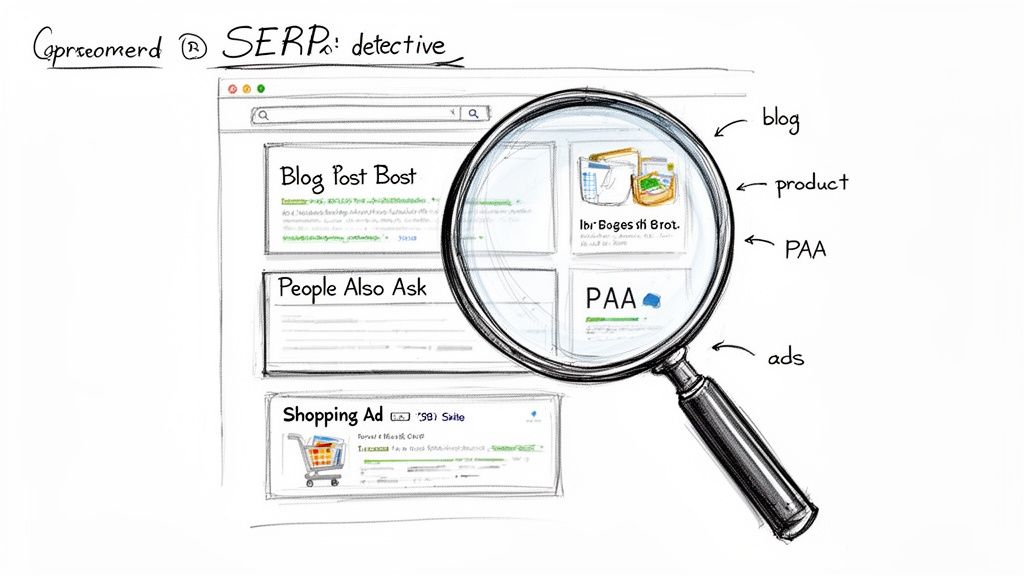
You don’t need a crystal ball to figure out what your customers are looking for. You just have to learn how to read the clues Google leaves right on the search results page. Think of the SERP as the ultimate cheat sheet.
Google’s entire business model depends on giving people the most helpful results. This means the pages ranking at the top are a direct reflection of what Google’s algorithm believes will satisfy a searcher's goal. By learning to analyze these results, you can stop guessing and start making confident, data-backed decisions.
The Anatomy Of A Results Page
The first step is always the simplest: search for the keyword yourself. Take a hard look at what shows up.
Are the top spots filled with in-depth blog posts and how-to guides? That’s a massive clue pointing straight to informational intent. People want to learn, not buy just yet. On the flip side, if you see a grid of product pages from major retailers, you’re looking at transactional intent. These searchers have their wallets out, and Google knows it.
The most powerful insight you can gain is by observing the types of pages Google has already chosen to reward. If the top 10 results are all blog posts, your product page has almost no chance of ranking there, no matter how well-optimized it is.
Beyond the main organic listings, keep an eye out for the special features Google sprinkles throughout the page. These SERP features are direct signals of user intent.
- Shopping Ads: A carousel of products at the top is a dead giveaway for commercial or transactional intent.
- "People Also Ask" (PAA) Boxes: This section highlights related questions, signaling strong informational intent.
- Featured Snippets: When Google pulls a direct answer to the top, it confirms the searcher wants a quick, concise, informational answer.
- Local Pack: Seeing a map with business listings means there's a strong "near me" or local intent, even if the search query doesn't explicitly say so.
Decoding Keyword Modifiers
While the SERP gives you the big picture, the specific words people add to their searches—called modifiers—are like flashing neon signs. These little words carry a ton of weight and tell you exactly what kind of content to build.
For example, a search for "running shoes" is pretty vague. But add a modifier, and everything changes. A search for "best running shoes" instantly signals they're in the comparison stage. This is a classic case of commercial investigation.
These subtle changes in language completely transform the searcher's goal. Paying attention to these modifiers is one of the fastest ways to get a read on intent.
To help you get started, here's a quick reference table that connects common modifiers to their likely intent and the type of content you should create.
Mapping Keyword Modifiers To Likely Intent
| Keyword Modifier | Likely Search Intent | Example Content Type |
|---|---|---|
| how to, what is, guide, tutorial, tips | Informational | Blog Post, How-To Guide |
| best, top, review, vs, comparison | Commercial Investigation | Listicle, Comparison Page |
| buy, deal, discount, sale, coupon | Transactional | Product Page, Category Page |
| near me, [city name], local | Navigational / Local | Local Landing Page, GMB Profile |
| brand name, website name | Navigational | Homepage, Login Page |
This table isn't exhaustive, but it's a solid starting point for recognizing patterns. The more you analyze keywords in your niche, the more you'll see these modifiers pop up, guiding your content strategy.
A Practical Checklist For SERP Analysis
To make this process easy to repeat, use a quick checklist every time you're sizing up a new keyword. This ensures you don’t miss any crucial clues. If you want to go deeper on this topic, check out this excellent guide on mastering search query analysis.
- Analyze Top Organic Results: What's the dominant format—blog posts, product pages, or category pages?
- Check for SERP Features: Do you see Shopping Ads, PAA boxes, a Featured Snippet, or a Local Pack?
- Examine Titles and Meta Descriptions: Look for transactional words like "buy," "sale," or "deal." Note informational phrases like "how to" or "guide."
- Identify Keyword Modifiers: Does the query contain words like "best," "review," "vs," "price," or a location?
- Synthesize Your Findings: Based on the evidence, confidently assign a primary intent: Informational, Navigational, Commercial, or Transactional.
By consistently using this framework, you'll move beyond just looking at search volume. You’ll start to understand the human on the other side of the screen, allowing you to create content that perfectly matches their needs, satisfies Google, and drives better traffic to your store.
Matching Content Types To Search Intent
Knowing the theory is one thing, but actually putting it to work is what separates a struggling e-commerce store from a thriving one. The goal is to stop throwing content at the wall to see what sticks and start creating a smart content map where every page has a clear job to do.
Think of it like this: you wouldn’t use a hammer to turn a screw. So why would you use a blog post to target a searcher who’s ready to buy? When you match the right content format to what the user actually wants, you satisfy their need instantly. This builds trust with Google and guides your visitor smoothly from their first question to the final click of the "buy" button.
This whole process is about being methodical. It’s about building a reliable system for creating pages that don't just rank, but actually move the needle for your business.
Building For The Buyer: Transactional Intent
When a customer is ready to pull the trigger, your only job is to get out of the way and make the purchase as simple as possible. Any search that includes words like "buy," "sale," "discount," or a specific product name is a massive signal that they have their wallet out. If you send them anywhere but a product or category page, you’re just throwing away a sale.
These pages are laser-focused on one thing: conversion.
Product Pages: This is your digital shelf space for a single item. It needs to target super-specific, long-tail keywords like "buy Hoka Clifton 9 men's size 11." The non-negotiables? High-quality photos from every angle, crystal-clear pricing, detailed specs, customer reviews, and a big, obvious "Add to Cart" button.
Category Pages: Think of these as the organized aisles of your store. They should go after broader transactional terms like "men's running shoes sale." The main focus here is making it easy to browse, with helpful filters for size, color, brand, and price so people can find exactly what they're looking for, fast.
For any page with transactional intent, friction is the ultimate enemy. Every single element should build confidence and make the path to checkout feel effortless.
Earning Trust With Informational Content
Long before someone is ready to buy, they’re in research mode. They're asking questions and looking for an expert to give them answers. Searches that start with "how to," "what is," or "guide to" are textbook examples of informational intent. This is your golden opportunity to become the go-to, trusted resource in your space.
The goal isn't to sell—it's to help.
Your blog is the engine that captures all this top-of-funnel traffic. When you consistently publish genuinely helpful content that solves your audience's problems, you build brand authority and trust long before they even think about making a purchase.
The best formats for this stage are the classics:
- Blog Posts & How-To Guides: Dive deep into a specific problem. For a running shoe store, a killer post would be "How to Choose the Right Running Shoes for Your Foot Type."
- Glossaries & Definitions: If your industry is full of jargon, a simple glossary page can attract people looking for quick definitions (e.g., "what is pronation in running").
- Video Tutorials: Showing someone how to use a product or solve a problem is incredibly engaging and can keep them on your site for much longer.
These informational assets are magnets for new audiences and valuable backlinks. They gently nurture potential customers, warming them up until they’re ready for the next step.
Guiding The Decision: Commercial Investigation
Sitting right between learning and buying is the crucial "comparison" stage. At this point, the user is weighing their options, digging through reviews, and trying to figure out the best choice. Their searches are full of modifiers like "best," "top," "review," and "vs."
Your job here is to provide clarity and validation. You need to help them feel confident in their decision, gently pointing them toward your products without being pushy.
These are your most powerful content types for commercial intent:
- "Best Of" Listicles: These are roundup articles that compare the top products in a given category. Think "The 10 Best Trail Running Shoes of 2024."
- Product Comparison Pages: Create a dedicated page that pits two or more products head-to-head, breaking down the features, pros, and cons of each. A perfect example is "Asics Gel-Kayano vs. Brooks Adrenaline."
- In-Depth Buying Guides: Go a step beyond a simple listicle and create a comprehensive resource that walks a user through absolutely everything they need to think about before they buy.
This content perfectly bridges the gap between your helpful blog posts and your hard-working product pages. By offering unbiased, genuinely useful comparisons, you build incredible trust and position your store as the obvious place to finally make that purchase.
Advanced Strategies For Local And Evolving Intent
Getting a handle on the four main types of search intent is a huge step forward. But if you really want to outmaneuver the competition, you need to dig deeper into two concepts that most marketers miss: evolving intent and local intent.
Search intent isn't set in stone. It's fluid, and it can shift over time. A keyword that starts out purely informational can gradually take on a commercial or transactional flavor as a market matures, a new product category takes off, or simply because people’s search habits change.
Think about a brand-new technology, like "smart running insoles." In the beginning, nearly every search is informational: "what are smart insoles?" But as soon as products start hitting the shelves, you'll see a surge in commercial queries like "best smart insoles review." That’s quickly followed by transactional searches like "buy RunScribe smart insoles." If you aren't paying attention, that informational blog post you wrote a year ago will suddenly be out of sync with what searchers actually want.
Tracking And Adapting To Evolving Intent
The secret to staying on top is to think of your most important keywords like a stock portfolio. You can't just set it and forget it. You have to monitor their performance and keep an eye on the landscape to know when it’s time to make a move.
Your most reliable tool for this is the SERP itself. Seriously. Just set a quarterly reminder to manually Google your most valuable keywords and see what shows up.
- Have the content formats changed? Are you seeing fewer blog posts and more product pages or comparison guides?
- Are new SERP features popping up? The appearance of Shopping ads or review snippets is a dead giveaway that intent is shifting toward a purchase.
- What are your competitors doing? If the top-ranking pages are suddenly adding pricing tables or "buy now" buttons, that's a clear signal you should probably do the same.
By regularly auditing the SERPs for your core terms, you can catch these shifts early. This allows you to update your content—or create new pages entirely—to realign with the new dominant intent before your rankings begin to slip.
Capitalizing On The Power Of Local Intent
While evolving intent asks you to look to the future, local intent is a massive opportunity you can jump on right now. The importance of local search has absolutely exploded over the last 12 years. In fact, searches including the phrase "near me" have skyrocketed, and current data shows that a staggering 46% of all Google searches now have local intent.
The scale here is hard to overstate: in the U.S. alone, there are over 5.9 million keywords tied to "near me," driving 800 million searches every month. You can read more about how local SEO is changing the game on soci.ai.
Even if you run a 100% online-only e-commerce store with no physical locations, you can still tap into this incredibly valuable traffic. People often research online before buying from a local shop, or they might be looking for local services or events related to the products you sell.
Here’s how any e-commerce business can start winning with local intent:
- Create Geo-Targeted Blog Content: Write articles like "The Best Running Trails in Austin, Texas" or "Where to Find Marathon Training Groups in Chicago." This captures people searching with local informational intent and positions your brand as a genuinely helpful resource in their community.
- Build Localized Landing Pages: If you see a high concentration of customers coming from a particular city, why not build a dedicated landing page for them? A page titled "Running Shoes & Gear for San Diego Runners" can be fine-tuned for local keywords and feature area-specific running tips or testimonials from local customers.
By thinking locally, you can reach a motivated audience that your bigger, national competitors are completely overlooking. It's a fantastic way to carve out a distinct and profitable edge.
Common Questions About Search Intent In SEO
Once you get the hang of the basic concepts, you'll inevitably run into some real-world questions when putting a search intent strategy into practice. This section is all about tackling those common hurdles e-commerce pros face, with clear answers to help you handle tricky situations.
Think of it as your field guide for all the "what if" scenarios that pop up when you move from theory to execution.
Can A Single Keyword Have Multiple Search Intents?
Yes, and it happens all the time. This is what we call "mixed" or "fragmented" intent.
Take a broad keyword like "running shoes." Someone typing that into Google could be at any stage of their journey. They might be looking for information ("what are the different types of running shoes"), comparing options ("best running shoes"), or have their wallet out, ready to buy ("running shoes for sale").
The trick isn't to guess what they want but to let the SERP tell you. Just search the term and see what Google serves up. You'll likely find a mix of category pages from big retailers, comprehensive buying guides from review sites, and maybe a few blog posts explaining key features. Your job is to create content that matches the dominant intent you see on page one, or even create a few different pages to target the different facets of the query.
How Does Search Intent Affect My Product Page SEO?
Intent is everything for product page SEO. These pages have one job: to convert. They need to be laser-focused on transactional intent, meaning every single element should nudge the visitor toward making a purchase.
This starts with targeting keywords with strong buying signals, like "buy," "for sale," or a specific product model number. But it goes much deeper than that—the entire page design has to support the user's mission to buy.
A product page trying to rank for a purely informational term like "how running shoes are made" is set up to fail. It's a fundamental mismatch. The user wants to learn, but your page is built to sell. That page needs to be a direct path to purchase.
Make sure your product pages have:
- High-quality photos and videos showing the product from every angle.
- Clear pricing and shipping details right up front. No surprises.
- Visible customer reviews and other forms of social proof.
- A big, bold, impossible-to-miss "Add to Cart" button.
How Do I Use SEO Tools To Find Search Intent?
SEO tools like Semrush or Ahrefs are massive time-savers here. When you're researching a new keyword, don't just look at search volume and difficulty. Dive straight into the "SERP Analysis" or "SERP Overview" report.
This feature is basically your cheat sheet. It lays out the titles, URLs, and types of pages that are already ranking at the top. Are they blog posts? Product pages? Category pages? This report shows you exactly what kind of content Google thinks satisfies the user for that query, saving you from making a costly mistake.
How Often Should I Re-Evaluate Search Intent?
This isn't a "set it and forget it" task. For your most important, high-traffic keywords, it’s a good idea to check in every 6 to 12 months. Search intent isn't set in stone; it can shift as new products hit the market, trends change, or Google just gets better at understanding what people want.
A simple way to keep tabs on this is to just Google your main keywords every so often. If you notice the results are starting to look different—maybe more product pages are showing up where guides used to be, or video results are taking over—that's your cue. It's a clear signal that the dominant intent is evolving, and it's time to adjust your content to match.
Ready to stop guessing and start making data-driven decisions? The tools inside EcomEfficiency give you everything you need to analyze SERPs, track competitors, and uncover the exact search intent of your customers. Instead of paying thousands for individual subscriptions to tools like Semrush, Ahrefs, and Similarweb, you can get bundled access to over 50+ premium tools for one low monthly price. Cut your software costs by up to 99% and get the insights you need to dominate the search results. Start your EcomEfficiency Pro plan today.